
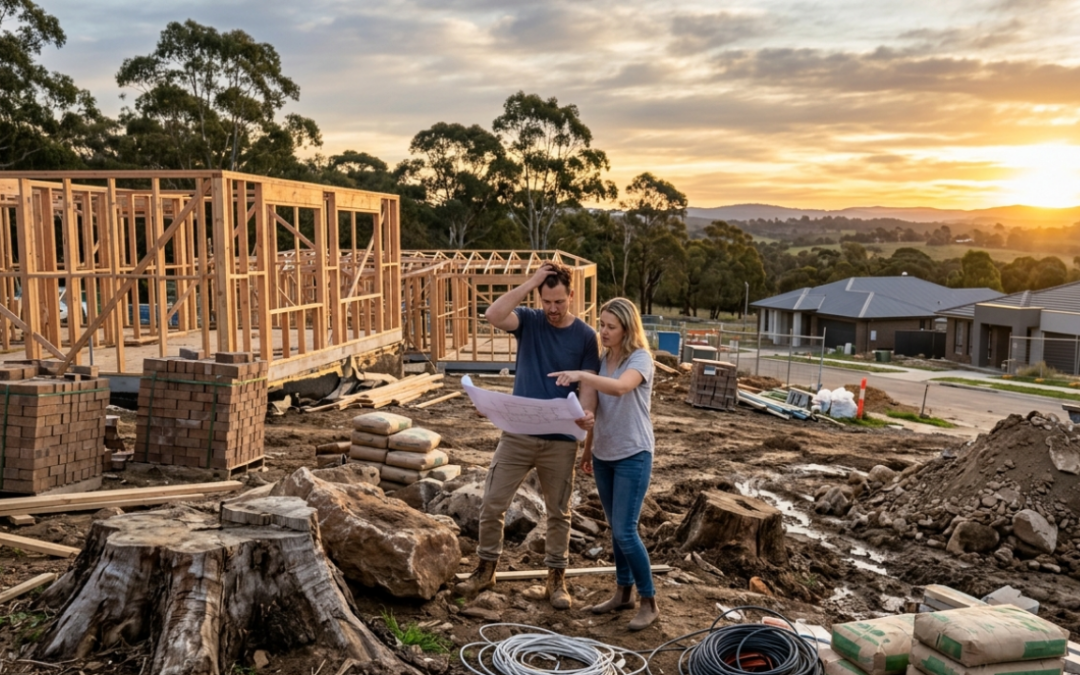
I want to start with a story that is not about any one person but reflects something that happens regularly in the Australian home building process.
Someone spends months researching builders, comparing designs, and getting their finances sorted. They find a home they love at a price that works within their borrowing capacity. They sign a contract feeling organised and in control.
Then, over the next several months, a series of additional costs appear. Some were mentioned briefly in early conversations but did not register. Some emerged from the site assessment. Some came from decisions made during the selections process. Some were items they simply never thought to ask about.
None of these costs were invented. None of them were unreasonable in isolation. But nobody had laid them all out clearly at the beginning, and the cumulative effect was a final cost that was meaningfully higher than what was originally envisioned.
This is one of the most common experiences in Australian home building. It is also almost entirely preventable — not by finding a builder with no extra costs, but by understanding what the real total looks like before you plan around any particular number.
Why the Gap Exists Between the Base Price and the Real Cost
The base price is not a deceptive figure. It is the genuine cost of constructing the home to a standard specification on a standard site. It is the starting point of what the project will cost — the number from which everything else builds.
The problem is that most buyers treat it as the ending point. They build their financial planning around the base price and then discover the additional costs progressively throughout the process, rather than understanding the full picture from the outset.
The additional costs exist because every project is specific in ways that a standard base price cannot account for. Your block of land has specific characteristics — soil conditions, slope, drainage, access — that affect site preparation costs in ways that cannot be determined without actually assessing the land. Your preferences during the selections process will take the finishes above the standard specification in ways that add cost. The approvals, connections, and items outside the construction contract are real costs that need to be funded regardless of what the base price is.
None of this is hidden in the sense of being deliberately concealed. It is simply the gap between what a standard base price covers and what a finished, liveable home on a specific block of land actually costs.
Granton Homes is straightforward about this gap and will walk you through the full cost picture if you ask specifically. The conversation worth having early is not “what is your base price?” but “what does a project like mine realistically cost in total, from land purchase through to moving into a finished home?” The answer to that question is the one worth planning around.
Site Preparation — The Cost Nobody Can Fully Predict Without Looking
Ask any experienced builder what the most common source of budget surprise is, and site costs come up more reliably than anything else.
The reason is straightforward. Every block of land is different, and the characteristics of a specific block that affect the cost of preparing it for construction — soil type and classification, slope and topography, drainage conditions, access for construction equipment and materials — cannot be determined from a desktop assessment or a real estate listing. They require an actual site assessment to quantify properly.
A flat, clear block with stable soil, good drainage, and easy access for machinery is the best-case scenario. Site preparation costs in this situation are relatively predictable and modest. A sloped block that needs significant cut and fill work, with reactive clay soil that requires an engineered slab design, on a street with limited access — that is a very different cost picture.
The soil classification of the block drives the slab specification in a way that directly affects cost. An M-class site — moderately reactive clay — requires a different slab design from a P-class site — problem soils that include soft or loose material — which requires a different design again from a straightforward S-class site. The cost difference between slab designs for different soil classifications can be substantial.
Rock is another site cost variable that surprises people. A block that appears normal on the surface may have rock at shallow depth that requires mechanical breaking during excavation. This is not predictable without investigation and can add significant cost.
The practical response to this is to arrange a proper site assessment before you finalise your budget — not as a formality after the budget is set, but as the information-gathering step that makes it possible to set a realistic budget in the first place. Granton Homes conducts site assessments as part of their pre-construction process. Getting the results of that assessment and understanding what they mean for site costs is an essential step before committing to a financial plan for the project.
Council Approvals and Permits — Real Costs That Get Forgotten
Getting formal approval to build is not optional and is not free. The approval costs for a residential project in Australia need to be in the budget from the beginning rather than discovered as an additional expense during the process.
The two main approval pathways in NSW have different cost structures. A Complying Development Certificate through a private certifier involves certifier fees that vary based on the project value and the certifier. A Development Application through council involves council application fees that are generally based on the assessed value of the development, plus fees for any required inspections and certifications during construction.
Beyond the direct application fees, many projects require supporting documentation that carries its own cost. A soil report is almost always required. A structural engineering assessment is required for the foundation design. Depending on the site and planning environment, additional specialist reports — bushfire attack level assessment, acoustic report, stormwater management plan, heritage assessment — may be required by the certifier or council.
These costs are not enormous relative to the total project cost, but they are not trivial either. In most standard residential builds, the total approval and documentation costs run to several thousand dollars. In more complex projects or in areas with specific planning requirements, they can be higher.
Confirming whether approval and documentation costs are included in the builder’s quoted price or are additional to it is an important early question. The answer varies between builders and needs to be understood before the budget is finalised.
Upgrades — How They Accumulate Faster Than Anyone Expects
The selections process is where most budget plans come under the most pressure, and it is the stage that is hardest to fully prepare for without having been through it before.
The base specification — the standard inclusions for which the base price is charged — is a defined level of finish that is documented in the inclusions list. It is functional and compliant and perfectly adequate. It is also typically less impressive than what you saw in the display home, because the display home is built to a higher specification specifically to show what is achievable.
During the selections process, you make a series of decisions about where to step above the base specification. The kitchen benchtop — stone rather than laminate. The bathroom tiles — a larger format or a more expensive range. The tapware — an upgraded finish or a premium brand. The flooring — engineered timber rather than carpet in the living areas. The kitchen appliances — a brand you recognise rather than the standard specification.
Each of these decisions has a cost. Most of them seem individually manageable — a few hundred dollars here, a couple of thousand there. The challenge is that you are making many of these decisions across multiple selection appointments, and the cumulative total accumulates in a way that is easy to lose track of.
By the end of the selections process, some buyers have added a significant amount to their total cost in upgrades — sometimes more than they had planned, because each individual decision seemed reasonable in the moment and the total was only apparent at the end.
The approach that works is to decide on your upgrade budget before the selections process begins — a specific dollar amount that you treat as the total available for all upgrades combined, not as a rough guideline — and to track the running total against that budget throughout the selections process. Knowing that you have a specific ceiling keeps each individual decision in context of the total rather than treating each one in isolation.
Granton Homes walks buyers through the selections process in a way that keeps the budget conversation active. Use that support by being specific about your upgrade budget upfront so that the selections process is guided by a realistic financial constraint rather than by enthusiasm in the moment.
Utility Connections — The Costs That Are Easy to Forget
A finished home with no connection to mains power, water, sewer, or telecommunications is not a home you can move into. These connections are necessary and have costs that are real and need to be in the budget.
In established urban areas with existing infrastructure nearby, connection costs are relatively predictable and generally modest — application and connection fees to the relevant service providers, plus the cost of running connections from the existing mains to the home’s connection point. The total is in the range of a few thousand dollars for a straightforward urban connection.
In developing estates and newer areas, the infrastructure is being established as part of the development and the situation varies. Some estates have infrastructure in place and connections are straightforward. Others are still being developed and connection timelines and costs may be less predictable.
In more rural or semi-rural locations, the distance from existing mains services can make connection costs significantly higher. A block that requires a long power connection run to the nearest pole, or a water connection that requires significant distance to the existing main, can have connection costs that are substantially higher than in an established urban area.
Telecommunications — specifically the connection to high-speed broadband — is worth confirming specifically for any block you are considering. The availability of NBN or equivalent service and the process and cost of connection varies by location. In some areas it is straightforward. In others, particularly in newer estates where the infrastructure rollout is ongoing, it can be more complicated.
Landscaping and Outdoor Areas — The Part That Gets Deferred and Costs More Later
The outdoor areas of a new home are consistently the category where budgets run out and plans get put off. Construction takes the budget, move-in takes the remaining cash reserves, and the garden becomes a future project that ends up getting delayed well beyond the original intention.
The costs involved in creating a functional and presentable outdoor area are real and should be in the budget from the beginning rather than treated as something to fund from whatever is left over.
Driveway is usually not included in the construction contract. The concreted or paved connection from the garage to the street is a real cost that needs separate budgeting.
Fencing around the property boundary is typically not included and needs to be arranged and funded separately. In estates with specific fencing requirements, the specification is defined and the cost is predictable. In more individual site situations, it depends on the extent of fencing required and the materials chosen.
Landscaping — the lawn, garden beds, plants, irrigation, and any retaining or garden structure work required — represents a significant investment to do properly and is almost never included in the construction contract. The temptation to defer this until later is understandable and almost always results in a bare dirt yard for longer than anyone intended.
Outdoor lighting for the entertaining area and pathways, clothesline, letterbox, and other items that are necessary for the home to function and that are typically excluded from the construction contract all need to be in the budget.
Setting aside a specific outdoor budget — a realistic figure based on what you actually want to achieve, not an aspirational figure that assumes everything will be done cheaply — at the beginning of the financial planning process produces a much better outcome than discovering the gap at handover.
Interior Finishing — The Costs That Appear After You Move In
Even after the construction is complete and you have your keys, there are costs associated with making the home fully liveable and comfortable that need to be anticipated.
Window furnishings — blinds, curtains, shutters, or other coverings for the windows of the home — are almost universally excluded from the construction contract. Moving into a new home and realising every window is uncovered is a practical problem that requires immediate attention. The cost of window furnishings for a new home depends on the number and size of windows and the type of covering chosen, but it is a real budget item that needs to be planned for.
Wardrobe fittings and internal organisation systems in walk-in wardrobes may or may not be included depending on the builder’s inclusions specification. Confirming what is provided and whether additional fitting out is required is worth doing during the selections process so the cost is understood before handover.
Additional storage — freestanding furniture, storage systems in the garage, any shelving or organisation that is needed beyond what is built in — is a cost that new homeowners consistently encounter in the weeks and months after moving in.
The garden and outdoor setup — pots, outdoor furniture, any garden tools and equipment needed for the first time — are costs that accumulate through the first year of ownership.
These post-handover costs do not need to be funded all at once and should not consume the contingency buffer that is meant for construction-phase surprises. But they are real and need to be anticipated in the overall financial picture of the project.
Carrying Costs During the Build — The Budget Item That Is Invisible Until It Matters
If you are building a new home while living somewhere else — renting, staying with family, or managing the timing from a property you are selling — the ongoing living costs during the construction period are part of the total project cost.
A build that takes fourteen months and involves twelve months of rent in a concurrent rental tenancy means twelve months of rent is a cost of the project, not a separate living expense. A construction loan that runs for fourteen months before converting to a standard mortgage means fourteen months of construction loan interest is a cost of the project.
These costs are real, they accumulate throughout the build period, and they are affected by how long the build takes. A build that runs three months over schedule means three additional months of rent and three additional months of construction loan interest that were not in the original budget.
Planning your financial arrangements around the realistic end of the build timeline — not the optimistic end — means these carrying costs are accounted for rather than discovered as an overrun. The contingency buffer needs to be sized to cover both construction-phase surprises and carrying cost overruns from timeline extensions.
How to Build a Budget That Is Actually Realistic
Putting all of this together, a realistic budget for a home building project in Australia needs to include more than the construction base price. Here is what a complete budget picture looks like.
Land cost if not already purchased. Site preparation costs based on an actual site assessment rather than a guess. Base construction cost from the builder’s quote. An upgrade allowance based on a realistic estimate of where you will step above the standard specification during selections. Approval and documentation costs. Utility connection costs. Landscaping, driveway, fencing, and outdoor areas. Window furnishings and interior finishing. Carrying costs for the expected build duration.
Add to that total a contingency of ten to fifteen percent for the unexpected — the site condition that was not anticipated, the variation that turns out to be necessary, the timeline extension that adds to carrying costs. The contingency is not money you plan to spend. It is insurance against the inevitable surprises that every build encounters.
The sum of all of these components is the real budget. Planning around that number — rather than around the base construction price — is the difference between a financial plan that holds up through the project and one that requires constant revision as additional costs appear.
Granton Homes helps buyers build this picture from the beginning of the process rather than discovering the components progressively. The conversations worth having early are not just about the base price but about everything that sits around it — the site costs, the typical upgrade patterns, the items outside the contract, the realistic total for a project like yours. That full picture, held from the beginning, is what makes the rest of the process manageable.