
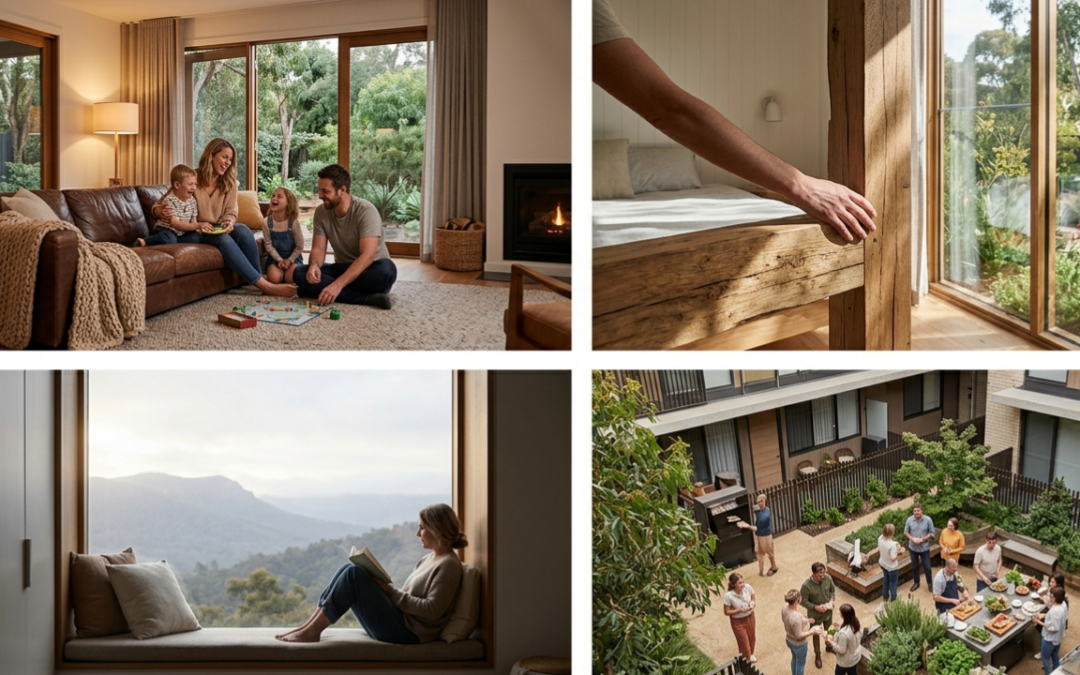
Buying a home has always been one of the most significant decisions a person makes. The financial weight of it is obvious. But beyond the money, there is something deeply personal about it — the sense that you are choosing the place where real life will unfold, where routines will form, where the days will begin and end for years to come.
For a long time, that decision was heavily influenced by appearances. Buyers wanted the latest designs, the most current interiors, features that looked impressive in photos and created a strong reaction during inspections. Looking good was treated as more or less equivalent to being good.
But something is shifting. Quietly and genuinely, more Australians are beginning to understand that how a home looks and how a home feels to live in every day are two very different things — and that the second one matters considerably more in the long run.
First Impressions Are Real, But They Are Not the Whole Story
The things that grab attention during a first home visit are predictable and understandable. A modern kitchen with quality finishes. A stylish bathroom that looks freshly designed. Attractive flooring throughout. Contemporary touches that signal the home is current and well-presented. These create genuine impact — and it makes sense that they do.
But first impressions, by their nature, are formed in a short window of time under conditions that are rarely representative of daily life. The inspection happens once. Daily life happens every day for years.
What a significant number of homeowners discover, after they have been living somewhere for a few months, is that the features that made the strongest first impression during the inspection are often not the features they end up caring most about. The things that actually shape how much they enjoy their home day to day tend to be different — quieter, more practical, more functional — and they only reveal their full importance once real routines have settled in.
What People Actually Talk About When They Talk About Loving Their Home
When homeowners who are genuinely happy in their homes are asked what they love about it, the answers are consistently revealing. They rarely mention paint colours. They rarely talk about the specific design trend the home reflected at the time it was built. They almost never bring up the decorative features that looked impressive in the listing photos.
What they talk about is comfort. The way the home feels to be in at the end of a long day. How naturally the layout supports the household’s daily routines. How good the natural light is in the main living areas and how much that lifts the whole atmosphere of the space. How well the storage works and how much easier it makes keeping the home feeling organised. How the rooms connect and flow in a way that makes daily movement feel effortless rather than slightly awkward.
These are the features that shape the actual lived experience of a home. They are not always the most visually exciting things to evaluate during a search. But they are almost always what ends up mattering most — and the buyers who understand that early tend to make significantly better decisions.
What Natural Light Does That Almost Nothing Else Can
Of all the practical features that influence long-term homeowner satisfaction, natural light is one of the most consistently mentioned and one of the most consistently underestimated during the buying process.
During an inspection, it is easy to focus on the kitchen design or the master bedroom configuration and not pay much attention to how light moves through the home at different times of day. But once you are living somewhere, the quality of natural light is something you experience every single morning, every afternoon, and every evening — and it has a profound effect on how the home feels.
Spaces filled with good natural light feel more open and more generous than spaces of identical dimensions without it. They feel warmer, more welcoming, and more genuinely pleasant to spend extended time in. The atmosphere of the main living areas is lifted throughout the day in a way that artificial lighting simply cannot replicate regardless of how much is invested in it.
Many buyers only fully appreciate how much natural light matters after they have spent time inside multiple homes and directly compared how different they can feel despite similar sizes and features. That comparison, once experienced, tends to permanently shift how much priority natural light gets in the decision-making process.
Why Layout Is More Important Than Most People Realise Going In
A home can be beautifully designed in every visible way and still feel subtly frustrating to live in if the layout does not work well for how the household actually operates. Layout is the kind of thing that is easy to overlook when walking through a space quickly during an inspection — and hard to stop noticing once daily life has made its shortcomings apparent.
A layout that flows well makes daily routines feel effortless. Movement through the home is natural and intuitive. The kitchen relates sensibly to the dining and living areas. Bedrooms are positioned in a way that gives the household the right balance of connection and privacy. The home simply works the way you need it to without requiring workarounds or adaptations.
A layout that does not work well creates the opposite experience. Small inefficiencies that seem minor in isolation accumulate over time into something that genuinely affects how pleasant the home is to be in. Spaces that feel slightly disconnected from each other. Rooms positioned in ways that create unnecessary friction in daily routines. The sense that the home was designed to look impressive on a floor plan rather than to actually function well for the people living in it.
More buyers are recognising that the floor plan deserves far more careful attention than it typically gets during the initial search. It is the foundation of everything else — and getting it right matters more than almost any other design decision.
Why Flexibility Has Become Such a Valued Quality
Modern Australian life moves and changes faster than it once did. Work arrangements shift — often toward more time at home rather than less. Families grow or change configuration. Priorities evolve in ways that change how the home is used on a daily basis. What the household needs from its space at one stage of life can look quite different from what it needs five years later.
Homes that are designed with genuine flexibility — spaces that can honestly serve different purposes as needs change — hold their value and their usefulness across those transitions in a way that rigidly configured homes simply cannot manage as gracefully.
A spare room that genuinely functions as a home office when that is what is needed and transitions comfortably to a guest bedroom or nursery when circumstances change. A study or activity space that adapts as children move through different ages and requirements. Living areas that can be arranged and used differently depending on what the household needs at any given time.
Buyers who plan for this flexibility during the design process consistently find themselves glad they did as the years go on. It is one of those qualities that is easy to overlook when current needs feel fixed and stable — and one that reveals its value clearly every time life changes in ways that were not fully anticipated.
Storage Is Consistently Undervalued at the Start and Deeply Appreciated Afterward
There are very few features in a home that are as consistently undervalued during the buying process and as consistently appreciated once daily life is fully underway as storage. It rarely makes the top of a wishlist. It rarely generates excitement during a display home visit. And it turns out to matter enormously.
The reason is simple and experiential. A home without enough well-placed storage becomes gradually harder to live in as real household life accumulates its inevitable collection of possessions, hobbies, and practical requirements. Things end up without proper homes. Spaces that should feel open and calm start to feel cluttered and slightly chaotic. The ongoing effort of managing a home that lacks good storage creates a low-level friction that is easy to underestimate until you are living with it every day.
Conversely, a home where storage has been genuinely thought through — where wardrobes actually accommodate how the household stores its belongings, where kitchen organisation makes cooking feel easy, where the garage handles the practical side of family life, where the laundry is functional rather than cramped — stays on top of itself with relatively little effort. It feels more organised, more calm, and more genuinely comfortable. And that matters, quietly but consistently, across every ordinary day.
Why Simpler Homes Are Getting More Appreciation
There is a persistent assumption that more features, more upgrades, and more elaborate design automatically produce a better home. The experience of actually living in homes tells a more nuanced story.
The homes that people find most genuinely enjoyable to live in are often not the most elaborate ones. They are the ones that do the important things well — that are thoughtfully designed, appropriately sized, and focused on real functionality — without adding layers of complexity that increase maintenance burden without meaningfully improving daily life.
Simpler homes are easier to maintain without that maintenance becoming an ongoing drain on time and money. They are easier to keep organised because they are not generating more than the household can comfortably manage. They feel calmer and less demanding. And they give the people inside them the space — both physical and mental — to actually enjoy being there.
In a world where most households are already managing significant complexity and demands across multiple areas of life, a home that reduces the overall load rather than contributing to it is genuinely valuable. That is not a compromise. It is a considered and intelligent choice.
Why Thinking About the Future Improves Present Decisions
The buyers who tend to be most satisfied with their homes over the long term consistently share one quality — they were thinking ahead when they made their choice. They were not just asking what the home needs to do right now. They were asking what it will need to do as life moves forward, and whether the home they were considering would keep meeting those evolving needs well.
Will this still work well if the family grows or changes? Can it handle shifting work arrangements without requiring expensive modifications? Does it offer enough flexibility to remain genuinely right through different life stages rather than being a perfect fit now and a frustrating mismatch later?
These questions take more time and more honest self-reflection to work through properly. But they consistently produce better answers — and better homes. The investment in that thinking during the search process pays dividends across every subsequent year of living with the result.
What a Dream Home Actually Means Today
The definition of a dream home is evolving across Australia in a way that reflects genuine maturity in how people think about what they want from where they live. The biggest house on the street is no longer automatically the most desirable one. The most elaborately featured home is no longer the one most people aspire to.
What more Australians are dreaming of today is something quieter and more sustaining. A home that feels comfortable and easy to be in. One that makes daily life feel manageable rather than demanding. One that supports a genuinely balanced lifestyle rather than competing with it. Less ongoing stress. More real comfort. Better functionality that works for real life rather than for the version of life that looks good in a brochure.
That shift in aspiration is producing better decisions — and homeowners who feel more satisfied with those decisions for considerably longer.
Final Thought
The homes that people truly love — the ones they remain grateful for and happy in years after the excitement of moving in has settled — are rarely chosen because of a single impressive feature. They are chosen because they feel right. Because they make daily life easier and more comfortable. Because they fit the household naturally rather than requiring the household to adapt to them.
As buyer priorities continue to evolve, one thing is becoming increasingly clear. The best homes are not the ones designed purely to look impressive — they are the ones designed to be genuinely wonderful to live in. Day after ordinary day, across all the seasons and stages of life that follow.
That is the standard more Australians are holding their home decisions to. And it is a far better standard for producing homes that deliver lasting satisfaction rather than fading excitement.
It is also what Granton Homes builds toward every single day — creating homes that are designed not just to look right, but to feel genuinely right for the people who will live in them for years to come.