
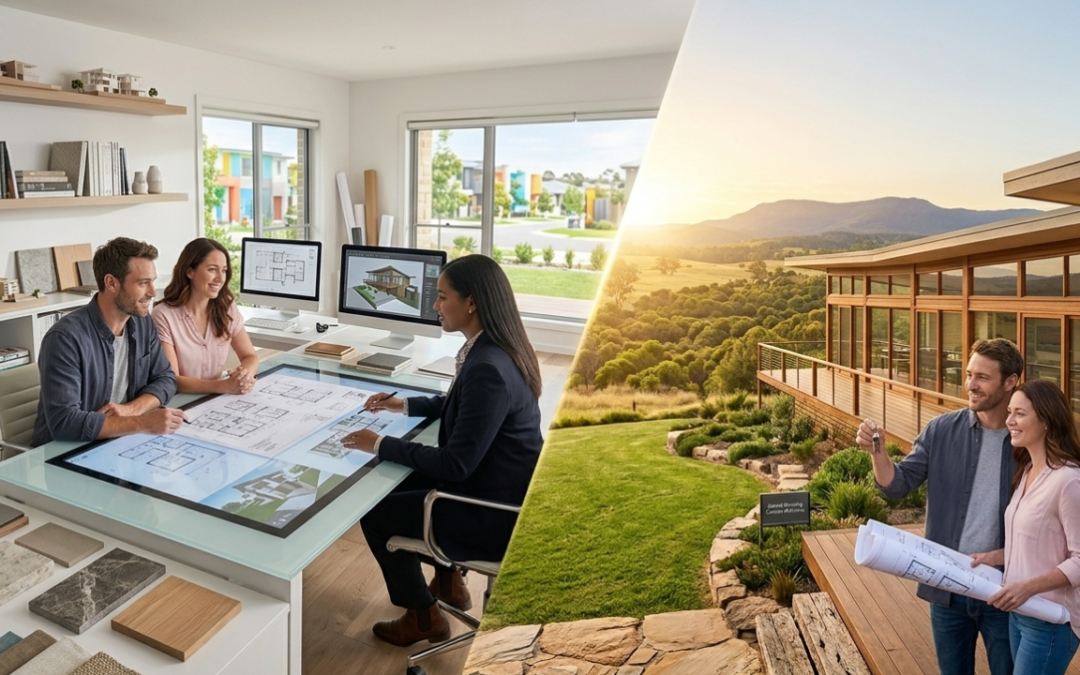
The first week after you decide to build your first home is all excitement. You are saving photos, walking through display homes, imagining which room will go where. It feels like the beginning of something great because it is.
Then the second week arrives and the questions start piling up. How much is this actually going to cost? Which builder do I even talk to first? What if I make the wrong decision and spend the next two years regretting it?
That shift from excited to quietly terrified — is something almost every first-time builder goes through. And the reason it happens is simple. Building a home is a big, complex process, and most people walk into it without anyone having properly explained how it works.
So that is what this is. Not a sales pitch. Just a plain, honest walkthrough of what you actually need to think about — from someone who has seen what happens when people get it right, and what happens when they do not.
The Budget Conversation You Keep Putting Off
Here is the thing about budgets. Most people have a rough number in their head. A figure they have decided feels manageable. And then they go looking at builders and land and start to build a picture around that number — without ever checking whether the number is actually realistic.
The base price on a builder’s website or display home is rarely the full picture. It is the construction cost for the home itself, often with a fairly standard level of inclusions. What it does not usually include is everything else.
Site costs come first. Before your builder can even start, the land needs to be assessed — soil type, slope, drainage, access. Depending on what they find, you might be looking at additional costs for a more complex foundation, cut and fill, retaining walls, or extra drainage work. This varies enormously from block to block, and it is genuinely impossible to know upfront without a proper site assessment.
Then you have design fees, engineering documentation, the cost of going through the approval process — whether that is a certifier for a CDC or council for a DA. Utility connections. Driveway. Fencing. Landscaping.
And then the upgrades. Walk through a display home and fall in love with the stone benchtops, the larger format tiles, the particular tapware in the master bathroom — and you start making upgrade decisions that each seem individually small but collectively add a significant amount to the final cost.
None of this is designed to catch you out. It is just how building works. The way to stay on top of it is to have an honest conversation about the full cost picture before you commit to anything — and to make sure your budget includes a contingency. Ten to fifteen percent on top of your total expected costs is not excessive. It is sensible. Things come up in every build.
Location — More Than Just the Address
When you are in the process of finding land, the block itself tends to dominate your attention. The size, the price, the orientation, the neighbours on either side.
But the suburb, the street, and the surrounding area matter just as much as the block — and sometimes more.
Think about the day-to-day reality. Where do you work, and how long are you comfortable commuting? If you have kids or plan to, what are the schools like? Where is the nearest hospital, GP, supermarket? These things become very real very quickly once you are actually living somewhere.
Then think further ahead. Is the area growing? Are there planned infrastructure projects — new roads, train lines, community facilities — that might improve liveability in the next five to ten years? What is the likely trajectory of property values in that area?
A well-located home in a suburb with strong fundamentals will hold and grow its value over time. A beautiful home in the wrong location does not benefit from that same momentum, regardless of how well it is built.
Spend real time in any area you are seriously considering. Not just a quick drive-through. Walk around at different times of day, on weekdays and weekends. Get a feel for it beyond what the real estate listing tells you.
Choosing a Builder — The Decision That Shapes Everything Else
You can have a brilliant design and a great block of land and still end up with a miserable building experience if you choose the wrong builder. Conversely, a good builder can make even a complicated project feel manageable.
This is the most important decision you will make in the whole process. Treat it that way.
Start by looking at their actual work. Not the photos on their website — those are always the best examples, shot in the best light, at the best angle. Try to see completed homes in person. Look at the quality of the finishes, the attention to detail, the kind of work that shows up on close inspection rather than just in photographs.
Talk to people who have built with them. Ask your builder for references and actually follow through on calling them. Do not just ask whether they are happy with the home — ask whether the process itself was well managed. Was communication good? Were they honest when problems came up? Would they use the same builder again?
Check credentials. In NSW, all residential builders must hold a licence through NSW Fair Trading, and the Home Building Compensation Fund provides protection if a builder becomes insolvent or abandons the project. Verifying these things takes minutes and is absolutely worth doing.
And pay attention to the early interactions. How does the builder’s team treat you when you are just asking questions and have not committed to anything yet? Are they patient and informative, or do they seem like they are waiting for you to stop talking so they can close the sale? That early impression usually reflects how the relationship will feel throughout the build.
Granton Homes approaches this differently from a lot of builders. Their focus is genuinely on the client experience — not just delivering a finished product, but making sure the person going through the process feels informed, involved, and confident at every stage. For a first-time builder, that kind of support makes a meaningful difference.
The Design — Build It Around Your Life, Not Around a Trend
Display homes are beautiful. They are meant to be. They are styled and presented specifically to make you want to live in them, and they are very good at doing exactly that.
The question worth asking yourself as you walk through them is not just “do I love this?” but “would I love living in this, specifically, with my family, doing our actual daily routines?”
Those are different questions.
A design that works for your life takes into account how your household actually functions. If you work from home, you need a proper dedicated space — not a nook in the corner of an open-plan area where every noise from the kitchen and living room carries straight to you. If you have young kids, you might need a space where they can be noisy without the whole house feeling it. If you love cooking, the kitchen layout matters in a practical sense, not just an aesthetic one.
Storage is the one thing almost everyone wishes they had thought about more carefully. It is not exciting to discuss in the design phase. It becomes very exciting — or rather very frustrating — once you are living in the home and trying to find somewhere to put things. Think honestly about what you own and where it is going to live.
A home that genuinely fits your daily life is worth more than one that photographs well. Keep that in mind when you are making design decisions.
The Timeline — Patience Is Part of the Process
A custom home build in Australia takes time. A realistic expectation from signing a contract to collecting your keys is somewhere between twelve months and two years, depending on the complexity of the build and the approvals pathway. Before that, there is the design and approval period, which adds more time again.
Delays happen in almost every build. Weather. Trade availability. Material lead times. Council or certifier processing times. It is not a reflection of anyone doing anything wrong — it is just the reality of coordinating a complex project with many moving parts.
What makes delays manageable is communication. A builder who keeps you genuinely informed — who tells you about a delay and explains why, rather than letting you wonder why nothing seems to be happening — makes the experience feel very different from one who leaves you chasing updates.
When you are talking to builders, ask directly how they handle communication during the build. How often will you receive updates? Who is your main point of contact? What happens if there is a delay? The answers tell you a lot about how much thought they have given to the client experience, as opposed to just the construction.
Communication — Underestimated Until It Is Missing
There is a reason communication comes up in almost every conversation about what makes a good or bad building experience.
When you are building a home, you are making the biggest financial commitment most people ever make. You are entitled to know what is happening with it. You should never feel like you need to apologise for asking a question, or feel like you are being difficult by wanting a straight answer.
A good builder operates this way naturally. They keep you updated without you having to ask. When something changes, they tell you before you find out on your own. When a problem comes up, they explain what it is and what they are doing about it. They make you feel like an informed participant in the project rather than someone waiting on the outside for news.
This matters more than most people realise when they are choosing a builder. In the excitement of looking at designs and imagining the finished home, the quality of communication can feel like a secondary consideration. It is not. It is one of the most important things.
Mistakes That Are Easy to Avoid Once You Know About Them
A few things come up regularly when first-time builders reflect on what they would have done differently.
Choosing purely on price. The lowest quote is not always the best value. Sometimes it means things are excluded that you assumed were included. Sometimes it means lower quality materials or finishes. Sometimes it means the builder is underquoting to win work and plans to recover the margin through variations later. Look carefully at what is actually included in each quote before comparing the numbers.
Not reading the contract. Read all of it. If anything is unclear, ask your builder to explain it before you sign. For a build of any significant size, having a solicitor look over it is a small cost relative to the total spend and worth every cent.
Not thinking about the future. The home you are building today will probably still be your home in ten years. Your life will change. Building something that only works perfectly for your household right now may feel limiting sooner than you expect.
Rushing decisions during the design phase. This is the time when changes cost nothing. On paper, moving a wall or adjusting a room size is a conversation. On site, it is a variation with a price tag. Get the design right before signing the contract.
The Part That Makes It All Worth It
There will be a moment maybe on handover day, maybe a week after you have moved in where you walk through your home and everything just fits.
Not in a vague way. In a specific, practical, daily-life way. The bench is at the right height. The light comes in where you wanted it. The study actually works as a study. There is somewhere to put everything. The whole place feels like it was made for you because it was.
That is the difference between a home that was built around your life and one that was not. And it is something you notice every single day, not just when you first move in.
Getting to that point takes real effort. It takes time on the research, care in choosing the right builder, patience through the approval process and the build itself, and genuine thought about what you actually need rather than just what looks good in a display home. But it is worth every bit of that effort. Start carefully. Choose wisely. Ask every question you need to ask. Your first home is worth doing properly.