
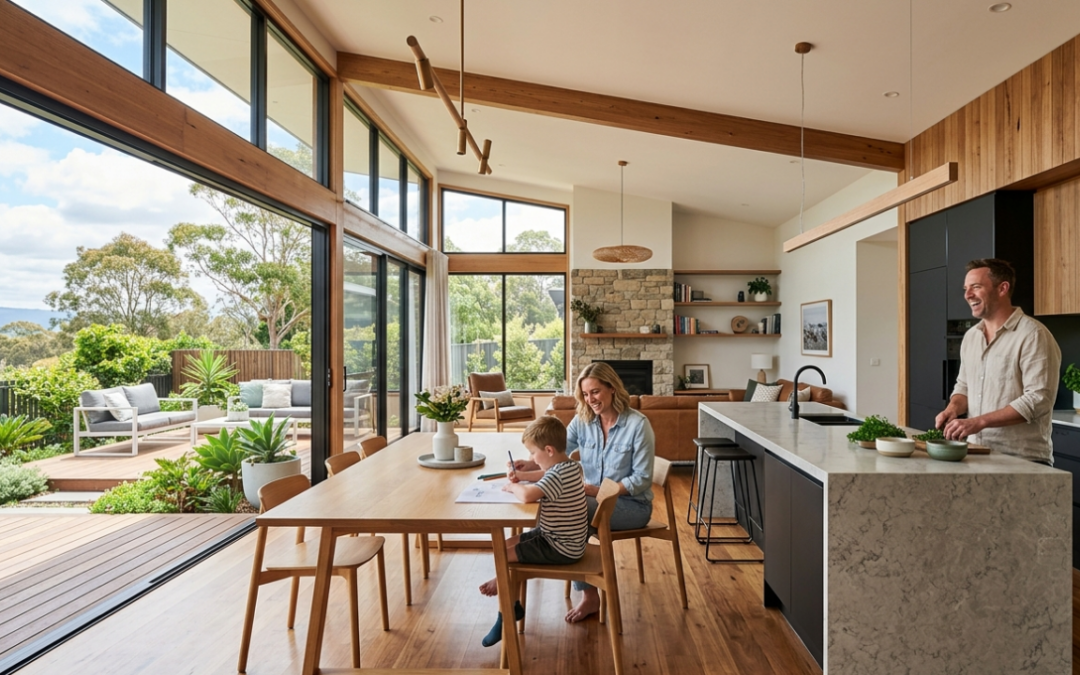
Not long ago, the default approach was simple. You went to one of the big volume builders, picked a design from their catalogue, made a few minor tweaks, and got on with it. It was straightforward, relatively fast, and most people accepted that the end result would look and feel a lot like every other house on the street.
That is changing. And it is changing for reasons that make a lot of sense once you actually look at them.
More and more buyers are walking away from the catalogue approach and towards builders who will actually sit down with them and design something around their life. Builders like Granton Homes, who have built their entire reputation on doing exactly that — creating homes that fit the people living in them, not the other way around.
So what is actually driving this shift? And what does building with a custom builder like Granton Homes actually give you that a standard builder does not?
First — What Does “Better Living Space” Actually Mean?
It is one of those phrases that gets thrown around a lot without anyone really defining it. So let me be specific.
A better living space is not about having more square metres. It is not about having the most expensive finishes or the most impressive facade. A better living space is one that works for the specific way you actually live — day in, day out, for years.
Think about the homes you have lived in that felt genuinely comfortable versus the ones that did not. The difference is rarely about size. It is usually about things like whether the kitchen is positioned so that whoever is cooking can still be part of what is happening in the living room. Whether the bedrooms are placed far enough from the noisy parts of the house that you can actually sleep in on a weekend. Whether there is enough storage that things have a place to go rather than accumulating on surfaces.
These things are design decisions. And they are decisions that only get made well when someone sits down and thinks about how a specific household actually functions — not about how a floor plan looks on a brochure.
That is the core of what Granton Homes does. Before any plans are drawn, the conversation starts with the client. How do you live? What does your daily routine look like? What frustrates you about the home you are in now? The design grows out of those answers rather than being handed to you as a starting point.
The Flexibility Gap Between Custom and Standard
Walk into the display suite of a volume builder and you will typically see a range of designs — maybe ten, maybe twenty, maybe more. Each one has a name, a price point, and a set of specifications. You can swap some things out. You can upgrade finishes within the available options. But the fundamental structure of the home — the layout, the way the rooms connect, how the inside relates to the outside — is fixed.
That works fine if one of those plans happens to match what you need. But a surprising number of people find themselves making significant compromises to fit into a standard layout. The study ends up being a converted bedroom that is slightly too small. The master suite is on the wrong side of the house relative to the morning sun. The living areas flow in a way that makes sense for a generic household but not for theirs specifically.
Granton Homes operates differently. Their focus is on designs that can genuinely be shaped around the client — floor plans developed to suit the actual block of land, the orientation, the views, and the lifestyle of the people who will live there. Want an open living area that connects directly to the outdoor entertaining space? A dedicated work-from-home room that has a door and is away from the noise? A layout that keeps the kids’ rooms separated from the master bedroom? These are not special requests that require lengthy negotiations. They are the starting point of the conversation.
Space — It Is About How It Works, Not How Much of It There Is
One of the things that custom builders like Granton Homes tend to do better than volume builders is not giving people more space — it is making the space they have work harder.
There is a version of home design that prioritises impressive numbers. Big total floor area. High ceilings throughout. Grand entrance hallways. These things look good in a listing, but they do not always translate to a home that feels comfortable and functional to live in.
A well-designed home thinks about how space is actually used. Corridors that are wide enough to feel comfortable but not so wide they are wasting square metres that could be doing something useful. Rooms that are sized for their actual purpose rather than being generously oversized in some areas and cramped in others. Storage that is built into the design from the beginning rather than crammed in as an afterthought.
Good flow between spaces matters too. A home where the kitchen, dining, and living areas connect in a way that feels natural — where you are not constantly walking around obstacles or through awkward transitions — is more comfortable to live in than one where those spaces feel disconnected, regardless of their individual sizes.
This is the kind of thinking that Granton Homes brings to the design process. Not just how does this look on paper, but how will this actually work for the people who live here.
The Quality Conversation
Custom builders and volume builders approach quality differently, and it is worth understanding how.
Volume builders achieve their pricing partly through standardisation. The same materials, the same suppliers, the same specifications across hundreds of homes. That gives them buying power, which keeps costs down. But it also means the level of finish is set at a certain standard that may or may not be what you had in mind.
With Granton Homes, the conversation about materials and finishes is part of the design process from the beginning. You are not choosing from a locked-in specification — you are making selections that reflect your priorities and your budget. That means the quality of the final result can genuinely reflect what matters to you, rather than what made sense for a standardised product.
That said — and this is worth being clear about — quality in any build depends partly on how involved you are as the client. Staying engaged throughout the process, visiting the site regularly, raising questions when something does not look right, and being thorough during the final inspection are all things that affect the outcome. A good builder like Granton Homes will do their part. Staying involved is how you do yours.
Personalisation — The Thing That Makes a House Feel Like Home
Every household is different. Not just in the obvious ways — number of bedrooms, presence of kids — but in the less obvious ones too.
Some people cook seriously and need a kitchen designed around how they actually use it, not around how kitchens typically look in display homes. Some people work from home and need a space that genuinely functions as an office, not a nook in the corner of an open-plan living area. Some people entertain regularly and want the indoor and outdoor spaces to work together in a specific way. Some people have elderly parents either living with them or likely to in the future, and need a design that can accommodate that.
None of these needs are unusual. But none of them are well served by picking the closest catalogue option and hoping it works out.
Granton Homes builds specifically around these kinds of individual requirements. The design process exists to surface what actually matters to a particular household and make sure the home reflects that — not in a vague, aspirational way, but in a practical, functional way that shows up in the floor plan and the way the spaces work day to day.
What About the Cost?
It is a fair question and deserves a straight answer.
Custom builds tend to cost more upfront than project homes. That is true, and anyone who tells you otherwise is not being straight with you. The design work, the individualised documentation, the higher level of involvement from the builder’s team — these things have a cost.
But the comparison is not as simple as looking at the base price of a project home versus a custom build and concluding one is cheaper.
A home that genuinely fits your life from day one avoids a lot of the cost that comes from living with a design that does not quite work. Extensions, renovations, modifications to fix things that were never right to begin with — these are expensive, and they happen more often in homes that were not designed around the people living in them.
Granton Homes works with buyers to find the right balance between what they want and what makes sense financially. The goal is not to maximise the cost of the build — it is to deliver a home that represents genuine value for the money spent, which means getting the design right in the first place rather than building something that will need to be changed later.
The Challenges Are Real — Worth Knowing About
Building custom is not without its demands, and it would not be an honest article if I pretended otherwise.
The design phase requires more of your time and attention than picking from a catalogue. Decisions that are made for you in a standard build have to be made by you in a custom one. That is actually a good thing — you end up with a home that reflects your choices — but it requires genuine engagement, particularly in the early stages.
The timeline is generally longer than a standard project home. A custom design takes more time to develop. Approvals can take longer depending on the complexity of the project and the pathway through council or a private certifier. Construction itself may take longer if the design is more complex. Going in with realistic time expectations — and the patience to let the process unfold properly — is part of building custom.
And upgrades and customisations can add to the cost in ways that are not always anticipated at the beginning. Managing your selections carefully, being clear about what matters most and where you are happy to keep things simple, is how you keep the final cost within the range you planned for.
None of these things are reasons not to build custom. They are just things to go into with your eyes open.
Why the Shift Is Happening
The move towards custom builders in Australia is not a fad. It reflects something real about what people want from their homes.
After years of living in homes that were not quite right — that almost worked but not quite, that compromised in ways that seemed acceptable at the time but added up over years of daily life — a lot of buyers have decided they would rather spend the time and money getting it right from the start.
Granton Homes has been part of this shift. Their approach — designing homes around individual clients rather than fitting clients into standard plans, delivering genuine quality and attention to detail, and treating each project as the specific and personal thing it is — resonates with buyers who are done with the catalogue approach.
What It Comes Down To
A better living space is not a luxury. It is just a home that was designed around the people living in it rather than around the lowest common denominator of what most households might need.
Custom builders like Granton Homes give you more control over that outcome. More say in how the space works. More opportunity to get the details right before anything is built. More chance of ending up in a home that feels genuinely yours rather than a version of something off a shelf.
That control comes with responsibility — to be involved, to make good decisions, to think carefully about what you actually need rather than just what looks impressive. But for buyers who take that responsibility seriously, the result speaks for itself.
A home that works for your life, built the way you wanted it, in a place you genuinely want to be. That is what custom building gives you. And it is why more Australians are choosing it.