
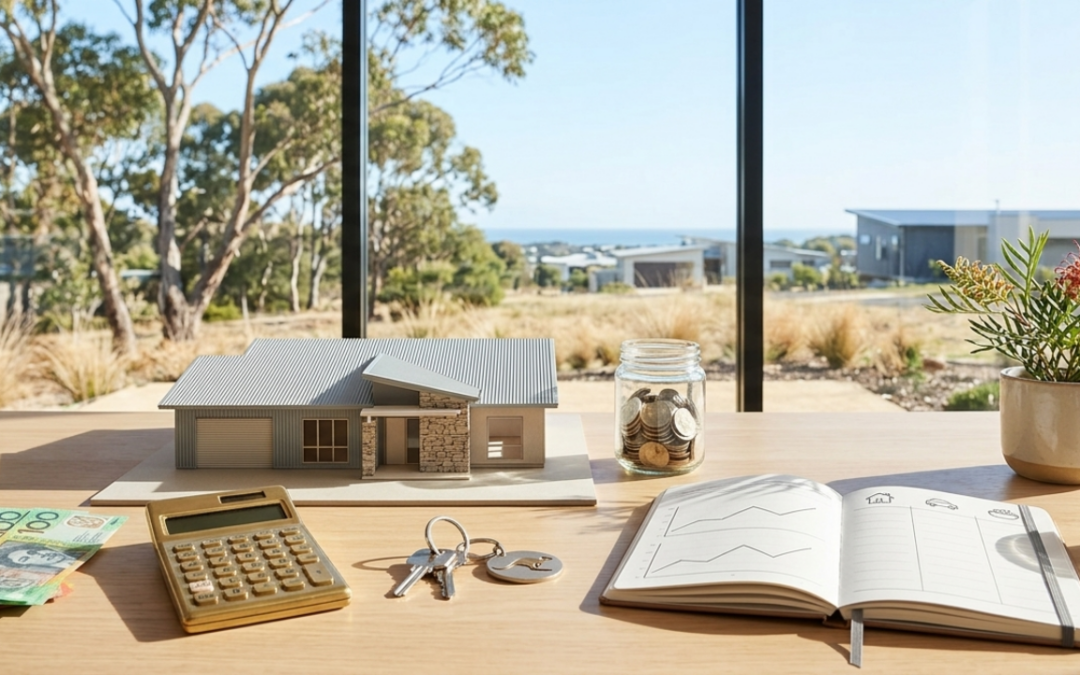
Most budget guides for home buyers start with something like “the first step is to understand your finances.” Which is technically true but not particularly useful, because understanding your finances is not really the hard part.
The hard part is building a budget that reflects what your home is actually going to cost — not what you hope it will cost, not what the advertised base price suggests, not the optimistic number you have been working around since you first started thinking about building. The real number. The one that includes everything.
That gap between the number people start with and the number they end up with is where a lot of the stress in the home building process comes from. And most of it is avoidable if you go into the budgeting process with clear eyes rather than optimistic ones.
This is how to do it properly.
Get Your Financial Position Clear Before Anything Else
This sounds like the obvious starting point, and it is. But there is a difference between having a rough sense of what you can afford and actually knowing your financial position in enough detail to build a realistic budget around it.
Start with what you have. Your savings, your deposit, any equity you are releasing from a property you are selling. This is the foundation of your budget — the money you are bringing to the table before any borrowing happens.
Then get serious about your borrowing capacity. Not the theoretical maximum that a borrowing calculator spits out when you put in optimistic numbers, but what a lender will actually approve you for given your income, your existing commitments, and the current lending environment. A pre-approval from your bank or a conversation with a mortgage broker is the right way to get this number. It takes a few hours and gives you a reliable ceiling to plan around.
The gap between your available funds and your total borrowing capacity is your maximum budget. But — and this is important — building to your maximum budget is not the same as building to a comfortable budget. Leave yourself some financial breathing room. The period after you move into a new home almost always involves expenses you did not fully anticipate, and having some capacity to absorb those without stress is worth more than squeezing every extra dollar into the build.
The Full Cost Picture — This Is Where Most People Come Unstuck
Here is the honest reality of building a new home in Australia. The base price — the number on the builder’s website, the figure discussed at the first meeting, the headline number in the brochure — is the cost of constructing the home to a standard specification. It is not the cost of building a home and having it ready to live in.
The difference between those two things is significant, and understanding every component of it is essential before you commit to a budget.
Land. If you have not yet purchased a block, land is typically the largest single cost outside construction. Prices vary enormously by location, suburb, proximity to services, and market conditions at the time of purchase. In many parts of Sydney and other major cities, land cost represents a very substantial portion of the total spend. In some cases, more than the house itself.
Site preparation. Before construction can begin, the land has to be assessed and prepared. What this involves — and what it costs — depends entirely on the characteristics of the block. A flat, clear block with good soil and easy access is straightforward. A sloped block needing cut and fill work, a site with reactive clay soil requiring a more engineered slab, land with drainage issues, or a block with difficult access for construction vehicles can all add meaningfully to the cost. You cannot know exactly what site costs will be until a proper assessment has been done, and that assessment needs to happen before you finalise your budget.
Approvals and documentation. Getting the necessary permits and approvals to build has a cost. Whether your project goes through a private certifier for a Complying Development Certificate or through council for a Development Application, there are fees involved. Engineering documentation, soil reports, and other supporting documentation required for the application also carry costs. These are not enormous relative to the total budget, but they are real and need to be included.
Utility connections. Connecting your new home to mains water, sewer, electricity, and gas involves connection fees that vary by location and provider. In established urban areas with existing infrastructure nearby, these are generally modest. In more rural or developing areas where services may need to be extended to reach the site, they can be considerably higher.
Landscaping, driveway, and fencing. These elements are almost never included in the base construction price and yet they are essential for the home to function properly. A finished home with no driveway, no fencing, and a dirt yard is not a home you can live in comfortably. Budgeting for these from the beginning rather than treating them as something to figure out later is the right approach.
Window furnishings. Blinds, curtains, and shutters are another category that consistently gets forgotten until move-in day. A new home with no window coverings is impractical — you cannot sleep in, you have no privacy, and certain rooms are unusable at parts of the day. Budget for these as part of the build cost rather than as a post-move-in problem to solve.
Granton Homes is upfront about what is and is not included in their pricing. Use that transparency — ask directly what the base price covers and what you will need to budget for separately. Get that list early and build it into your total from the beginning.
Upgrades — The Part That Sneaks Up on You
Almost nobody builds to the base specification. This is not a criticism — it is just reality. The standard inclusions in most building packages are exactly that, standard. They are functional, they meet code requirements, and they are perfectly acceptable. They are also not what most people imagine when they picture their finished home.
The kitchen benchtop in the display home is stone. The standard specification might be laminate. The floor tiles in the display are large format and beautifully laid. The standard might be something considerably more modest. The tapware looks elegant. The standard might be a more basic range.
Each of these upgrades seems individually manageable when it is presented as a line item in the selections process. The stone benchtop is an extra few thousand dollars. The tile upgrade is another amount. The tapware upgrade is something else. Before you have finished the selections process, you have added a significant sum to your budget in increments that each felt reasonable in the moment.
There are two ways to manage this. The first is to go through the inclusions list carefully before you start the selections process and understand exactly what the standard specification looks like — not what the display home looks like, but what the base package actually delivers. The second is to decide in advance which upgrades genuinely matter to you and which ones you can live without, and stick to those priorities rather than saying yes to everything that looks good.
Granton Homes works with buyers through the selections process in a way that keeps the budget conversation active rather than treating selections as entirely separate from cost. Take advantage of that — ask what the budget impact is of each decision as you make it, rather than totalling everything up at the end and being surprised.
The Contingency — Non-Negotiable
Every home build has unexpected costs. Not because anything has gone wrong — just because building a home is a complex process on a specific site with specific conditions that cannot be fully anticipated before work begins.
Something comes up in the soil that requires a different foundation approach. A material is unavailable and a substitute costs slightly more. You decide mid-selections that a particular feature matters more to you than you initially thought. A variation is required to accommodate something that was discovered during construction.
These things are normal. What determines whether they are stressful or manageable is whether you had a contingency built into your budget to absorb them.
Ten to fifteen percent of your total budget is the standard advice, and it is good advice. On a $600,000 build, that means setting aside $60,000 to $90,000 as a contingency. That might sound like a lot, but it is money you hope not to spend rather than money you plan to spend. If you come out the other side of the build having used only part of it, the remainder is yours to keep.
What is not good is treating the contingency as money available for upgrades. It is not. It is insurance against the unexpected, and it needs to stay reserved for that purpose throughout the build.
Comparing Builders — Look at Value, Not Just Price
When you are getting quotes from multiple builders, the natural instinct is to compare the numbers. But comparing quotes without understanding what each one includes is not a meaningful comparison.
Two quotes for the same project can look very different for reasons that have nothing to do with one builder being more expensive than another. One might include approvals costs; the other might not. One might have a more comprehensive inclusions specification; the other might have more items that will trigger upgrade costs during selections. One might have site cost provisions in the contract; the other might treat site costs as entirely separate.
The right way to compare quotes is to understand what is inside each one. Ask each builder to walk you through specifically what is included and what is not. Ask about the most common additional costs that buyers encounter beyond the quoted price. Ask about the contract type — fixed price versus cost-plus — and what provisions exist for cost changes during the build.
Granton Homes provides structured, transparent pricing that makes this comparison easier. But apply the same scrutiny regardless of which builders you are comparing. The goal is to understand the full cost picture from each, not just the headline number.
Ongoing Costs — Budget Beyond the Build
Your budget does not end on handover day. The home you have just built comes with ongoing costs that are worth factoring into your financial planning from the beginning.
Energy bills are the most obvious. A home that has been designed and built with energy efficiency in mind — good orientation, adequate insulation, quality glazing, efficient systems — will cost less to run than one that was not. The investment in energy performance during the build pays back in lower bills for as long as you live there. Granton Homes builds with this in mind, and it is worth understanding how the specific design of your home is expected to perform before you finalise your ongoing cost estimates.
Maintenance is a cost that new homeowners sometimes underestimate because everything is new and nothing needs attention immediately. But homes require ongoing maintenance — painting cycles, appliance servicing, garden upkeep, periodic attention to gutters and drainage, and eventually replacement of things that wear out. Setting aside a maintenance budget from the beginning rather than treating these as surprise expenses when they arise is sensible financial planning.
Insurance — building and contents — is an ongoing cost that needs to be in your monthly budget from day one.
And if you have a construction loan that converts to a standard mortgage on handover, make sure you have modelled the ongoing repayment at the converted rate rather than the interest-only rate that typically applies during the construction period.
Lock In Decisions Early — Every Change During the Build Costs Money
This is the budget discipline that matters most once construction is underway.
Every change you make to the agreed scope after the contract is signed is a variation. Variations cost money in two ways — the direct cost of the change itself, and sometimes the indirect cost in schedule delay if the change affects trade sequencing or requires materials to be re-ordered.
Some variations are unavoidable. Something gets discovered during construction that requires a change to the original plan. That is just the reality of building. But variations that happen because decisions were not made properly before the contract was signed are avoidable, and they consistently represent one of the most significant sources of budget blowout in residential builds.
The discipline required is to use the design and selections phase thoroughly — to work through every decision you can think of before you sign the contract, to push through the decision fatigue rather than leaving things vague, and to resist the temptation to make changes once the build has started unless something is genuinely wrong.
Granton Homes encourages this approach specifically because it produces better outcomes for clients — fewer surprises, more predictable costs, and a build that runs more smoothly. Take that encouragement seriously and do the work during design.
Keep Tracking Throughout the Build
Once the build is underway, your job is not done on the budget front.
Keep a running total of everything — the contract price, any approved variations, upgrade costs that have been confirmed, and any other costs that are accumulating. Review it regularly against your total budget and your contingency. If you can see that you are approaching the limit of your contingency earlier than expected, you want to know that while there is still time to make different decisions, not at the end when options are limited.
This sounds like obvious advice. A surprising number of people do not do it, instead waiting until the end to see how everything adds up. The people who track throughout have fewer unpleasant surprises.
Ask For Help When You Need It
Budgeting for a home is not something most people do regularly. It is a complex, unfamiliar process involving large numbers and many categories of cost that interact with each other in ways that are not always intuitive.
There is no prize for figuring it all out on your own. Ask your builder questions — Granton Homes specifically encourages clients to ask as many questions as they need to, and a builder who is helpful and transparent with financial questions is telling you something important about how the whole relationship will work.
If you want an independent perspective on the financial side of things, a mortgage broker who specialises in construction loans can be genuinely useful. They understand how construction financing works, what lenders look for, and how to structure things to give you the most flexibility during the build.
And if something in the contract or the cost structure does not make sense to you, ask for clarification rather than signing and hoping it will be fine. The time to understand what you are agreeing to is before you agree to it.
The Budget That Actually Works
Let me be direct about what makes a home building budget work versus one that falls apart.
The budgets that work are the ones that were built around the real costs from the beginning — all of them, not just the ones that were easy to see. They include adequate contingency. They reflect realistic upgrade choices rather than optimistic assumptions about sticking to base spec. They account for the full journey from land purchase to moving-in-ready home. And they are tracked actively throughout the build rather than set and forgotten.
The budgets that create stress are the ones anchored to an optimistic number that never accounted for the full picture. Where the contingency was too small or was spent on upgrades. Where each individual cost seemed manageable but the total was never honestly examined.
Granton Homes works with buyers to build the honest version — the full picture, not the flattering one. Use that honesty, ask the hard questions, and build your budget around the real answers.
That is what it means to build with confidence. Not certainty that nothing unexpected will happen — that certainty does not exist in any build. But the knowledge that you have planned for the real journey rather than an idealised version of it, and that when the unexpected comes up, as it always does, you are prepared.