
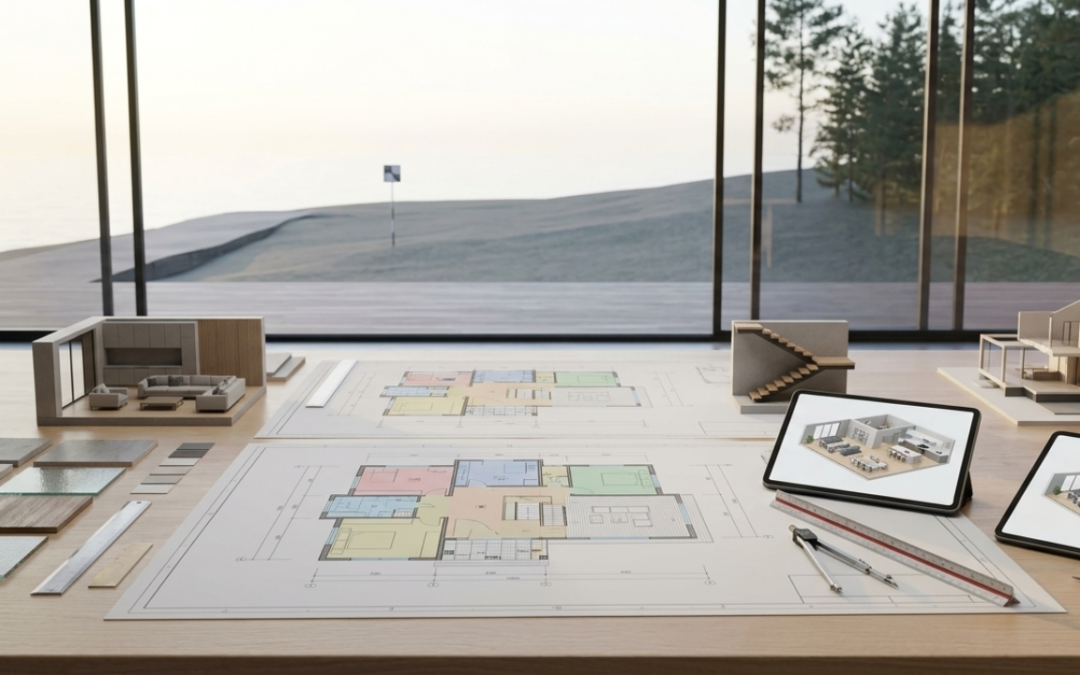
Most people spend more time choosing kitchen appliances than they spend thinking about their floor plan.
Which is understandable. Appliances are tangible and exciting. You can compare them, touch them in a showroom, read reviews about them. A floor plan is a set of lines on paper that requires real imaginative effort to translate into the experience of actually living in a space.
But here is the thing. The appliances you choose will be replaced eventually. The floor plan you choose will be your reality for as long as you own the home. The way rooms connect to each other, where light enters, how you move from the bedroom to the kitchen in the morning, whether the house feels generous or cramped — all of that is determined during the layout planning phase, often in conversations that happen too quickly and with too little thought.
People who have been through a build and come out the other side wishing things were different almost never say “I wish I had chosen different appliances.” They say things like “the kitchen faces the wrong direction,” or “the bedrooms are too close to the living area,” or “we never use the formal dining room and we should have used that space differently.” These are layout problems. And they are the hardest problems to fix after the fact because they are structural.
Granton Homes spends real time on this with clients — not just presenting a floor plan and asking for approval, but working through how a household actually lives and making sure the layout serves that reality. This is what that process should look like.
The First Question Has Nothing to Do With Floor Plans
Before you look at a single layout option — before you walk through a display home, before you browse designs online, before you sit down with a builder — spend some time thinking about how your household actually functions on an ordinary day.
Not an idealised version of your household. The real one.
Who gets up first and what do they need to do before anyone else is awake? If the answer is “make coffee in the kitchen,” then the relationship between the kitchen and the bedroom zone matters — specifically, whether the person moving through the kitchen at six in the morning is going to wake up the people still sleeping.
How do you use your living spaces? Are you a household that genuinely uses a formal sitting room, or does everyone end up in the same open area regardless of what the rooms are officially designated as? Do you cook seriously, or is the kitchen mostly for reheating and making coffee? Do you work from home, and if so, do you need a proper room with a door or do you work well in a shared space?
How often do you have guests, and what does that look like? A household that regularly hosts large gatherings needs an outdoor entertaining area and a living space that can accommodate groups comfortably. A household where guests mostly stay over needs a guest bedroom that provides genuine privacy. These are different layout requirements.
What frustrates you about where you live now? This question is often the most useful one. Every frustration with your current home is a piece of information about what the next one needs to do differently. If you are constantly irritated by the lack of storage, or by how noise travels from the living area to the bedrooms, or by how dark the kitchen is in the morning — those frustrations are telling you something specific about what to prioritise.
Granton Homes builds this kind of conversation into the early design process because the answers shape everything that follows. Go into those conversations having already thought through these questions and the outcome will be better.
Open Plan — Genuinely Understanding What You Are Choosing
Open plan living has been the dominant approach in Australian residential design for long enough that it is almost assumed rather than chosen. You want a new home, so obviously it will have open plan living. It is almost reflexive.
Which means a lot of people end up with open plan layouts without having genuinely considered whether it suits the way their specific household lives.
The case for open plan is real. Combining the kitchen, dining, and living areas into one connected space creates a more generous feeling than the same square footage would create if divided into separate rooms. It is better for natural light distribution across the main living areas. It is genuinely better for the Australian approach to entertaining — casual, relaxed, where whoever is cooking remains part of the conversation rather than disappearing into a separate room.
But open plan has a real limitation that often gets glossed over, which is noise. In an open plan space, sound moves freely. If one person is watching television, everyone can hear it. If the kids are playing loudly, the whole space is loud. If you work from home in a room adjacent to an open plan living area, the ambient noise of whatever is happening in the living area is your working environment.
For some households, this is fine. For others, it is a genuine daily problem.
The better question is not “do you want open plan?” but “how much acoustic separation do different activities in your household require?” A young couple without children who both work outside the home will experience open plan very differently from a family with kids who have a parent working from home. The layout that is right for one situation is not necessarily right for the other.
Granton Homes designs open plan spaces with zoning built in — using the arrangement of furniture, changes in ceiling height, the positioning of the island bench, and other spatial tools to create definition within the connected space. The result is a living area that feels generous and open while still having enough structure that different activities can happen without completely overwhelming each other.
Zone Placement — The Logic Behind Where Rooms Go
The positioning of different zones within the home is where floor plan planning gets genuinely technical, and it is where having an experienced design team — like the one at Granton Homes — makes a real difference.
The logic is straightforward even if the execution requires expertise. The home has loud zones and quiet zones, active zones and restful zones, private zones and social zones. The floor plan works when these zones are arranged so that they reinforce rather than undermine each other.
Sleeping areas need to be away from the noisy zones — the living area, the kitchen, the garage, any area where activity continues while some household members are trying to sleep. This seems obvious and is regularly ignored in floor plans that prioritise other considerations. A master bedroom positioned directly above the main living area will register every footfall and conversation from downstairs. Bedrooms on the same wall as the garage hear every car coming and going.
The kitchen as a social hub needs to connect naturally to the dining and living areas without forcing awkward transitions. The triangle between the fridge, the cooktop, and the sink — the three points of activity in any cooking process — should be compact enough to be efficient without being cramped. And the sight lines from the kitchen into the living area matter: the person cooking should be able to see and interact with what is happening in the rest of the space.
Bathrooms need to be accessible without requiring occupants to pass through private areas. A main bathroom that requires walking through the master bedroom to access is not a functional bathroom for general use. A bathroom positioned so that its plumbing wall is shared with a bedroom wall means every sound from the bathroom is audible in the bedroom.
Work spaces need quiet and preferably a door. This has moved from being a nice-to-have to being an essential functional requirement for a large proportion of Australian households. A room that works as a home office needs proper proportions — large enough for a desk, a chair, and storage — and acoustic separation from the noisier parts of the house.
Natural Light — The Invisible Force That Shapes Everything
Rooms that get good natural light at the right times of day feel dramatically different from rooms that do not. The quality of light in a space is one of those things that experienced architects and designers think about constantly and that most homeowners think about too late.
The starting point is orientation. In Australia, north-facing living areas receive good light throughout the day — the sun tracks from north-east in the morning to north-west in the afternoon, and north-facing spaces benefit from this for most of the year. Winter sun, which is lower in the sky, penetrates further into a north-facing space. Summer sun, which is higher, is more manageable with appropriate eaves or overhangs.
East-facing rooms receive morning light and afternoon shade, which works well for bedrooms — pleasant to wake up in without becoming uncomfortably hot through the afternoon. West-facing rooms receive afternoon sun that can create serious heat and glare issues in summer without appropriate shading. South-facing rooms are the coolest and least naturally bright.
Window size, placement, and proportion all affect how light moves through a space. A window positioned high on a wall throws light deep into the room. A window at eye level provides light at the occupied zone but does not penetrate as far. A corner window provides light from two directions and eliminates the shadowy zone that forms at a solid corner.
Internal layout choices affect how far natural light travels through the home. Open connections between spaces allow light to pass from one zone to another. Solid walls block it. A home that uses glazed internal screens — a glass panel between a corridor and an adjacent room, for example — can distribute light into spaces that would otherwise be dark.
Granton Homes considers orientation and natural light as fundamental design constraints from the very beginning of the floor plan process, not as considerations to be addressed once the layout is otherwise settled. If you are reviewing floor plan options, ask specifically about where the light will be at different times of day and make sure the answer aligns with how you want to use each space.
The Kitchen — Getting the Detail Right
The kitchen in a modern Australian home is not just a room for cooking. It is the operational centre of the home — where mornings start, where meals happen, where the family gathers, and where guests inevitably end up when they come over. Designing it well is worth significant time and attention.
The relationship between the kitchen and the adjacent spaces matters more than almost anything else about its design. A kitchen that connects naturally and generously to both the dining area and the outdoor entertaining space is a kitchen that works for the way most Australian households actually live. A kitchen that requires awkward transitions to reach the dining table or the barbecue is a daily friction point.
The layout within the kitchen — the positioning of the cooktop, the sink, the refrigerator, the preparation surfaces — affects how efficiently the space can be used during cooking. The classic working triangle between these three elements should be compact enough to avoid unnecessary movement but not so tight that two people cannot work in the kitchen at the same time.
Island benches have become standard in Australian kitchen design and for good reason. They provide additional preparation surface, a natural gathering point, and allow the person cooking to face the rest of the room rather than a wall. But an island bench that is too large for the kitchen proportions restricts movement awkwardly, and one that is too small does not deliver on its promise. The size needs to be considered in relation to the total kitchen floor area and the circulation space around it.
Storage in the kitchen is where most people wish they had thought harder during the design phase. Not just how many cabinets there are, but where they are positioned and how they are configured. A walk-in pantry positioned near the preparation area is significantly more useful than the same storage volume distributed across overhead cabinets on the wrong side of the kitchen. Under-bench drawers are more accessible and practical than deep lower cabinets with shelves. These are specific decisions that make a real difference to how the kitchen works.
Designing for How Life Changes
The people who are building homes right now will likely live in those homes for ten, fifteen, twenty years or more. Their lives in fifteen years will not look exactly like their lives today.
Children arrive or grow up and leave. Parents age and might eventually need to be accommodated. Work arrangements change — the home office that seemed unnecessary in 2020 was suddenly essential by 2022, and the pattern has not reversed. Health circumstances shift. Priorities evolve.
A floor plan that was designed only for the household’s current configuration will start to show its limitations as life changes. A plan that has some flexibility built in — rooms that can change purpose, spaces that can accommodate different configurations, infrastructure that supports different uses — remains useful as circumstances evolve.
Specific things worth thinking about during the design phase. Is there a ground floor bedroom and bathroom that could serve as a parent’s suite, a guest suite, or an accessible bedroom if mobility becomes a consideration later? Can any of the secondary bedrooms function reasonably as a study, a craft room, or a second living space if their current purpose is no longer needed? Is the garage positioned so that it could conceivably be converted to additional living space at some point?
None of these questions require designing a home that is optimised for hypothetical futures rather than the present. They just require not designing a home that is so specifically configured for one way of living that it becomes a problem if that configuration changes.
Granton Homes thinks about long-term liveability during the design process — building in the flexibility that costs very little during construction and can be genuinely valuable over the life of the home.
Storage — Build It In Before You Need It
Every experienced homeowner will tell you the same thing about storage: you always need more than you planned for, and it is always cheaper and better to build it in during construction than to try to solve the problem afterwards.
The storage conversation during home design tends to be brief. A certain number of wardrobes are specified, a pantry is included, the laundry has a cupboard. And then people move in and discover that the wardrobe is not deep enough for coat hangers on both sides, or the pantry is too narrow to actually hold what the household buys, or there is nowhere obvious to put the things that accumulate in every household — the sporting equipment, the seasonal items, the things that are not used every day but cannot be thrown away.
Think about storage specifically and concretely during the design phase. What are all the categories of things your household owns that need to live somewhere in the home? Not just clothes and food, but cleaning products, medications, tools, sporting equipment, children’s toys and craft supplies, seasonal decorations, spare bedding, luggage. Where does each of these currently live, and is that working? What would need to change in the new home for storage to actually be adequate?
Built-in storage is almost always more efficient and better-looking than freestanding furniture doing the same job. A built-in wardrobe uses the full available height of the room and has no visual footprint beyond the door. A freestanding wardrobe takes up floor space and has a visible top surface that accumulates things. In every room, asking whether storage can be built into the architecture rather than added to it later produces a better result.
Flow and Movement — The Design Element Nobody Mentions
There is a quality in well-designed homes that is immediately felt and rarely articulated. The home feels easy to be in. Moving from one space to another feels natural. Rooms feel proportioned correctly. There is no friction — no moment where you have to navigate around something awkward, no corridor that feels unnecessarily narrow, no transition between spaces that feels abrupt or confused.
This quality is about flow. And it is almost entirely determined by the floor plan.
The specific things that create good flow are mostly unglamorous. Door swings that do not conflict with each other or with furniture placement. Corridors that are wide enough to feel comfortable rather than just technically passable. Room proportions that allow furniture to be arranged in multiple configurations rather than only one. Transitions between spaces — from the entry to the living area, from the living area to the outdoor space — that feel natural rather than forced.
The specific things that undermine flow are similarly unglamorous. A corridor that is marginally too narrow in one section and creates a pinch point every time two people try to pass. A bathroom door that swings into the vanity when fully opened. A bedroom that is technically large enough but has a door and window placement that makes furniture arrangement difficult. A transition from the kitchen to the dining area that requires walking around the end of the island bench in a way that feels awkward in practice.
These are the details that experienced designers think about and that are easy to miss when reviewing a floor plan on paper. Granton Homes brings this kind of spatial thinking to the design process — walking through the plan mentally as it will be experienced physically, and catching the things that look fine on paper but will create friction in daily use.
Indoor-Outdoor Connection — Australia’s Non-Negotiable
In most other parts of the world, the indoor-outdoor connection in residential design is a nice feature. In Australia, it is essentially a requirement. The climate allows outdoor living for much of the year, Australian culture has built around that possibility, and a home that does not facilitate easy and generous connection between inside and outside is a home that does not work as well as it should in the Australian context.
What genuine indoor-outdoor connection looks like is specific. It is a covered outdoor entertaining area that is directly accessible from the main living space through a wide opening — not a narrow door, but a stacking or bi-fold arrangement that genuinely removes the boundary between inside and out. An outdoor space that is large enough to actually be used, with a proper floor surface, adequate shelter from sun and rain, and the same attention to lighting and finishing that the indoor spaces receive.
Flooring that transitions seamlessly between inside and outside — the same or complementary materials that do not create a visual interruption at the threshold — extends the interior into the exterior in a way that reinforces the connection rather than interrupting it. A sudden change from one floor material to a completely different one at the back door emphasises the boundary rather than dissolving it.
Sight lines from the kitchen and living areas to the outdoor space are worth specific attention. Being able to see the outdoor area from where you spend most of your time indoors — and particularly from the kitchen — creates a sense of connection even when the doors are closed.
Granton Homes designs this connection as a central feature of every home rather than as an add-on. The relationship between the internal living spaces and the outdoor areas is part of the initial brief, not something figured out after the floor plan is otherwise settled.
Simplicity — The Design Principle That Always Works
It is tempting, when you have the opportunity to design your own home, to pack as many features into it as possible. Every interesting room layout you have seen, every clever design solution you have admired, every feature that seemed appealing in a display home — the instinct is to include all of it.
This instinct produces complicated homes. Homes that are interesting to look at and slightly exhausting to live in. Homes where no single space quite achieves what it could have if the design energy had been more focused.
The layouts that age best and feel best to live in over time are almost always the simpler ones. Clear relationships between spaces. Proportions that feel correct without requiring careful thought. Rooms that have an obvious purpose and work well for that purpose. A home where the design disappears into the background of daily life because everything is working as it should.
Simplicity in a floor plan does not mean boring. It means disciplined. It means resisting the addition of features that are not genuinely useful in favour of getting the fundamental elements — the relationships between spaces, the quality of light, the flow of movement, the adequacy of storage — completely right.
Granton Homes applies exactly this discipline in their design process. The goal is not to impress on paper but to produce homes that work brilliantly in practice. Those two things are sometimes in tension, and when they are, the practical always wins.
The Floor Plan You Will Never Think About
Here is the test of a good floor plan. A few months after moving in, you stop thinking about it.
Not because you have forgotten the decisions you made, but because there is nothing to think about. The house works. Every morning is easy. Every evening is comfortable. Guests move through the space naturally. Storage is where you need it. Light comes from the right directions. The kitchen connects to where you want it to connect. The bedrooms are quiet when they need to be. The outdoor area is genuinely part of how the household lives.
That absence of friction — that quality of everything being right enough that it recedes into the background — is what a well-planned floor plan delivers. And it is what Granton Homes is working towards every time they sit down with a client and start thinking through how a home should be laid out.
Get the floor plan right and everything else in the home has the best possible chance of working well. Get it wrong and no amount of beautiful materials or expensive finishes fully compensates.
It is worth the time. Every hour spent getting the layout right during the design phase is an hour that pays back every single day for as long as you live in the home.
hard fun clicker but its google emoji is one of those games that feels better once you get into the loop. Definitely worth opening for a quick run.
clickerun fun has a nice casual feel. It is simple, but that is exactly what makes this kind of clicker game easy to replay.
little runmo is one of those games that feels better once you get into the loop. Definitely worth opening for a quick run.