
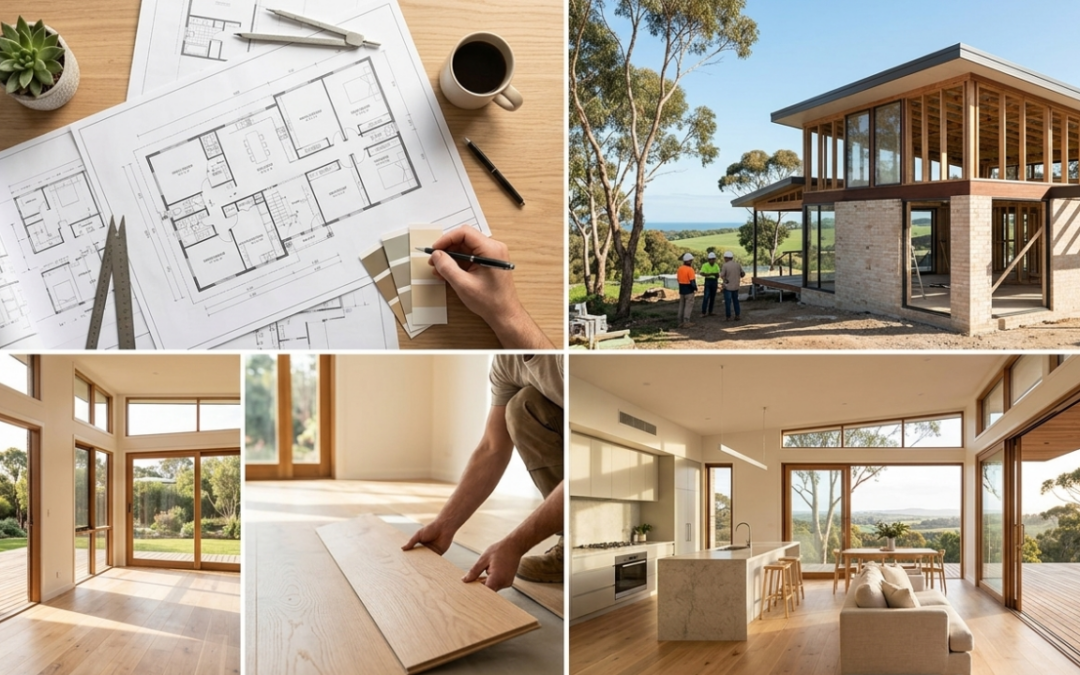
Every builder’s brochure promises to build your dream home. Every display home is positioned as the realisation of someone’s dream. The word gets attached to everything from a modest first home to a multi-million dollar custom residence, until it becomes a marketing phrase rather than a meaningful description.
But behind the cliché, there is something real. The home you design and build from scratch — one that was shaped around how you actually live, what genuinely matters to your household, and what you have been picturing for years — is different from a home you bought because it was available and close enough to what you needed. That difference is real. And achieving it requires going through a process that most people do not fully understand until they are already inside it.
What follows is an honest account of what that process actually involves — from the first conversations through to the day you get your keys. Not the polished version from the brochure, but the one that helps you know what to expect and how to approach each stage so the outcome is genuinely what you were working towards.
Get Genuinely Clear on What You Want Before Anything Else
This step gets treated as a formality by most people — a quick mental checklist of how many bedrooms and whether you want a double garage. It deserves considerably more than that.
The vision you build for your home at this stage shapes every decision that follows. A vague vision produces homes that are vaguely satisfying. A specific, well-thought-through vision produces homes that feel genuinely right.
What does specific mean here? It means thinking about how your household actually lives rather than how you imagine you might live in an idealised version of your life. Do you cook properly or mostly order in? Do you work from home regularly, and if so, do you need genuine acoustic separation or are you fine at a kitchen table with headphones? Do you entertain often, and what does that look like — large groups outdoors, small dinners inside, a mix of both? Do you have kids or plan to, and what does that mean for how the spaces need to work?
It means thinking about what genuinely frustrates you about where you live now. Every frustration with your current home is information. The kitchen that is too far from the dining area. The bedroom that is too close to the street noise. The lack of storage that creates daily irritation. These are the things your next home needs to address — and they only get addressed if you are specific about them.
And it means being honest about the gap between what you want and what you can afford. The vision you start with will be refined through the budget conversation, and starting with something too far removed from financial reality creates disappointment rather than clarity.
Granton Homes spends real time on this conversation at the beginning of the process. Come to it having already thought these things through, and the design conversations that follow will be more productive and the outcome will be closer to what you actually want.
Build a Budget Around the Real Cost — Not the Advertised One
The budget conversation is the one most people do too quickly, and the consequences follow them through the entire build.
The base price — the headline number on a builder’s website or brochure — is the starting point, not the finish line. It covers the construction of the home to a standard specification. It does not cover everything that a home needs to be liveable.
Here is what the real budget needs to account for.
Land, if you have not already bought it, is often the largest single cost. In many parts of Australia, particularly in and around major cities, land cost can exceed the construction cost. Even in less expensive areas, it is a substantial number that needs to be in the budget before any construction conversations happen.
Site preparation varies enormously depending on what the land is like. A flat, clear block with good soil needs modest preparation. A sloped block, a block with reactive clay soil, a site with poor drainage or difficult access — all of these require additional work that adds to the cost. You cannot know exactly what site preparation will cost until a proper assessment is done, which is why getting that assessment done early rather than after committing to a budget is important.
Approvals and documentation have real costs — certifier or council fees, engineering reports, other supporting documentation. Not enormous relative to the total, but real and necessary to include.
Utility connections, landscaping, driveway, fencing, and window furnishings all need to be in the budget. These are the categories that consistently get forgotten until move-in day when their absence becomes suddenly obvious.
And upgrades — the decisions you make during the selections process to step above the base specification in areas that matter to you — need to be anticipated and budgeted for rather than discovered as surprises. Granton Homes is transparent about what is and is not included in their base pricing. Use that transparency to build a real budget from the beginning rather than working from the optimistic number.
Then add a contingency. Ten to fifteen percent on top of your total expected cost is not pessimism — it is honest planning. Something always comes up in a build, and having the buffer means it is manageable rather than destabilising.
Choose Location Before You Fall in Love With a Block
Land selection is a decision that affects your quality of life every day and your financial position for as long as you own the property. It deserves more careful consideration than the surface-level factors — size, price, general area — that most people focus on.
The practical day-to-day considerations matter more than people sometimes account for in the excitement of finding an available block. How far is it from where you work, and is that commute genuinely sustainable long-term? What are the nearest schools like, now and over the next decade as the area develops? Where are the supermarkets, the medical centres, the community infrastructure that makes daily life function?
The longer-term investment considerations matter too. Is the area growing or stagnant? Are there infrastructure projects planned — transport links, community facilities, employment centres — that might improve liveability and property values over time? What is the broader trajectory of the suburb?
And the specific characteristics of the block matter beyond what the listing shows. What is the soil like, and what does that mean for foundation costs? How does the block slope, and in which direction does it face? What are the planning overlays and setback requirements that affect what can be built? Are there easements or restrictions that limit the design possibilities?
If you can arrange for your builder to look at any block you are seriously considering before you commit to buying it, do that. A builder who has experience with site assessments will see things that are not apparent to someone without that background, and the information can save you from committing to land that will significantly add to your costs or limit your design options.
Choose Your Builder Like the Decision Matters — Because It Does
Builder selection gets less careful attention than it deserves, particularly from first-time builders who are not sure what to look for beyond price and general reputation.
Your builder is the person or company responsible for turning everything you have planned and hoped for into an actual building. The quality of their work, the effectiveness of their communication, the honesty of their pricing, the way they handle problems when they arise — all of it shapes whether the build is an experience you look back on positively or one you are relieved to have survived.
Looking at their completed work is the most valuable thing you can do. Not the photographs on their website — those are the best examples, captured in the best light. Completed homes you can visit in person, or at minimum detailed references from people who have been through the process with them. What was the quality of the finishing? How was communication throughout the build? Did the final cost align with what was discussed at the start? Would they use the same builder again?
Verifying credentials takes minutes and is always worth doing. In NSW, builders must hold a current licence through NSW Fair Trading and must carry appropriate insurance. Confirming these things is a basic due diligence step that should never be skipped regardless of how professional a builder appears.
Pay attention to how the builder’s team communicates with you during the early conversations, before you have committed to anything. A builder who is patient, clear, and genuinely trying to understand what you need is showing you something about how the relationship will feel during the build. One who seems more focused on closing the sale is also showing you something.
Granton Homes has built a sustained reputation around the quality of both their homes and the experience of working with them — transparent communication, a structured process that makes the journey less confusing, and genuine attention to what each client specifically needs. That combination matters, particularly for buyers going through the process for the first time.
The Floor Plan — More Important Than Almost Anything
The floor plan conversation is where the vision you defined in the first step gets tested against reality. It is also where the decisions with the longest-lasting impact on your daily life get made.
You will live with your floor plan for as long as you own the home. The way rooms connect, where light enters, how you move between spaces on an ordinary morning — all of that is determined here. Getting it wrong is expensive and disruptive to fix. Getting it right is something you benefit from every single day without ever having to think about it.
With Granton Homes, you have the option of working from an existing design that can be modified to suit your needs, or developing something more fully custom if the existing designs do not serve your brief. The right choice depends on how closely the existing designs match what you need and what your budget allows for the additional design work that a fully custom approach requires.
Either way, the design process is collaborative — going through multiple rounds of plans, raising what works and what does not, refining until the layout genuinely serves how your household lives. Do not rush this. Do not approve a floor plan you have reservations about because you are eager to move forward. The time you spend getting the design right here is the most valuable time in the whole process.
Specifically think about: natural light and which direction rooms face, how the kitchen connects to the dining and outdoor areas, where the bedrooms are positioned relative to noise sources, whether there is adequate storage, and whether the home has any flexibility built in for how life might change over the years you will live there.
Finalise the Details Before You Sign Anything
The selections and inclusions process is where you make all the specific decisions about what your home will actually contain — the flooring, the tiles, the kitchen finishes, the tapware, the fixtures, the appliances. These decisions shape both the look and the cost of the finished home.
The most important thing to understand going into this process is the difference between the base specification and the display home standard. The display home has been built with upgraded finishes to show what is possible. The base specification is what you receive if you make no changes. The gap between the two is real, and every step from base to display-level finish has a cost.
The approach that works best is to decide in advance which upgrades genuinely matter to you and which you can live without. Kitchen benchtops that you will use every day for cooking — worth upgrading. Tiles in a spare bathroom that guests will rarely see — maybe not. Making these priorities explicit before you start the selections process helps you stay within budget rather than saying yes to everything and totalling it at the end in unpleasant surprise.
Ask your builder to show you base specification examples alongside display examples for the key selections. The comparison makes the upgrade decision more informed. And track the running cost impact of your selections as you go rather than at the end.
Approvals — Expect This to Take Time
Before construction can begin, formal approval for the build must be obtained. In Australia, this typically means either a Complying Development Certificate through a private certifier or a Development Application through local council.
A CDC is faster — often four to eight weeks if your design meets the standard planning codes. The certifier assesses the application independently of council, which keeps the process more predictable.
A DA through council is slower and less predictable — six weeks in straightforward cases, several months when the council has a backlog or when the application needs revision or additional supporting reports. Some DAs take considerably longer.
Your builder manages the documentation and the process. But the timeline is largely outside anyone’s control, and the worst thing you can do is set hard deadlines that assume the approval comes through at the optimistic end of the range. Give this stage the time it takes rather than planning around the best-case scenario.
Do not let work start on the site before approvals are in place. Building without consent is a serious issue in Australia with real consequences — stop-work orders, fines, and potentially being required to demolish unapproved work. The approval, however slow it feels, is not optional.
Site Preparation — What Happens Before the First Wall Goes Up
Once approvals are in hand, the site is prepared for construction. What this involves depends on the specific characteristics of the block.
Soil testing determines what kind of foundation the home will need. A flat, cleared block with stable soil needs straightforward preparation. Clay or reactive soil, a steeply sloped site, land with poor drainage, or a block with trees and vegetation that need to be removed all require additional work. The cost of this additional work is why a proper site assessment before finalising the budget is so important — these costs are real and need to be accounted for.
Site preparation also covers excavation for the foundation, installation of drainage and stormwater provisions, and setting up the site for construction access. For most residential builds, two to four weeks is the typical duration for this stage on a straightforward site.
Construction — Watching It Come Together
The construction phase is where everything you have planned and decided becomes a physical reality. It moves through a defined sequence of stages, each one building on the previous.
The base — foundation work, slab or subfloor construction — is the first stage. It is not visually dramatic but it is the most structurally important. The specification of the slab depends on the soil conditions and the structural design of the home. Getting this stage right matters more than getting it done quickly.
The frame goes up faster than most people expect and creates the first moment where the home feels real. Walking through the framed structure for the first time — standing in what will become each room, seeing the proportions, understanding the relationship between spaces — is one of those genuinely memorable moments in the build.
Lock-up follows — roof on, external walls complete, windows and external doors installed. The building is now weathertight and internal work can proceed regardless of conditions outside. Getting to lock-up feels like a significant milestone, and it is.
The fixing stage is the longest internal phase — electrical and plumbing rough-ins within the walls, plastering, tiling, cabinetry, joinery, all the internal work that turns a shell into a home. This stage takes longer than most people expect because there is more happening than is visible, and the trades have to work in sequence.
Completion brings all the finishing details together — painting, flooring, light fittings, tapware, appliances, the hundred small things that define the quality of the finished home. This stage is where the care of the workmanship becomes most visible.
Throughout the construction phase, stay engaged. Visit the site regularly — not to interfere, but to remain connected to what is happening and to catch anything that needs attention while it is still straightforward to address. Granton Homes maintains communication with clients throughout the build specifically to keep this connection alive, but your involvement alongside that communication makes outcomes better.
Inspections — Do Not Skip This
Independent building inspections at key stages — before the slab is poured, at frame stage, at lock-up, and before handover — provide an objective assessment of the build’s quality that is separate from the builder’s own quality checks.
An independent inspector looks at the work with different eyes than the people doing it. They regularly identify things that get missed in the normal flow of construction — not necessarily because anyone has done anything wrong, but because a fresh eye focused on compliance and quality sees things differently.
The cost of these inspections is modest relative to the total build cost. The potential cost of issues that are not identified until after handover, when they are harder to address and the builder’s attention has moved to the next project, is considerably higher.
No reputable builder will object to independent inspections. If a builder discourages them, take that seriously.
The Practical Completion Inspection and Handover
When your builder considers the home complete, you do a final walkthrough together — the Practical Completion Inspection. This is not a formality. It is your last opportunity to document anything that needs to be addressed before you formally accept the home.
Go through every room thoroughly. Every door, every window, every tap, every light switch, every surface. Check the grout lines in the tiling, the finish of the paintwork, the operation of the cabinetry. If something is not right, write it down — every item, regardless of how minor it seems.
Your builder is obligated to address everything on that defects list before handover, or in some cases shortly after depending on the nature of the item. A reputable builder takes this list seriously. Do not rush through the inspection because you are excited to move in. The items on that list are much easier to get fixed before handover than after.
Once you are satisfied, you make the final payment and receive your keys.
Keep all your documentation — the signed contract, the approved plans, any variation orders, your occupancy certificate, and warranty paperwork. In NSW, newly built homes carry statutory warranty protections of two years for minor defects and six years for major structural defects. Having your documentation in order means you can rely on those protections if you need to.
And Then You Live in It
There is a moment — not on handover day when there is still too much happening, but maybe a week or two after you have moved in, when the boxes are unpacked and you have settled into the rhythms of the new space — where you realise that the home is working.
The morning routine happens without friction. The kitchen is where things happen the way you wanted them to happen. The light comes in the way you hoped it would. The outdoor area gets used. The storage is adequate. The rooms do what they were designed to do.
That experience — of a home that was built around how you actually live, that reflects decisions you made carefully and thoughtfully, that feels genuinely yours in a way that a purchased home rarely does — is what the whole process was working towards.
It takes time. It requires patience through stages that feel slow and decisions that are sometimes exhausting to make. It requires choosing a builder carefully and staying involved throughout.
But the people who have been through it and done it well will tell you — it is worth every bit of the effort.