
Someone walks into a builder’s office with a budget they have been working around for months. They have been saving towards it, they have spoken to the bank, they have mentally committed to a figure that feels manageable. The base price of the home they want fits within that budget — not with a lot of room to spare, but it fits. They sign the contract feeling like everything is under control.
Six months later, the final cost looks meaningfully different from what they started with. Not because anyone deceived them. Not because the builder did anything improper. But because the base price was the starting point, not the destination — and the distance between those two things was never made completely clear at the beginning.
This is one of the most common sources of stress in the Australian home building process. And unlike a lot of building stress, it is almost entirely preventable — not by finding a builder who charges less, but by understanding what the full cost picture looks like before you plan around any particular number.
Start With Understanding Why the Gap Exists
The base price that builders advertise is not a deceptive figure. It is the genuine cost of constructing the home to a standard specification on a hypothetical flat, clear, well-serviced block of land. It is a starting point that allows meaningful comparison between builders and designs.
The problem is that most builds do not start from a hypothetical flat, clear, well-serviced block. They start from a specific block of land with specific characteristics that may or may not add cost. And most buyers do not end up with the base specification — they make upgrades during the selections process that add to the cost in ways that accumulate faster than people expect.
Layer on top of that the costs that simply sit outside the construction contract — approvals, connections, landscaping, the carrying costs of living somewhere while the build takes place — and the gap between the base price and the real cost of being in the finished home becomes clear.
The buyers who manage this well are not the ones who found a builder with no hidden costs. They are the ones who understood all the costs from the beginning and built their budget around the real total rather than the headline number.
Site Costs — The Variable Nobody Can Fully Predict Until It Is Assessed
Ask any experienced builder what the single most common source of budget surprise is and most of them will say site costs. Not because anyone was hiding them, but because the full site cost picture is genuinely impossible to determine without a proper assessment of the specific block of land the home will be built on.
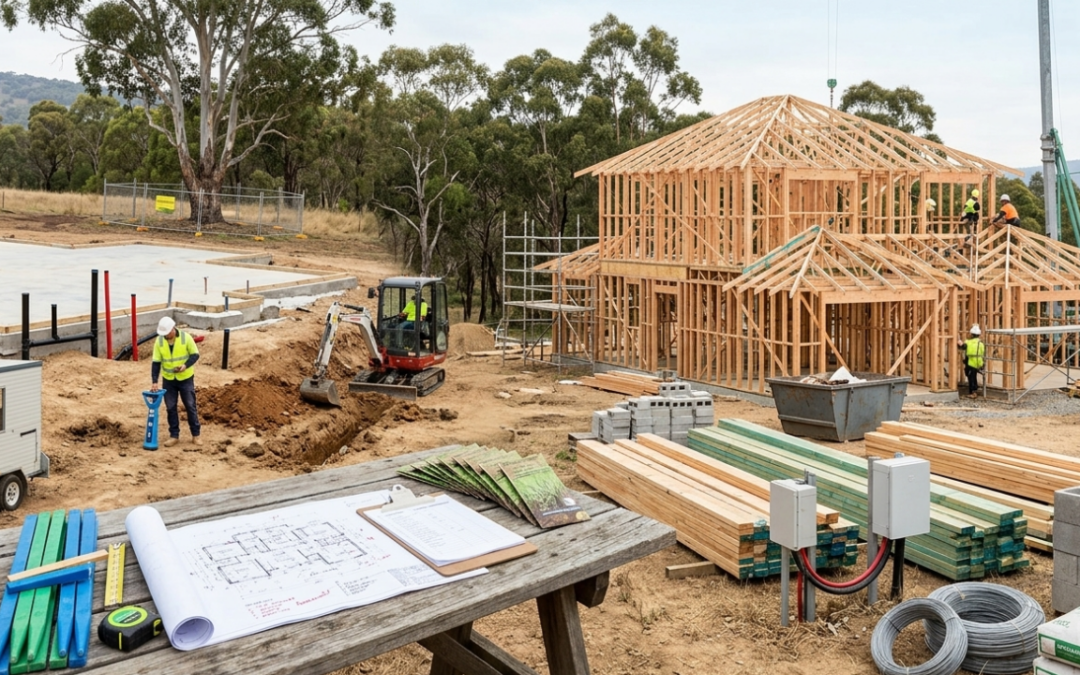
Every block is different. The slope, the soil type, the drainage characteristics, the access for construction vehicles and materials, the presence of rock or fill or other ground conditions that affect the foundation design — all of these vary from block to block and all of them affect what it costs to prepare the site for construction.
A flat block with stable soil, easy access, and straightforward drainage is the best-case scenario, and site costs in this situation are relatively predictable and modest. A sloped block that needs significant cut and fill work, with reactive clay soil that requires a more engineered foundation design, on a street with limited access for heavy machinery — that is a very different cost picture, and the difference can be substantial.
The soil classification of a block drives the slab specification. An H1 or H2 site — highly reactive clay — requires a more heavily reinforced slab than an M or S site — moderately or slightly reactive. The difference in foundation cost between these classifications can run to tens of thousands of dollars, and it is not something that can be determined from looking at the land. It requires actual soil testing.
The practical response is to arrange a proper site assessment before you finalise your budget, not after. Granton Homes conducts thorough site assessments as part of the pre-construction process, and the information from that assessment needs to feed into your budget rather than being discovered as a cost addition once you are already committed. If you are still choosing between blocks of land, getting a preliminary site assessment on each one before you commit to buying gives you much better information for the decision.
Upgrades — How Small Decisions Become a Big Number
The display home is not an honest representation of the base specification. It is the best version of what the builder can produce, fitted out with upgraded finishes specifically to show what is possible. Experienced buyers know this. First-time buyers often do not, and the selections process is where the realisation hits.
The base kitchen benchtop is laminate. The display has stone. The base flooring is a standard carpet and tile specification. The display has engineered timber and large-format tiles. The base tapware is a functional range. The display has something considerably more attractive.
None of this is deliberately misleading. The display home is doing its job — showing you what can be achieved. The base specification exists and is documented in the inclusions list. The gap between the two is real and needs to be budgeted for rather than discovered.
What makes the upgrades conversation difficult is that each individual decision seems manageable. The stone benchtop upgrade is a few thousand dollars. The flooring upgrade is another amount. The tapware upgrade is something else. The appliance upgrade, the tile upgrade, the lighting upgrade — each one, considered individually, feels proportionate.
Considered together, they can add a significant amount to the final cost. And because the decisions are made one at a time across multiple selection appointments, the accumulation is easy to lose track of unless you are tracking the running total deliberately.
The approach that works is to make two decisions before the selections process starts. First, decide your total upgrade budget — the maximum you are willing to add to the base specification cost — and treat that as a fixed ceiling rather than a flexible guideline. Second, decide which upgrades genuinely matter to you and which ones you can live without, so that when you are sitting in the selections appointment and everything looks appealing, you have already done the prioritisation work.
The items that are worth upgrading are the ones you will use and notice every day — kitchen surfaces and appliances, main bathroom fixtures, flooring in the main living areas. The items that matter less are the ones in spaces you will rarely use or that you will stop noticing quickly. Being honest about this distinction before you are in the selections environment helps you make decisions you will not regret.
What Is Not in the Contract — Read This Before You Sign
The inclusions list is the document that defines what the builder is contractually obligated to deliver. Everything on it is included. Everything not on it is not included, regardless of what you assumed.
The items that are most commonly assumed to be included and are most commonly not are worth being aware of specifically.
Driveway. The concrete or paved surface connecting your garage or carport to the street is often not included in the base construction contract. It is a real cost that needs to be planned for.
Fencing. Unless specifically included, the fencing around the property boundary is typically the owner’s responsibility and is not part of the construction contract.
Landscaping. Garden beds, lawn, plants, retaining walls in the garden — these are almost always outside the construction contract. The home will be handed over with the immediate construction area cleared, but the garden will need to be created from scratch.
Air conditioning. This is one of the most consistently surprising exclusions for first-time buyers who assume that a new home in Australia would come with air conditioning as standard. It often does not. Whether ducted air conditioning, split systems, or other cooling is included needs to be specifically confirmed.
Clothesline and letterbox. Minor items individually, but worth confirming rather than assuming.
Window furnishings. Blinds, curtains, shutters — the coverings for the windows of the home are almost universally outside the construction contract. Moving into a new home and realising every window is uncovered is a practical problem that requires an immediate solution.
Ask Granton Homes to walk you through the inclusions list specifically and confirm what is and is not included for each of these categories. The answer will be clear — the question just needs to be asked.
Council and Approval Costs — Real but Manageable
Getting formal approval for your build involves fees. These are not large relative to the total cost of a home, but they are real and need to be in your budget.
A Complying Development Certificate through a private certifier involves a certifier fee that varies by project size and certifier. A Development Application through council involves council application fees that vary by council and by the assessed value of the development.
Beyond the direct application fees, some projects require supporting reports — a soil report, a bushfire attack level assessment, a stormwater management plan, an acoustic report — depending on the site and the planning environment. These specialist reports have their own costs and need to be anticipated.
Engineering documentation — structural engineering for the foundation, steel design for certain structural elements — is a cost that is sometimes included in the builder’s documentation fees and sometimes billed separately. Confirming where engineering costs sit in your contract is worth doing early.
The total of all approval and documentation costs varies considerably by project and location. In most standard residential builds, the total is in the range of several thousand to low tens of thousands of dollars — not trivial, but not the largest cost category either. The key is having them in the budget rather than being surprised by them.
Utility Connections — Easy to Forget, Necessary to Have
A finished home with no power, water, sewer, or gas connection is not a home you can move into. The connections to existing services are a cost that is rarely included in the construction contract and is sometimes genuinely forgotten until the build is nearly complete.
In established urban areas with existing infrastructure nearby, connection costs are generally modest — application fees to the service providers plus the cost of running connections from the existing mains to the home. In developing areas where infrastructure is being extended, or in semi-rural locations where distances to existing mains are greater, connection costs can be considerably higher.
Telecommunications is worth separate attention. The availability of high-speed broadband at your specific address, and the cost of connecting to it, is worth confirming early rather than assuming it will be straightforward. In some locations, particularly newer estates, connection is simple. In others, it requires specific infrastructure that has lead times and costs.
Solar panels, battery storage, and EV charging infrastructure are worth considering during the construction phase if they are in your plans, since the provisions can be made much more economically during construction than as retrofits.
Landscaping and Outdoor Areas — The Part That Gets Left Until Last
The outdoor areas of a home are consistently the category where money runs out and plans get deferred. Construction takes the budget, move-in takes the remaining reserves, and the garden becomes a future project that ends up being a bare dirt yard for longer than anyone intended.
The way to avoid this is to include outdoor areas in the original budget rather than treating them as something to be funded from whatever is left. A realistic landscaping budget for a new home — basic lawn area, some garden beds, pathways, perhaps a retaining wall or two if the block requires them — is a real number that needs to be planned for.
The driveway, if not included in the construction contract, needs to be in the outdoor budget. Fencing around the property boundary needs to be in the outdoor budget. A garden shed or other outdoor storage structure needs to be in the outdoor budget.
Having a landscaping plan and a realistic budget for it before construction is complete means the outdoor areas can be addressed promptly after handover rather than being left as a deferred problem that gets harder to fund as time goes on.
Temporary Living Costs — The Budget Item That Is Entirely Invisible Until It Matters
If you are building a new home while living somewhere else — whether renting, staying with family, or managing the transition from a property you are selling — the ongoing living costs during the construction period need to be part of your financial plan.
A build that takes twelve months means twelve months of rent if you are renting during the construction period. A build that runs three months over schedule means three additional months of rent. These costs are not small and they are entirely real — they just do not appear on any builder invoice.
If you are renting, have a clear plan for what happens if the build takes longer than projected. Can you extend the lease on a month-by-month basis? Is there an alternative arrangement if the current rental ends before the build is complete?
If you are selling a current property and timing the settlement to align with the build completion, the risk of a timing mismatch — needing to be out of the current property before the new one is ready — needs to be managed carefully. Having a clear contingency plan for bridging accommodation means this scenario, if it occurs, is an inconvenience rather than a crisis.
Construction loan interest is another carrying cost that accumulates throughout the build period. A construction loan during a twelve-month build at current interest rates adds a real cost that needs to be factored into the total cost of the project. The faster the build progresses and the sooner the loan converts to a standard mortgage, the lower this cost — but it needs to be budgeted for at the longer-than-optimistic end of the timeline.
Variations During Construction — The Cost That Compounds
A variation is any change to the agreed scope of work after the building contract is signed. Variations happen for different reasons — some are unavoidable responses to things discovered during construction, some are decisions that were not made properly during the design phase and have to be made under time pressure during the build.
The first category is unavoidable and is handled as part of the normal construction process. Something is uncovered during excavation that affects the foundation design. A structural element needs to be adjusted based on the engineer’s detailed drawings. These things happen and reputable builders handle them transparently.
The second category is entirely avoidable, and it is where significant unnecessary cost accumulates. A wall that needs to be moved because the room proportions are wrong — a problem that would have been caught during the design phase if the floor plan had been reviewed more carefully. A window that needs to be repositioned because it turns out to be in the wrong place relative to where the furniture needs to go — something that would have been apparent from a more careful review of the plans. A room configuration that changes because the client’s needs were not properly thought through before the contract was signed.
Every variation has a direct cost — the cost of the change itself, plus the administrative cost of processing the variation. Some variations have indirect costs — if the change requires work to be undone and redone, or if it affects the trade sequence and causes delays. Variations that happen late in the build are generally more expensive than ones that happen early, because more work may need to be undone.
The investment of time and attention during the design phase — making decisions properly, reviewing plans carefully, thinking through how each space will actually be used — directly reduces the number and cost of variations during construction. This is something Granton Homes actively works on with clients, specifically because the outcome is better for everyone when decisions are made early rather than changed later.
How to Actually Manage All of This
None of what is described above is designed to discourage you from building. Building a custom home is one of the most rewarding projects most people will ever undertake, and the vast majority of people who go through it are glad they did.
The point is that going in with a realistic picture of the full cost — not just the base construction price but everything that the real total includes — puts you in a position to make good decisions rather than being surprised by costs as they emerge.
The specific things that make the biggest difference are straightforward.
Get a proper site assessment done before you finalise your budget, not after. The site cost information it provides needs to be in your planning from the beginning.
Read the inclusions list carefully and ask specifically about the categories that are most commonly excluded — driveway, fencing, landscaping, air conditioning, window furnishings. Confirm exactly what is and is not in your contract.
Build a full cost picture that includes everything — construction, site costs, approvals, connections, landscaping, outdoor areas, and a realistic estimate of the upgrade costs you will incur during selections. Not just the items that are obviously on the builder’s invoice.
Keep a contingency of ten to fifteen percent of your total expected cost. Treat it as already allocated, not as a reserve available for upgrades.
Track the running impact of your selections decisions as you go rather than at the end. Know where your upgrade spending is relative to your upgrade budget at each selection appointment.
And choose a builder who is transparent about costs — who will give you a clear inclusions list, who will walk you through the full cost picture rather than just the base price, and who will be honest about what site costs might be involved before you are committed.
Granton Homes works this way specifically because the relationship works better when buyers understand what they are committing to from the beginning rather than discovering costs progressively throughout the process. That transparency is one of the things worth looking for in any builder, and it is worth asking for directly rather than assuming it will be provided.