
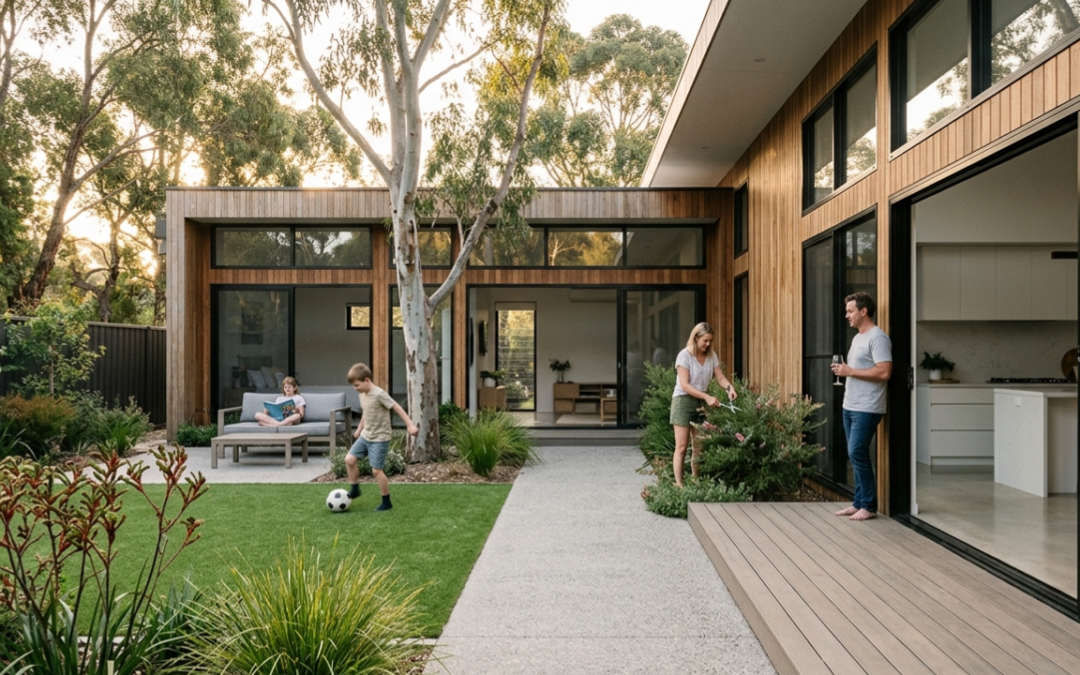
Nobody builds a home thinking about how much time they are going to spend maintaining it.
You think about the kitchen layout and the bathroom finishes and whether the master bedroom gets morning light. You think about the outdoor entertaining area and the storage and the connection between inside and outside. Maintenance is somewhere in the background — something you vaguely know will happen but do not spend much time planning for, because planning for it feels like planning for the boring parts of ownership rather than the exciting ones.
And then you move in. And you start to understand, usually within the first year, that the amount of time and money a home demands from you in ongoing maintenance is one of the most significant determinants of how much you enjoy living in it.
A home that was designed with maintenance in mind — where the materials were chosen for durability and cleanability as well as appearance, where the layout makes cleaning and upkeep straightforward rather than laborious, where the outdoor areas are manageable rather than overwhelming — is a home that gives back time rather than consuming it.
A home designed purely for aesthetic impact without any thought for how it will be maintained over years of real use is a home that gradually becomes a source of stress rather than comfort.
This is the guide to doing the first version — designing and building a home that looks genuinely good and is genuinely manageable to live in over the long term. Not a compromise between beauty and practicality, but a recognition that the best homes achieve both.
Materials — The Decision That Determines Everything Downstream
The materials you choose for your home affect the maintenance burden more than any other single category of decision. Get this right and the home takes care of itself reasonably well. Get it wrong and you spend your weekends catching up on upkeep that was built into the design from the start.
The framing question for any material choice is not just “does this look good?” but “how will this look and perform after five years of real use, and what will it take to keep it that way?”
Flooring. Flooring is the surface that takes the most punishment in any home — foot traffic, spills, furniture movement, pets, children, cleaning products. The maintenance implications of different flooring choices are significant.
Tiles are the lowest-maintenance flooring option for most applications. Properly installed and sealed, tiles do not stain, do not scratch, do not require periodic refinishing, and clean quickly. The grout lines are the main maintenance consideration — lighter grout shows staining more readily than darker grout, and grout that was not applied properly or sealed correctly will absorb stains. Specifying epoxy grout in wet areas and kitchens, and using a grout shade that is realistic about the maintenance you can provide, addresses this.
Engineered timber has the warmth and character of timber with better moisture resistance and dimensional stability than solid hardwood. It can be refinished a limited number of times depending on the thickness of the top layer. It requires protection from standing water and from heavy furniture movement. In the right application — living areas and bedrooms in a household without pets and children — it is excellent and relatively low maintenance. In a household with dogs, young children, and frequent spills, it will require more attention.
Polished concrete is a durable choice that suits certain aesthetics and is genuinely low maintenance once properly sealed. It needs resealing periodically — the frequency depends on traffic levels and the specific sealer used — but between sealings it requires only regular mopping.
Carpet is the highest-maintenance flooring option and the most vulnerable to the events of household life. Stains, odours, wear patterns, and the accumulation of allergens over time make carpet a choice that requires more ongoing attention than hard floor surfaces. In bedrooms where softness and warmth are the priority and traffic is light, carpet works reasonably well. In main living areas and hallways where traffic is heavy, hard flooring surfaces age better and require less maintenance.
External materials. The materials on the outside of the home are exposed to the Australian climate — intense UV radiation, significant temperature variation, rain, wind, and in coastal areas, salt air. The maintenance implications of different external materials vary substantially.
Brick requires essentially no maintenance over a very long period. It does not need painting. It does not deteriorate significantly with weathering. It is fire-resistant and pest-resistant. The grout between courses may require repointing after many years, but this is a once-in-a-generation maintenance event rather than an ongoing one. For a low-maintenance external facade, brick is hard to beat.
Painted render and weatherboard both require periodic repainting. The frequency depends on the quality of the original paint job, the quality of the paint used, and the degree of weather exposure. In a fully exposed position with intense UV, repainting may be needed every seven to ten years. In a more sheltered position with high-quality paint, fifteen years might be achievable. Either way, it is a recurring maintenance event that brick does not have.
Timber cladding requires the most ongoing maintenance of common external cladding materials. Depending on whether it is painted, stained, or oiled, it may need recoating every three to five years in exposed positions. It is the most beautiful of the options and the most demanding.
For roofing, concrete or terracotta tiles are essentially maintenance-free for decades. Metal roofing in quality materials — Colorbond in Australia is the dominant product — also requires minimal maintenance and is extremely durable. The gutters and downpipes that manage roof drainage require periodic cleaning — this is a maintenance task that cannot be designed away, but selecting gutter profiles that are less prone to leaf accumulation and ensuring adequate downpipe capacity reduces the frequency and consequences of blockages.
Granton Homes helps buyers understand the maintenance implications of material choices during the selections process. The conversation is not just about what looks good on the day of handover but about what will still look good — and what will be required to keep it looking good — five, ten, and twenty years later.
Design Simplicity — The Maintenance Factor That Gets No Attention
Complex architectural details look impressive on a building. They also create maintenance challenges that simple, clean designs do not have.
Intricate rooflines with multiple valleys and intersections are more likely to develop leaks than simple gable or hipped roofs. Every valley is a potential water-management problem. Every penetration through the roof membrane — for a skylight, a vent, a chimney — is a potential failure point. A simple, well-executed roof with minimal complexity is more reliable over time than an architecturally dramatic one with many elements.
External detailing — decorative brackets, elaborate cornices, feature elements that project from the wall surface — creates ledges where water pools and dirt accumulates. Every horizontal surface on the exterior of a building collects debris and becomes a place where moisture penetrates if not properly maintained. Simplified external detailing with clean lines, properly sloped surfaces, and minimal projections requires less attention.
Internal joinery with complex profiles and decorative elements is harder to clean and repair than simple, flat-profile joinery. Elaborate door profiles collect dust in the grooves. Complex cabinetry with decorative handles and ornate finishes shows wear more visibly than simple, handle-free or simple-hardware cabinetry.
None of this means designing a boring or characterless home. It means applying the maintenance test to decorative decisions — asking whether the visual benefit of a particular detail justifies the ongoing maintenance it creates. Many buyers would make different decisions if they had a clear picture of what maintaining different design choices actually requires over ten or fifteen years.
Wet Areas — Where Maintenance Problems Concentrate
Bathrooms and laundries are where moisture, cleaning products, and daily use combine to create the most demanding maintenance environment in any home. Designing wet areas with maintenance explicitly in mind pays back significantly.
Waterproofing is the most important decision in any wet area and the least visible. Inadequate waterproofing behind bathroom tiles is the root cause of most serious bathroom failures — water penetrating behind tiles causes substrate damage, mould growth, and eventually structural problems that are expensive to remediate. The waterproofing specification in wet areas should be robust — exceeding the minimum requirements rather than meeting them, and applied by an experienced tiler who knows that the membrane needs to be taken up the wall to an adequate height and across the floor with no gaps.
Tile format and grout colour have maintenance implications. Larger format tiles with fewer grout lines are easier to maintain than small tiles with extensive grout networks. Grout, regardless of format, requires appropriate sealing and realistic colour selection — white grout in a heavily used shower will not stay white without significant cleaning effort. Mid-toned or darker grout that does not show staining readily is a maintenance-informed choice.
Frameless shower screens rather than framed ones eliminate the aluminium frame that accumulates soap scum and mould in the profile gaps and requires regular detailed cleaning. A frameless panel or a wet room design with no screen at all is the most maintenance-friendly approach.
Tapware and fixtures in appropriate quality and finish will last decades and require minimal maintenance. Cheap tapware corrodes, develops drips, and requires replacement within years rather than decades. The price difference between adequate and quality tapware is meaningful at the time of purchase and is recovered many times over in the absence of replacement and repair costs.
Ventilation in bathrooms prevents the moisture accumulation that causes mould — on surfaces, in grout, on the ceiling. A properly sized exhaust fan that runs for an adequate period after the shower is used is essential. The design detail of where exhaust air goes matters too — a fan that exhausts into the roof space rather than to the outside simply moves moisture from the bathroom to the roof cavity, which is not an improvement.
Kitchens — Designed for Real Use
The kitchen takes more daily punishment than almost any other room in the home, and the maintenance implications of kitchen design choices compound over years of cooking, cleaning, and use.
Benchtop material is the kitchen selection with the most significant maintenance implications. Stone — natural or engineered — is durable and relatively easy to clean, but natural stone requires sealing and is susceptible to etching from acidic substances. Engineered stone is harder and more resistant to staining and etching. Laminate is the easiest to maintain and the least durable. Timber benchtops are beautiful and the most demanding in a wet kitchen environment, requiring periodic oiling and protection from prolonged water exposure.
The range of specific products within each category varies considerably. Within engineered stone, some products are more resistant to heat and staining than others. Asking specifically about the maintenance requirements and limitations of any benchtop product you are considering — rather than assuming all stone is the same — produces better decisions.
Cabinetry finish and door profile affect how long the kitchen looks good and how easy it is to keep it that way. Polyurethane and two-pack finishes are durable and easy to wipe clean. Timber veneer is warmer in appearance and requires more care. Handle-free or J-pull cabinetry eliminates the hardware that collects grease and requires regular cleaning and eventual replacement. Soft-close hinges and drawer runners perform better over a long period than standard ones and reduce the wear that eventually makes doors and drawers misalign.
The splashback material behind the cooktop is in the highest-impact zone for cooking grease and heat. Full-height glass, stainless steel, or fully vitrified tiles with appropriate grout are the most maintenance-friendly choices. Timber splashbacks in the zone immediately behind the cooktop are beautiful and demanding.
The rangehood size and power needs to be appropriate for the cooking that actually happens in the kitchen. An undersized rangehood that does not capture cooking vapours allows grease to settle on surfaces throughout the kitchen and beyond. A properly sized rangehood that captures what it should makes the kitchen significantly easier to keep clean.
Outdoor Areas — Where Maintenance Gets Forgotten Until It Is Too Late
The outdoor areas of a home are where the best maintenance intentions most frequently fall short. Gardens that were planned with ambitious plantings become neglected as the reality of ongoing maintenance proves more demanding than expected. Outdoor surfaces that looked great at installation degrade with weather exposure in ways that were not anticipated.
Designing outdoor areas with a realistic assessment of how much maintenance you will actually provide — not how much you intend to provide — produces outdoor spaces that stay presentable rather than gradually deteriorating into something that requires a major intervention to restore.
Planting. Native and drought-tolerant plants are genuinely lower maintenance than exotic species fighting against the Australian climate. Once established, they require less water, less fertilising, less pest management, and less intervention generally than plants that need conditions they are not naturally suited to. The native plant palette available in Australia is extensive and visually interesting — the assumption that going native means a boring garden is simply not accurate.
The density and configuration of planting matters for maintenance. Overcrowded planting requires constant pruning and creates conditions that encourage pest and disease problems. Well-spaced planting in configurations that are manageable from an access perspective — not planted against walls or fences where access for maintenance is difficult — stays healthier and requires less intervention.
Mulching is one of the highest-return-on-effort garden maintenance investments. A proper mulch layer suppresses weeds, retains moisture, moderates soil temperature, and gradually improves soil health as it breaks down. A well-mulched garden requires significantly less weed management than an unmulched one.
Lawn area is often the most maintenance-intensive element of an outdoor space because of the regularity of mowing, the need for irrigation during dry periods, and the attention required to keep it looking good. Being realistic about how much lawn area suits your maintenance appetite — rather than aspirational about how much you will enjoy mowing — produces an outdoor space that does not become a source of guilt and neglect.
Hardscaping. The paved, decked, or concreted surfaces in outdoor areas affect maintenance significantly. Timber decking looks wonderful and requires periodic oiling or staining to maintain its appearance — annually in fully exposed positions, less frequently in sheltered ones. Concrete pavers or tiles require essentially no maintenance beyond occasional cleaning. Exposed aggregate concrete surfaces can be hosed down and need no other attention.
Fencing and boundary structures in materials that require painting or oiling need periodic attention — every five to ten years typically, depending on exposure and material. Colorbond steel fencing requires no maintenance and simply weathers reliably. Masonry boundary walls are equally maintenance-free once built.
Ventilation and Moisture — Preventing the Problems That Are Expensive to Fix
Moisture problems — mould growth, timber decay, substrate damage from water penetration — are among the most expensive maintenance issues a home can develop, and they are almost entirely preventable through appropriate design and construction.
Good ventilation in bathrooms and laundries, as described above, prevents the moisture accumulation that leads to mould. Good ventilation in the kitchen prevents grease and moisture from settling on surfaces throughout the home. Good roof ventilation prevents moisture accumulation in the roof cavity that can damage insulation and structural timber over time.
The roof, walls, and subfloor of the home need to be able to breathe — to allow moisture vapour to escape rather than accumulating within the building fabric. A home with adequate vapour control, properly installed sarking under the roof cladding, and appropriate subfloor ventilation where applicable has far fewer moisture problems over its life than one where these elements were underspecified.
External drainage around the home — ensuring that water from the roof and from rain on adjacent ground drains away from the building rather than pooling against the footings — is a maintenance concern that is cheap to address during construction and expensive to fix retrospectively if it causes problems.
Granton Homes builds with these considerations built into the construction standards rather than as optional extras. The quality of waterproofing, the ventilation design, the drainage provisions — these are the elements that determine whether a home remains sound and dry over its full life rather than developing the moisture problems that are eventually found in homes where they were not taken seriously.
Quality Fixtures — The Investment That Pays Back Over Time
The fixtures and fittings of a home — tapware, door hardware, window locks, cabinetry handles, light switches and power points — are things most people do not think much about during the build and think about a great deal over the following years as they fail, wear, or need replacement.
Quality fixtures have a simple economic logic. A quality tap that lasts twenty years without requiring repair or replacement costs less in total than a cheap tap replaced twice over the same period, with the added inconvenience of the replacements. Quality door hardware that operates smoothly after a decade costs less in total than inferior hardware that requires adjustment, lubrication, or replacement within years.
The price difference between adequate and quality fixtures is real but modest relative to the total cost of a home. The durability difference is meaningful over the life of the home, and the daily experience of hardware that works as it should — doors that latch cleanly, taps that operate smoothly, windows that seal properly — is genuinely better than living with fixtures that have deteriorated.
Granton Homes specifies fixtures at a quality level that reflects their commitment to homes that perform well over the long term rather than just at the point of handover. When you are going through the selections process, the question of fixture quality is worth asking directly — not just what brand or finish, but what the expected service life is and what the maintenance or warranty provisions are.
The Long-Term View
The decisions made during the design and construction of a home have consequences that play out over decades, not just years. A material choice that seemed minor at the selections stage becomes a significant maintenance event when it needs replacing or refinishing five years later. A design detail that was appealing at handover becomes a frustrating maintenance challenge when it proves difficult to keep clean through real-world use.
Taking the long-term view during the design process — asking not just “does this look good now?” but “how will this perform and how demanding will it be in ten years?” — is the thinking that produces homes that are genuinely good to live in over time rather than just impressive at the start.
Granton Homes brings this perspective to the design and selections process — helping buyers understand the maintenance implications of their choices rather than just the aesthetic implications. The best homes are ones where both of those things were considered together, producing a result that looks good and stays that way without demanding more than the household can reasonably provide. A home that looks after itself is not a compromise on design. It is the product of better design.