
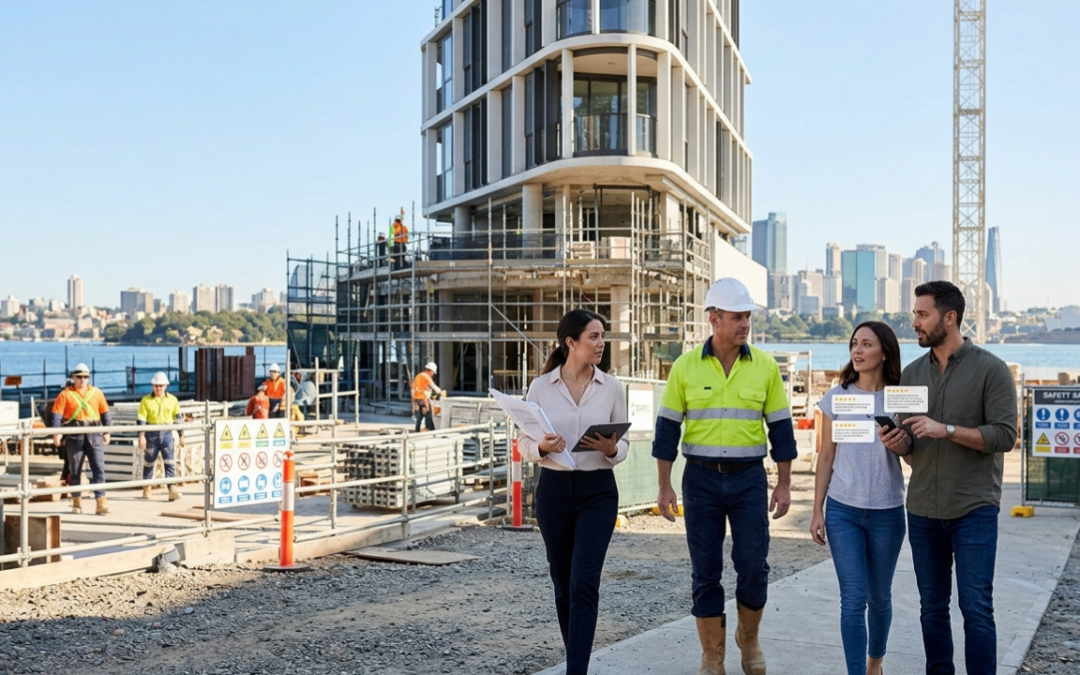
If you have spent any time researching home builders online, you have probably noticed that the internet has a lot of opinions about builders — and a significant portion of them are old.
Forum threads from 2019. Google reviews written during the construction chaos of 2021 and 2022. Reddit discussions that reference problems that may or may not still apply to the builder in question. Facebook group posts from people who had experiences that reflect a very different market than the one operating today.
When you search for Granton Homes Australia — or any builder you are seriously researching — you will encounter this mix of old and new, specific and vague, useful and misleading. The question worth spending a moment on is how to navigate it sensibly rather than either dismissing reviews entirely or trusting them more than they deserve.
Because the honest answer is that reviews are useful but limited. And in the specific context of the Australian home building industry in 2026, the temporal dimension — when a review was written — matters considerably more than it does in most other industries.
Why the Period Between 2020 and 2023 Produces Reviews That Require Caution
The Australian construction industry went through one of the most disruptive periods in its recent history during 2020 to 2023. Understanding what happened during that period is essential for interpreting any reviews written during it.
COVID-related supply chain disruptions caused material shortages that had no precedent in modern building. Timber, steel, fixtures, electrical components, and many other materials became unavailable or had lead times that stretched from weeks to months. Builders who had ordered materials on normal schedules found themselves waiting for deliveries that had no reliable arrival date.
Labour shortages compounded the material problems. Skilled tradespeople were in short supply across the industry as demand surged and workforce availability contracted. Trades that would normally be scheduled in sequence were delayed and rescheduled as availability dictated rather than project logic.
Construction costs increased significantly and rapidly as both material and labour markets tightened. Fixed-price contracts that had been quoted before these increases put builders under severe financial pressure. Some builders absorbed losses to honour contracts. Others sought variations or had difficult conversations with clients about cost increases. Some did not survive.
The combined effect was that virtually every builder in Australia during this period was delivering worse outcomes on timeline, cost, and communication than they had before the disruption and than they would after it resolved. Reviews written during this period reflect the extraordinary conditions of that period, not the normal operation of the builder in question.
A review from 2021 saying that a builder had communication problems and significant delays during a time when the entire industry was experiencing unprecedentedly difficult conditions tells you something about what happened in 2021. It tells you considerably less about what building with the same builder is like in 2026.
This does not mean reviews from that period should be ignored. It means they should be read with this context in mind and weighted accordingly. A builder whose 2021 reviews describe how they communicated through an impossible situation — honestly, proactively, with genuine effort to keep clients informed — tells you something positive about their character. One whose 2021 reviews describe silence and evasion tells you something else.
What Has Actually Changed Since Then
The building industry in 2026 operates in a materially different environment from the one that produced most of the negative reviews you will find from that disruption period.
Supply chains have stabilised. The material shortages that caused unpredictable lead times have largely resolved, and builders can now plan and schedule with a level of reliability that was simply not available during the disruption years. Timber, steel, and most fixtures and fittings are available on normal timescales.
Labour markets have adjusted. Trade availability has improved as the industry adapted to post-COVID demand patterns and the workforce expanded. While good tradespeople are always in demand and scheduling is never perfectly predictable, the extreme shortages of 2021 and 2022 are not the current reality.
Builder processes have evolved. The builders who survived the disruption period learned from it. Many implemented better communication systems, improved their supply chain management, developed more sophisticated cost management practices, and built more resilience into their project management processes. A builder in 2026 has two or three more years of operational refinement than the builder who received reviews in 2020 or 2021.
This means that reviews from 2020 through mid-2023 should be read with significant caution about how well they predict the current experience. Reviews from the last twelve to eighteen months are considerably more relevant to what building with a particular builder is actually like right now.
For Granton Homes specifically, their operation in 2026 reflects the experience and process refinement that has come from navigating a genuinely difficult period and continuing to build. The reviews that are most relevant to your decision are the recent ones — and the reference conversations with past clients who have built in the last eighteen months or so.
How to Read Reviews That Are Actually Useful
Not all reviews provide equally useful information, and learning to distinguish the useful ones from the noise makes the research process considerably more efficient.
Specificity is the most reliable quality indicator. A review that describes what specifically happened — what the problem was, how the builder responded, what the outcome was — is providing information you can evaluate. A review that expresses general satisfaction or dissatisfaction without specifics is not. “Granton Homes built us a beautiful home, we are very happy” is not actionable information. “Granton Homes identified a defect in our kitchen cabinetry at the practical completion inspection and had it resolved within two weeks” is.
The response to adversity is more informative than the experience of smooth sailing. Reviews that describe how a builder handled something that went wrong reveal character and process that smooth-sailing reviews cannot. A builder who communicated honestly about a delay, explained the cause, and provided a revised timeline has shown you something important. A builder who went quiet when a problem arose and was difficult to reach has shown you something else. These patterns, visible in specific reviews, are more useful than any amount of positive feedback from clients who happened to have uncomplicated builds.
Volume and consistency matter more than any individual review. One negative review for a builder who has completed thousands of homes may reflect an anomalous situation. A consistent pattern of negative reviews across different clients over a recent period is more significant. Look for the pattern rather than anchoring to any individual data point.
Platform matters. Reviews on the builder’s own website are moderated. Google reviews are less moderated. Forum discussions on platforms like Whirlpool, Reddit, or Facebook groups are the least filtered but also the most susceptible to outlier voices. A combination of sources gives a more balanced picture than any single platform.
The emotional temperature of a review affects its reliability. Reviews written in anger are often one-sided and may omit context that would change how you interpret them. Reviews written with calm specificity tend to be more reliable even when they are negative.
What Reviews Cannot Tell You
Understanding the limitations of reviews is as important as understanding how to read them well.
Reviews cannot tell you what building with this builder will be like for your specific project. Building outcomes are influenced by the specific site, the specific project manager assigned, the specific trades available at the time of your build, and the specific decisions you make during the design and construction process. A client who had an exceptional experience may have had an easier site, a more experienced project manager, and a more straightforward design than another client who had a more difficult one.
Reviews cannot tell you whether the positive things you want to be true about a builder are true. A builder with overwhelmingly positive reviews may still have the specific weakness that matters most for your situation. A builder with some negative reviews in its history may have addressed those issues and be operating at a higher standard now.
Reviews cannot substitute for the direct evidence of seeing completed homes and speaking with past clients. The most important research you can do about any builder — more important than any number of reviews — is speaking directly with people who have been through the process. Not reading their accounts online but actually having a conversation where you can ask specific questions and probe specific answers.
And reviews cannot tell you whether the inclusions, the contract terms, the communication process, and the full cost picture of a specific builder are right for your specific project. Those things require direct research and direct conversations.
The Research Framework That Actually Works
Given all of the above, here is the approach to builder research that produces genuinely useful information rather than just a lot of noise.
Start with reviews but use them as input rather than conclusion. Read reviews from the last twelve to eighteen months for any builder you are seriously evaluating. Look for specific patterns in what clients describe — about communication, about cost alignment, about timeline accuracy, about quality. Use what you find to generate specific questions for the direct research that follows.
Verify credentials before investing significant time. A five-minute check on the NSW Fair Trading website confirms that the builder holds a current licence and has no significant regulatory history. This is not a sufficient basis for choosing a builder but it is a necessary foundation.
Visit completed homes with a specific quality assessment agenda. Not a display home visit — a visit to homes that have been built and lived in. Look at specific quality indicators rather than general impressions. Grout lines, paint finish at junctions, joinery operation, material transitions. These details reveal the standard of workmanship that the builder’s trades and site supervision deliver under real construction conditions.
Speak directly with past clients. Ask the builder for references — contact details for past clients you can speak to. Follow through on contacting them. Ask specific questions about communication, cost alignment, timeline accuracy, and their assessment of the quality of the finished home after living in it. The information from these conversations is more reliable than any combination of online reviews.
Focus the direct client conversations on recent builds. Clients who built in the last twelve to eighteen months are experiencing the builder in current form — with current processes, current teams, and current market conditions. Their experience is more representative of what you can expect than the experience of clients who built during the disruption years.
Compare with alternative builders using the same methodology. Apply the same research approach to two or three builders and compare the results. The comparison that matters is between the builders as they actually are now, based on current evidence, not between historical reviews that may not be representative.
Applying This to Granton Homes Specifically
If Granton Homes is one of the builders you are seriously evaluating, the research framework above applies directly.
The reviews you will find from the disruption period — 2020 through 2023 — reflect a market that was under extraordinary pressure. Some of those reviews describe problems that reflected industry-wide challenges rather than Granton Homes-specific failures. Others may describe genuine issues with how Granton Homes handled specific situations during that period. Reading them with awareness of the context and looking for what they reveal about the builder’s character and process rather than just the outcomes is the right approach.
The reviews from the last twelve to eighteen months are more indicative of the current operation and deserve more weight in your assessment.
The direct evidence — visiting completed homes, speaking to past clients who have built recently — provides more reliable information than any combination of online reviews, and it is the research that should ultimately anchor your assessment.
Granton Homes builds homes that reflect their premium inclusions positioning and their commitment to custom design quality. Their operation in 2026 reflects the refinement that comes from sustained experience, including the difficult years of the disruption period. Whether their current operation is right for your specific project is a question that the direct research framework will answer more reliably than any review summary.
The Bottom Line on Reviews
Reviews are useful. They are one input in a research process that should also include licence verification, completed home assessment, direct client conversations, inclusions comparison, and full cost picture discussions.
Used well — reading them for specific patterns, weighting recent reviews more heavily than older ones, contextualising the disruption period appropriately, using them to generate questions rather than as conclusions — they can meaningfully contribute to your builder evaluation.
Used poorly — treating any single review as definitive, not accounting for when a review was written, using them as a substitute for direct research — they can produce impressions that do not hold up when tested against reality.
The smart approach to builder research in Australia in 2026 is to use reviews as the beginning of your research rather than the end of it. They point you towards the questions worth asking. The answers to those questions — from direct conversations, direct assessment, and direct comparison — are what you make your decision on.
That approach, applied consistently and rigorously, produces a decision that reviews alone never can — one based on a genuine understanding of what building with a specific builder is actually like, right now, for projects like yours.