
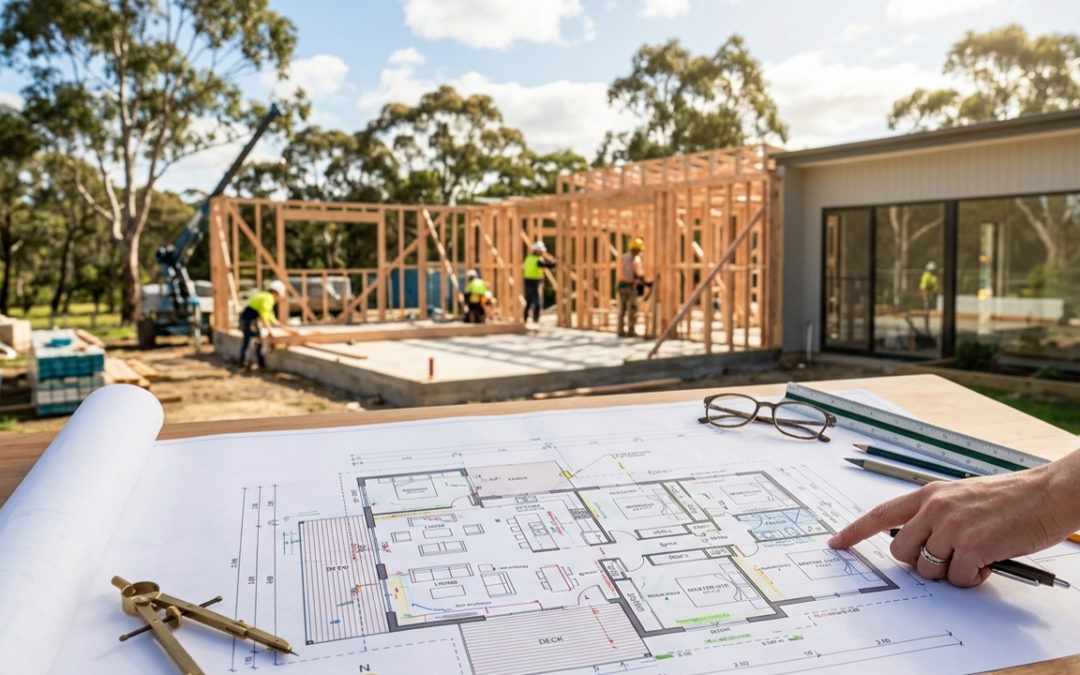
There is a particular kind of regret that experienced homeowners describe when they reflect on homes they have lived in that did not quite work.
It is not usually about the finishes. They do not say “I wish I had chosen different tiles” or “if only the kitchen benchtop had been a different material.” The regret is almost always structural. The kitchen that never connected well to the outdoor entertaining area. The master bedroom positioned so that every morning in the living area was audible in bed. The study that got walked through because it was the only route between two parts of the house. The dining room that nobody used because it was isolated from where the household actually spent time.
These are layout problems. And they are the problems that are hardest to fix after the home is built, because fixing them requires structural intervention rather than cosmetic update.
This is why floor plan decisions matter more than almost anything else you will decide during a home build — and why it is worth spending considerably more time on the layout than on the finishes that typically get more of the attention and the emotional energy.
The Asymmetry That Most People Get Backwards
The typical home building journey allocates attention roughly in inverse proportion to how much each category of decision will affect daily life.
Finishes — the kitchen cabinetry style, the tile selection, the tapware finish, the flooring material, the paint colours — are visually engaging, tangible, and endlessly browsable on Instagram and Pinterest. They are the decisions people discuss with most enthusiasm and dwell on longest during the research and planning phase. They are also the decisions with the most flexibility — they can be updated, replaced, or modified over the life of the home relatively straightforwardly.
Floor plan decisions — where rooms sit relative to each other, how the traffic flows through the home, how natural light is distributed, where noise sources are positioned relative to quiet spaces — are less visually engaging and harder to visualise in the abstract. They tend to get less time and less emotional investment than finishes decisions. And they are the decisions that are most permanent — changing them after construction requires structural work that is expensive, disruptive, and often not fully achievable.
The asymmetry is striking when you make it explicit. You will change your kitchen benchtop before you change your floor plan. You will update the flooring before you will move a load-bearing wall. The finishes that get the most attention during the planning phase are the ones with the most flexibility. The floor plan that gets less attention is the decision you are living with for the entire time you own the home.
Understanding this asymmetry and deliberately inverting it — spending more time and more careful thought on the floor plan than on the finishes — is one of the most practically impactful things any prospective home builder can do.
What the Floor Plan Actually Determines
The floor plan determines things that are fundamental to the experience of daily life in a home in ways that finishes simply cannot match.
How the home actually functions as a living environment. The floor plan is not just a technical document — it is a description of how life will happen in this home. The route from the bedroom to the kitchen in the morning. The path from the car to the front door in the rain. The way the person cooking dinner can see and participate in what is happening in the living area. The proximity of the children’s bedrooms to the adult living spaces. All of these are floor plan outcomes.
A floor plan that supports the natural rhythms and patterns of a household makes the home feel effortless — you move through it without friction, things are where you expect them to be, spaces work for the activities that happen in them. A floor plan with mismatches between design and life creates daily friction that accumulates in ways that are hard to describe individually but very noticeable in aggregate over years of living with them.
Where natural light comes from and how it is distributed. Light is arguably the single most powerful determinant of how a home feels, and its distribution through the home is entirely a function of the floor plan — specifically, which direction rooms face, where windows are positioned, and how spaces connect to allow light to travel between them.
A north-facing living area in Australia receives good quality light throughout the day. A south-facing one is darker and cooler. An open-plan kitchen-dining-living arrangement with north-facing windows distributes that light across all three zones. A kitchen on the south side of the home behind a closed door gets minimal natural light regardless of the size of the window.
These outcomes are determined at the floor plan stage. The orientation of the home on the block, the direction each room faces, the placement of windows within rooms — these decisions happen on the drawing board, and they cannot be meaningfully improved after construction without significant structural intervention.
Granton Homes thinks about light distribution as a fundamental design consideration from the beginning of the design process, not as an afterthought. The orientation of the home on the block, the positioning of living areas to capture useful solar gain, the window placement within rooms to distribute light to where people actually spend time — all of this is worked through as part of the design rather than left to chance.
Acoustic performance — how well different parts of the home are acoustically separated. Sound travels through buildings in ways that are determined by the floor plan. Where the bedrooms sit relative to the living areas, whether the master bedroom is on the same wall as the kitchen, whether children’s rooms are adjacent to each other or to the main bedroom, whether the home office is acoustically separated from the noisiest parts of the house — these are all floor plan decisions with real daily life consequences.
A household where someone works from home requires a floor plan that provides genuine acoustic separation between the work space and the living areas. A family with children at different ages has different acoustic needs within the bedroom zone. A couple who have different sleep schedules benefits from a floor plan that minimises the sound transmission between the early-rising side of the home and the late-sleeping side.
These needs cannot be addressed after construction except through acoustic retrofit that is expensive and of limited effectiveness. Getting the floor plan right — positioning rooms with acoustic logic as well as spatial logic — is how these needs are met.
Privacy within the home and from the street. The position of rooms relative to each other and relative to the street determines the privacy experience within the home. A master bedroom that faces the street with no screening, or a living area that is fully visible from a busy footpath, creates a privacy compromise that can only be resolved cosmetically — with window furnishings or external screening — rather than architecturally.
The position of bedroom zones relative to living zones within the home determines whether household members have genuine private space or whether every room feels connected to the activity of the rest of the household. For families with teenagers, multi-generational households, or households where one person needs to work from home undisturbed, this internal privacy is genuinely important and needs to be addressed in the floor plan.
The indoor-outdoor relationship — one of the most important design outcomes for Australian homes. Australia’s climate makes outdoor living genuinely possible for much of the year, and the relationship between the internal living spaces and the outdoor entertaining area is one of the most significant design outcomes in any Australian home. A floor plan that positions the living area to connect directly and generously with the outdoor space — through wide-opening doors, with consistent flooring that extends the inside to the outside, with sight lines from the kitchen to the outdoor area — creates a home that works with Australian lifestyle.
A floor plan where the living area connects to the outdoor space through a narrow door or through an awkward transition misses one of the most important functional opportunities available in Australian home design.
Why Finishes Are the Wrong Place to Spend the Most Energy in the Planning Phase
This is not to say finishes do not matter. They contribute to how a home feels and how long it stays looking good, and the selections process is worth taking seriously.
But finishes are updateable. The kitchen that has laminate benchtops rather than stone can have stone benchtops ten years later, with modest disruption and manageable cost. The flooring that is carpet in the first version can be replaced with timber when the budget allows. The tiles in the bathroom can be refreshed in a renovation. These are not simple or cheap interventions, but they are feasible in a way that moving walls and reorienting rooms are not.
The floor plan, by contrast, is effectively permanent. The bones of the home — the structural walls, the slab, the roof structure — define what is possible and what is not. Changing the floor plan after construction means opening up finished walls, potentially moving structural elements, re-routing plumbing and electrical, replastering, repainting. It is not impossible, but it is expensive, disruptive, and usually only partially achievable because some elements simply cannot be changed without disproportionate cost.
Given this asymmetry, the planning phase should allocate energy accordingly. The floor plan deserves the most time, the most careful thought, the most specific consideration of how the household actually lives and what the home needs to do. Finishes deserve serious attention but proportionally less of the planning energy, because the floor plan decisions are the ones with the most permanent consequences.
How to Actually Review a Floor Plan Well
Most people review floor plans visually — looking at the drawing, forming a general impression of whether it seems to work, noting whether the rooms are a reasonable size. This produces an assessment that is heavily influenced by how the drawing looks rather than how the home will feel.
A more useful floor plan review involves walking through the plan mentally as a lived experience — not looking at it as a drawing but imagining being in the spaces it describes.
Stand mentally in the kitchen at six-thirty in the morning and think about where the light is coming from. Is it pleasant or is it dark? What is the route from the master bedroom to here — is it comfortable or does it involve passing through areas you would rather not disturb?
Stand mentally in the living area on a Saturday afternoon and think about how it connects to the outdoor area. Can you step directly out to the garden from here, or is it through another room? Can you see the children playing outside from where you are sitting?
Stand mentally in the master bedroom at ten o’clock on a weeknight and think about what sound is travelling to this room. Is the television audible? Is the kitchen noise audible? If someone is still moving around in the living areas, will you know about it?
Walk mentally from the front door to the kitchen carrying groceries from the car. Is this route direct or does it involve going through spaces that seem odd for this purpose?
These mental walkthroughs are how you discover whether a floor plan actually works for your household, as opposed to whether it looks reasonable on paper. They reveal things that visual inspection of a drawing cannot.
Granton Homes works through these kinds of functional questions during the design process — asking how the household actually uses the home, what the daily routines look like, what the specific acoustic and privacy requirements are — because the answers shape the design in ways that make a genuine difference to the daily experience of living in the finished home. Engaging thoroughly with this process, bringing specific and honest answers about how your household actually lives, is how the design conversation produces a floor plan that genuinely works rather than one that merely looks reasonable.
The Storage Question — More Important Than Most People Realise
Storage is the floor plan element that people consistently wish they had thought more carefully about — usually after they have been in the finished home for six months and discovered that the thoughtfully designed built-in storage is not quite enough for how the household actually operates.
Storage is not exciting to discuss. It does not feature in the Pinterest boards and the Instagram saves that shape most people’s visual sense of their ideal home. But the presence or absence of adequate, well-placed storage is one of the most significant determinants of whether a home feels comfortable and organised to live in over time.
Good storage planning starts with a specific inventory of what the household actually owns and where it needs to live. Not a vague sense that there will be wardrobes and a pantry, but a specific accounting of the categories of things that need storage — clothing, shoes, linens, cleaning products, food, tools and equipment, seasonal items, sporting equipment, children’s belongings — and where within the floor plan each of these categories needs to be stored.
This exercise almost always reveals that the default storage provisions in a standard floor plan are inadequate for a real household’s storage needs. The walk-in wardrobe that looks generous on a plan is cramped when fitted out for two people with normal amounts of clothing. The kitchen pantry that seems adequate becomes a source of daily frustration when it needs to hold everything a real household’s pantry contains. The linen press that appears on the floor plan is not actually large enough for the linens, towels, and bathroom consumables it is expected to hold.
Adding storage during the design process costs very little — a few adjustments to the floor plan, a bigger wardrobe here, a properly sized pantry there. Adding it after construction is expensive and often involves compromising finished spaces to find the room.
The Long-Term Question That Floor Plans Need to Answer
A floor plan designed only for the household’s current configuration will start showing its limitations as life changes — and life does change over the typical ownership period of a home.
The nursery becomes a child’s bedroom becomes a teenager’s retreat. The household grows and then contracts as children leave. Work arrangements evolve in ways that change what the home office needs to be. Physical circumstances change. Parents age. Priorities shift.
A floor plan that is thoughtfully designed to accommodate the most predictable versions of these changes without significant structural intervention holds its usefulness over a longer period than one that was optimised only for the household’s current configuration.
This does not mean designing for every possible future scenario — that produces overcomplicated homes that do not serve any version of your household particularly well. It means making specific, deliberate choices that leave options open where leaving them open is easy and closing them off would be costly — a ground floor bedroom provision that does not compromise the floor plan, rooms with proportions that serve multiple purposes, infrastructure that supports future additions.
Granton Homes builds long-term thinking into the design conversation specifically — asking not just what the household needs now but what the home might need to accommodate over the years ahead. This forward-looking design thinking is one of the characteristics that distinguishes a genuinely well-considered custom home from one that was designed only for the immediate brief.
The Decision That Sets Everything Else Up
The floor plan is the decision that determines the quality of the daily experience of your home for as long as you live in it. Everything else — the finishes, the fixtures, the kitchen style, the external presentation — contributes to how the home looks and feels aesthetically.
But the floor plan contributes to how the home actually works. Whether it is easy to live in or frustrating. Whether it fits the household’s rhythms and routines or creates friction. Whether it adapts as life changes or becomes a constraint. Whether it feels like it was designed for the people living in it or just happens to be where they ended up.
Spend the time on the floor plan that it deserves. Walk through it mentally. Challenge it with specific questions about daily life. Think about it at the times of day when each room is used most. Consider it not just for today’s household but for the household of five and ten years from now.
And then, when the floor plan is genuinely right — when you can walk through it in your imagination and feel that it works — give the finishes the serious attention they also deserve. Just not before.