
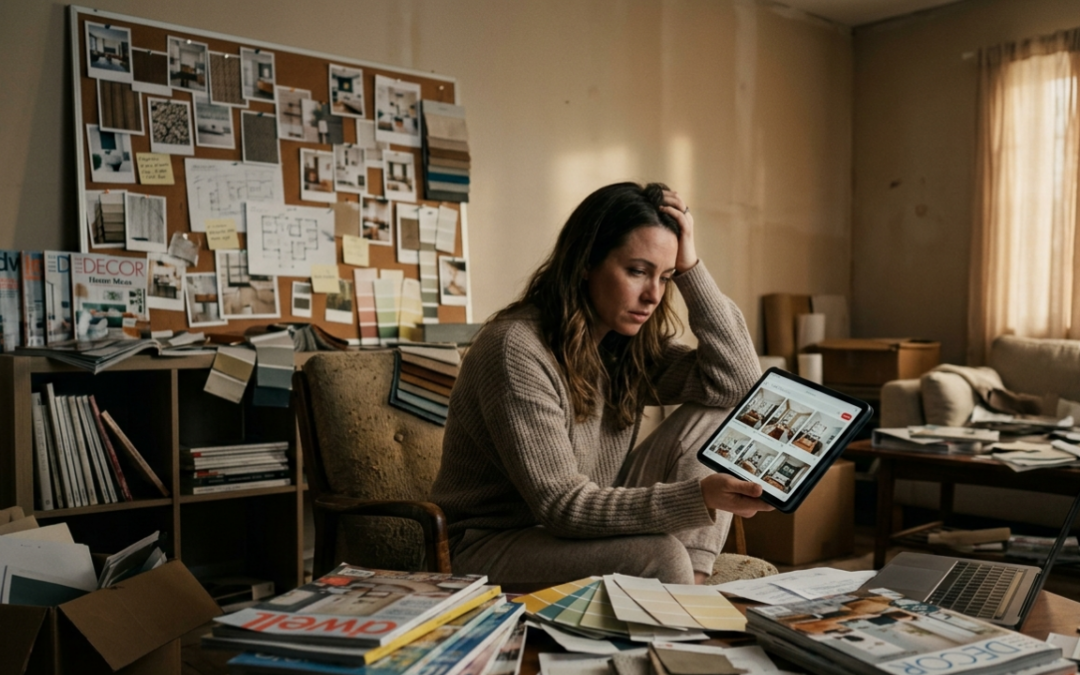
There is a point in the home planning process that most people hit — usually somewhere between three and six months in — where they realise they have been researching for a long time and are somehow further from a decision than when they started.
Not because they have not found anything good. They have found plenty of good options. The problem is that every good option leads to more searching, because there is always the possibility that the next design will be slightly better than the one they were just about to commit to. And the one after that might be better still. And so the search continues, the options accumulate, and the decision recedes.
This is not a discipline failure or a character flaw. It is a predictable response to the combination of a high-stakes decision, an abundance of available options, and a natural human tendency to avoid the loss of foreclosed possibilities. The internet has made it significantly worse by making an essentially infinite supply of home designs, display home tours, renovation reveals, and aspirational lifestyle content available at any moment — content specifically designed to make you want the next thing you see rather than be satisfied with what you have already found.
Understanding why this happens, and what to do about it, is genuinely useful for anyone who is in the middle of planning a new home — or who is about to start the process and wants to avoid a trap that is very easy to fall into.
How the Search for Perfect Actually Works Against You
When you begin looking at home designs, the variety available is one of the things that makes the early research phase exciting. There are so many options. So many different ways to configure a home, so many aesthetic directions, so many features you had not thought of that might be exactly right for your household.
This variety is real and genuinely useful in the early stages. Exploring the range of what is possible helps you develop a sense of your own preferences, identify the features that genuinely matter to you, and build the vocabulary to communicate with a builder about what you want. The early browsing phase is valuable.
The problem sets in when the browsing phase does not end. When the research that was valuable at the start becomes habitual rather than purposeful — you are looking at home designs not because you are genuinely refining your brief but because it is easier and more comfortable than making the decision.
Each new design you look at does a specific thing: it introduces possibilities you had not been considering. Maybe this kitchen configuration is better than the one you had decided on. Maybe the way this home manages the indoor-outdoor connection is smarter than the approach in the design you were leaning towards. Maybe this floor plan solves a problem you had accepted as a limitation in your preferred option.
And so you go back to look at the previous option again, and now it seems slightly worse compared to the new reference point. You start the comparison again. Your mental model of what you want shifts.
This process can continue indefinitely, because the supply of home designs is essentially unlimited and because each new option genuinely does have some merit that your previous favourite does not fully match. There is always another design that does something slightly better on some dimension. Waiting to find the one that is best on every dimension means waiting forever, because that design does not exist.
Why the Perfect Design Does Not Exist and Why That Is Fine
A home design is a set of trade-offs. Every choice about where to position a room, how to configure a space, which connection to prioritise, how to handle the relationship between the building and the site involves giving something up in order to get something else.
A floor plan that prioritises a generous master suite has less floor area available for other rooms. A design that opens the living areas fully to the outdoor space gives up some acoustic separation between inside and outside. A home that maximises natural light on the north side has rooms on the south side that receive less. A design with a large central open-plan kitchen-dining-living zone sacrifices the acoustic privacy of separated rooms.
These are not failures of design. They are inherent in the nature of designing something in three dimensions on a finite block of land with a finite budget. Every professional designer, every experienced builder, every architect who has ever worked on residential projects understands that the job is to find the best available combination of trade-offs for a specific household on a specific site — not to find a design that eliminates trade-offs entirely.
When you search for the perfect design, you are implicitly searching for something that does not involve trade-offs. A floor plan that gives you everything you want with nothing given up. That search is structurally impossible to complete, which is why it continues indefinitely.
The more productive frame is not “which design is perfect?” but “which design makes the best trade-offs for my household?” This is a question that has an answer — one that can be found through specific thought about your actual priorities and your actual daily life rather than through extended comparison of an expanding set of options.
What Actually Makes a Home Good to Live In
The homes that people are genuinely happy living in over years are rarely the ones that looked most impressive during the planning phase. They are the ones that fit the actual patterns of the household’s daily life — the homes where the kitchen works for how the household actually cooks, the bedroom is in the right position relative to the noise sources and the morning light, the storage is adequate for what the household actually owns, and the outdoor area is genuinely usable for the way the household actually spends time at home.
These qualities are not visible in inspiration photos. A home that photographs beautifully might have a kitchen that is difficult to cook in. A floor plan that looks elegant in a brochure might create daily friction for the specific household that lives in it. A design that wins design awards might not suit the way any particular family actually uses their home.
The homes that work brilliantly — that their owners are genuinely glad to live in year after year — were designed around specific, honest answers to specific questions about daily life. Not around the aspiration of what a beautiful home should look like, but around the reality of how a specific household actually functions.
This is one of the reasons the design process at Granton Homes starts with the client’s brief rather than with a catalogue of options. Their design team wants to understand how your household actually lives — the morning routines, the work arrangements, the entertaining habits, the storage needs, the privacy requirements — before any floor plan is developed. The design that comes from that process may not look as impressive as some of the aspirational examples you have saved from Instagram. But it will work better for the people living in it, which is the measure that actually matters.
The Specific Trap of Social Media and Online Inspiration
A significant portion of the decision paralysis that afflicts home planners comes directly from the nature of the content that dominates online home design spaces.
The homes that appear in Instagram posts, YouTube tours, and Pinterest boards are not typical. They are exceptional — the most expensive, the most dramatically styled, the most visually impressive versions of residential design. They are shot by professional photographers in controlled conditions, staged with furniture and objects that make them look as beautiful as possible, and curated to highlight their strengths while minimising their limitations.
Comparing your real budget against the homes that dominate online inspiration content is a comparison between your reality and the most exceptional examples of an aspirational genre. The gap is almost always significant, and it produces the specific frustration of feeling like your realistic options are not as good as what you keep seeing — even though the realistic options would be considered extraordinary relative to the context of most people’s housing reality.
The practical response is not to stop using online inspiration — it is genuinely useful for developing a visual sense of what you are drawn to — but to use it with awareness of what it is. A source of ideas and aesthetic direction, not a benchmark for what your home should look like or a realistic representation of what a home at your budget level should deliver.
The inspiration that is most useful for your specific planning process comes from seeing completed homes at your budget level in your market — homes that were designed for real households with real budgets and that show what genuinely good design within realistic constraints looks like. Visiting completed homes built by the builder you are considering, speaking to past clients about how their homes function for their households, and asking your builder to show you examples of their completed work in your price range gives you a more useful reference point than any number of aspirational Instagram posts.
How to Know When You Have Found the Right Design
If you are in the middle of the endless-searching phase, the question of how you will know when you have found the right design feels difficult to answer. How do you distinguish between the design that is genuinely right and the one that just seems right before the next option comes along and displaces it?
The distinction is not about how impressive the design looks or how many features it includes. It is about how well it fits the specific requirements you have identified for your household.
If you have been genuinely specific about your requirements — the non-negotiable elements, the important but flexible elements, the things you would like to have if budget allows — then you can evaluate any floor plan against that specific brief and determine reasonably objectively whether it meets it.
A design that meets your specific requirements — the number and configuration of rooms, the acoustic separation you need, the connection between indoor and outdoor that suits the way you use outdoor space, the storage provisions that work for what your household owns, the orientation that works for your site — is a good choice for your household regardless of whether it would be the best choice for someone with different requirements.
The search for a design that meets requirements you have been genuinely specific about is finite. There are designs that meet them and designs that do not. The search for the perfect design, by contrast, is infinite because perfection is always relative to the next option.
Getting specific about requirements before returning to any more design searching is the most effective intervention for people who are stuck in the search loop.
When to Actually Move Forward
The decision to stop searching and commit to a design does not require certainty. No decision of this significance comes with certainty, and waiting for certainty is another version of the endless search.
What it requires is confidence — confidence that comes from having been genuinely specific about your requirements, having found a design that meets those requirements well, and having worked with a builder you have researched properly and trust to execute the design well.
That confidence is available. It does not require perfect information or the elimination of all doubt. It requires having done the work — the specific thinking about requirements, the specific research on the builder, the specific cost planning that tells you the project is financially feasible — rather than the indefinite searching that produces the feeling of activity without the substance of progress.
Granton Homes’ design process is built to support this kind of confident decision-making. The collaborative design approach — starting with a detailed brief about how your household lives, developing the floor plan through specific discussion of your requirements, working through revisions until the design genuinely fits the brief — produces a design that you have good reasons to be confident in rather than one you are accepting because you have run out of patience for searching.
The conversation worth having with their team is not “show me what you have available” but “here is how my household lives and what I need the home to do — help me design something around that.” That conversation, approached with the specific brief that comes from having thought carefully about what you actually need, produces a design outcome that searching indefinitely through available options cannot.
The Thing Worth Remembering
There is a home that is right for your household. Not a perfect home — that does not exist. But a home that fits your daily life, makes the trade-offs that suit your specific priorities, works well for how your household actually functions, and feels genuinely right to live in year after year.
That home is not at the end of an indefinitely extended search. It is the result of being specific about what you need, working with a builder who starts with your brief rather than their catalogue, and making a confident decision based on genuine information rather than waiting for certainty that will not come.
Stop searching for perfect. Start being specific about right. The difference between those two approaches is the difference between months more of productive confusion and a decision you can actually move forward on.