
It has not happened all at once, and it is not complete. You can still see the impulse toward the maximalist dream home in plenty of conversations and planning sessions. But a clear trend has emerged over the last couple of years — one that is visible in the conversations happening between buyers and builders, in the design briefs that are coming in, and in the kinds of homes that people are most satisfied with after they have moved in.
More people are building with practicality as the primary objective rather than impressiveness. More people are asking “will this work for how we actually live?” before they ask “how does this look?” More people are making peace with the idea that a home does not need to be the most ambitious version of what they could afford to be genuinely excellent to live in.
This shift has real causes and real consequences for how homes are being designed and built in 2026. Understanding it is useful whether you are in the early stages of planning a build or partway through a process that started with a different set of assumptions.
What Changed — The Context Behind the Shift
The aspiration toward increasingly larger and more luxurious homes did not emerge from nowhere. It developed in a period when the combination of low interest rates, relatively accessible credit, and steadily appreciating property values made the financial logic of building at the upper edge of what you could afford seem reasonable. If the home was going to go up in value, building more of it seemed sensible. If borrowing was cheap, extending the budget felt manageable.
That context has changed significantly. Interest rates that were at historic lows are now considerably higher, which means the monthly repayment on any given loan amount is meaningfully larger. Construction costs have risen substantially over the last several years — a combination of material cost increases, labour market tightening, and supply chain disruptions that have only partially normalised. Land prices in most Australian markets remain elevated from the boom years.
The aggregate effect on household finances is real. The same borrowing capacity that felt comfortable at 2021 interest rates requires significantly higher income to service comfortably in 2026. The build budget that seemed achievable several years ago now requires more careful management of where the money goes.
But the shift in mindset is not purely a financial response to constraint. It is also a genuine recalibration of what a good home actually is — one that has been accelerated by the financial context but that has its own independent logic.
The homes that people are most satisfied with after living in them for several years are not consistently the most expensive or the most dramatic. They are the ones that work well for the specific household — that fit the daily life of the people living in them, that do not create ongoing financial pressure, and that remain comfortable and functional as the household evolves over time.
This observation, increasingly shared among people who have been through the process, is changing what people are asking builders for.
The Problem With Bigger for Its Own Sake
There is a version of Australian residential aspiration that equates the quality of a home with its size. More bedrooms. Larger living areas. Additional rooms for activities that may or may not materialise. The logic is partly about status, partly about the perceived financial value of a larger asset, and partly about the feeling of abundance that generously proportioned spaces provide.
The lived reality of large homes is more complicated than this aspiration suggests.
Large homes cost more to run. Heating and cooling a substantial volume of air is expensive, and the gap between the running costs of a 200-square-metre home and a 350-square-metre home is not trivial. This cost continues every year, compounding over the decades of ownership in a way that the initial build budget comparison does not capture.
Large homes cost more to maintain. More surfaces to repaint. More flooring to replace. More systems to service. The ongoing maintenance cost of a larger home is higher in absolute terms, and it accumulates over time in ways that eat into the financial advantage of building smaller and keeping more cash.
Rooms that do not have a clear, active purpose tend to become storage or nothing. The formal dining room that nobody uses except at Christmas. The media room that the family stopped using when everyone got their own devices. The home gym that serves primarily as a guilty reminder of good intentions. These rooms cost money to build, heat, cool, and maintain, and the return on that cost is limited when their actual use does not match the intended purpose.
The households that are most satisfied with their homes are not consistently the ones that built the most — they are the ones that built appropriately for how their household actually lives.
What Practical Design Actually Means
Prioritising practicality over impressiveness does not mean building something boring or compromised. It means designing and building around what genuinely serves the household rather than around what looks most impressive to someone who does not live there.
Layouts that match the household’s actual daily routines. This sounds simple and requires genuine thought to achieve. The kitchen that connects directly to the outdoor entertaining area because the household actually entertains that way. The master bedroom that is acoustically separated from the children’s rooms because the household has young children and early risers. The home office that has a door and is positioned away from the living areas because one or both adults work from home regularly. These are not generic good design principles — they are responses to specific household needs.
Granton Homes’ design process starts from this kind of specific understanding. Before any floor plan is drawn, the conversation is about how the household actually lives — the daily routines, the work arrangements, the entertaining habits, the storage requirements. The design that comes from that conversation fits the household rather than a generic vision of what a good home should look like.
Right-sized rooms rather than generous ones. There is a meaningful difference between a room that is appropriately proportioned for its purpose and one that is generously oversized. An appropriately sized master bedroom is comfortable, fits the furniture naturally, and does not waste floor area on space that serves no function. A generous master bedroom is impressive in the render and marginally less useful in daily life.
Right-sizing every room in the home — thinking specifically about what will happen in each room, what furniture and activities it needs to accommodate, and what size achieves that without excess — produces a home that uses its floor area efficiently. This either allows a smaller total floor area for the same functional outcome or uses the same floor area to better overall effect.
Natural light and ventilation as design priorities, not afterthoughts. The homes that feel genuinely comfortable to live in — that feel light, airy, and connected to the outside world — achieve this through design decisions made at the floor plan stage, not through expensive interventions after the fact.
The orientation of the home on the block, the position of living areas relative to north, the sizing and placement of windows, the provision for cross-ventilation — these decisions determine the quality of light and air in the home for as long as it stands. Getting them right during design costs nothing extra. Getting them wrong means living with the consequences and potentially spending on energy costs to compensate.
Storage designed for what the household actually owns. The homes that stay organised and feel comfortable over years of use are the ones where storage was designed specifically rather than generically. Not “there is a wardrobe” but “the wardrobe is sized and configured for what we actually own.” Not “there is a pantry” but “the pantry is large enough to hold how we actually shop and cook.”
This specificity requires some homework — actually thinking through what the household owns and where it needs to live — but it produces storage that works rather than storage that technically exists but is inadequate.
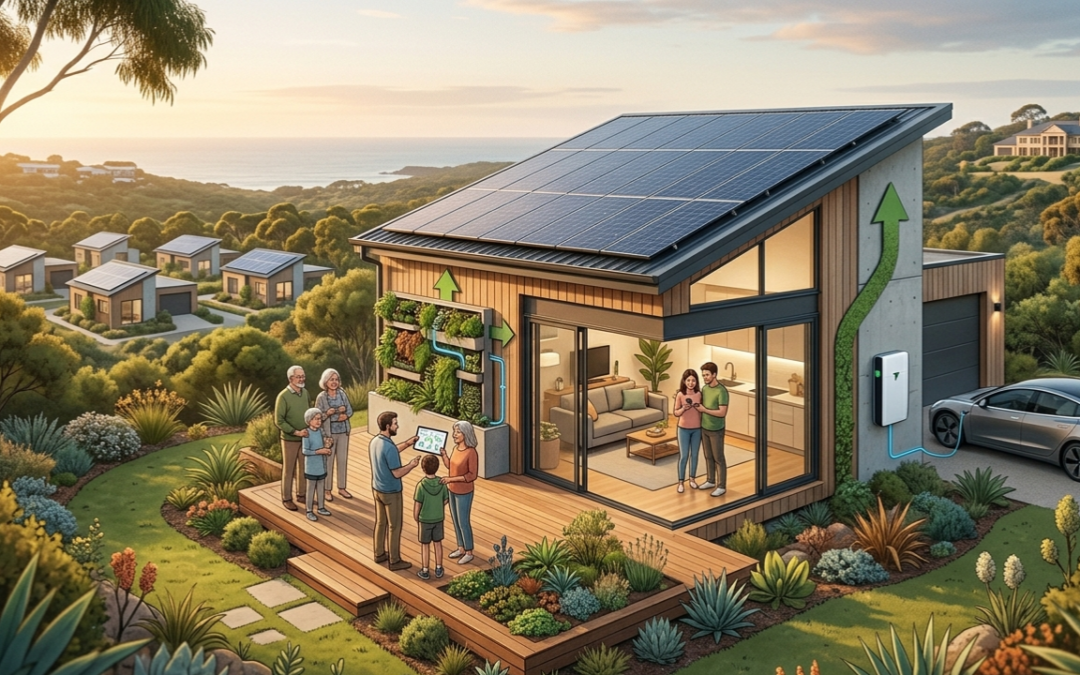
Energy performance built into the structure. The ongoing cost of running a home — electricity for heating, cooling, and appliances — is a real expense that continues every month for as long as the home is occupied. Building energy performance into the home’s structure through good orientation, adequate insulation, appropriate glazing, and cross-ventilation reduces this ongoing cost meaningfully and sustainably.
This is not about technology or expensive add-ons. It is about design decisions made during the planning phase that have essentially no incremental cost but significant long-term impact on running costs.
The Location Question — What It Means in 2026
One of the most significant manifestations of the shift toward practical thinking is visible in how people are approaching the location decision.
For a period, the combination of working from home flexibility and lower interest rates made the trade-off between location and size more attractive toward size. If you were not commuting daily, living further from the city in exchange for a larger home on a larger block made practical sense.
The recalibration is visible now. Working from home arrangements have settled into patterns that are less extreme than the early post-pandemic period for most households. Interest rates have made the financial premium for location feel more justified relative to the cost savings of building further out. And the practical value of proximity — to schools, to employment, to community infrastructure, to family networks — has reasserted itself.
A home that is practically sized but in a location that suits the household’s daily life is increasingly seen as a better outcome than a more impressive home that requires significant commuting time or distance from important facilities.
This shift is reflected in the nature of the projects Granton Homes is working on — more emphasis on maximising the quality and functionality of the home relative to the available budget and site, less emphasis on maximising scale. The design conversation is more often about how to make the available space work brilliantly than about how to maximise the total area.
What This Means for How Homes Are Being Designed
The practical design priority is producing homes that look different from the maximalist aspiration of a few years ago — not in a lesser way, but in a different way that in many respects produces more satisfying daily living.
Smaller total floor areas used more intelligently. Rooms that are sized for their purpose rather than for impressiveness. Open-plan living that is carefully zoned rather than just open. Outdoor areas that are designed as genuine extensions of the living space rather than afterthoughts. Storage that is genuinely adequate for the household rather than technically present. Energy performance that reduces running costs.
The aesthetic is not less beautiful — a home that uses its space intelligently and is well oriented for light and ventilation can be genuinely beautiful. But the beauty comes from design quality and thoughtfulness rather than from scale or expensive specification.
This is the kind of design work that Granton Homes does well. Their approach to custom design starts from the household’s brief and the site’s specific characteristics, and the homes that come from that process are well suited to the people living in them regardless of their scale. A 250-square-metre Granton Homes build that was designed specifically around the household’s requirements and the site’s potential will serve that household better than a 350-square-metre house that was designed generically and acquired as much space as the budget allowed.
The Financial Dimension — Why This Makes Sense Right Now
Building a home that is sized and specified appropriately for the household’s actual needs, rather than at the upper edge of what the budget allows, produces financial outcomes that are meaningful over the life of the home.
A smaller build cost means either a smaller loan — which has an ongoing benefit in monthly repayments for the entire duration of the mortgage — or available capital that can be used for other purposes. Lower running costs — from better energy performance and a smaller area to heat and cool — reduce the ongoing cost of homeownership year after year. Lower maintenance costs — from a more manageable home and more durable specification choices — further reduce ongoing expenditure.
These financial advantages compound over time. The difference between the right-sized home and the maximally ambitious home in financial terms is not only the difference in construction cost but the accumulated difference in ongoing costs over decades of ownership.
In an environment where interest rates are meaningfully higher than they were during the period of maximum home building ambition, the financial case for building appropriately rather than maximally is stronger than it has been for many years.
The Mindset Shift That Makes This Work
The shift toward practical homes requires a genuine recalibration of what a good home is — one that many people find liberating rather than limiting once they actually make it.
The aspiration toward the dream home is partly genuine and partly driven by external comparison — what others are building, what appears on social media, what feels impressive to people who will visit. When you filter out the comparison dimension and focus on what genuinely serves your household, the answers are often less ambitious in scale and more specific in character than the dream home aspiration suggests.
A home that fits your daily life — that makes the morning routine effortless, that accommodates your household’s actual activities, that does not create financial pressure, that runs efficiently and stays comfortable through the seasons — is a better home than one that looks impressive and requires constant management.
This is not settling. It is prioritising the right things. In 2026, more Australians are making exactly this call — choosing the home that works for their life over the home that performs on a rendering. And the homes that result from that choice, designed by builders like Granton Homes who start with the household’s brief and the site’s specific potential, are genuinely excellent places to live.