
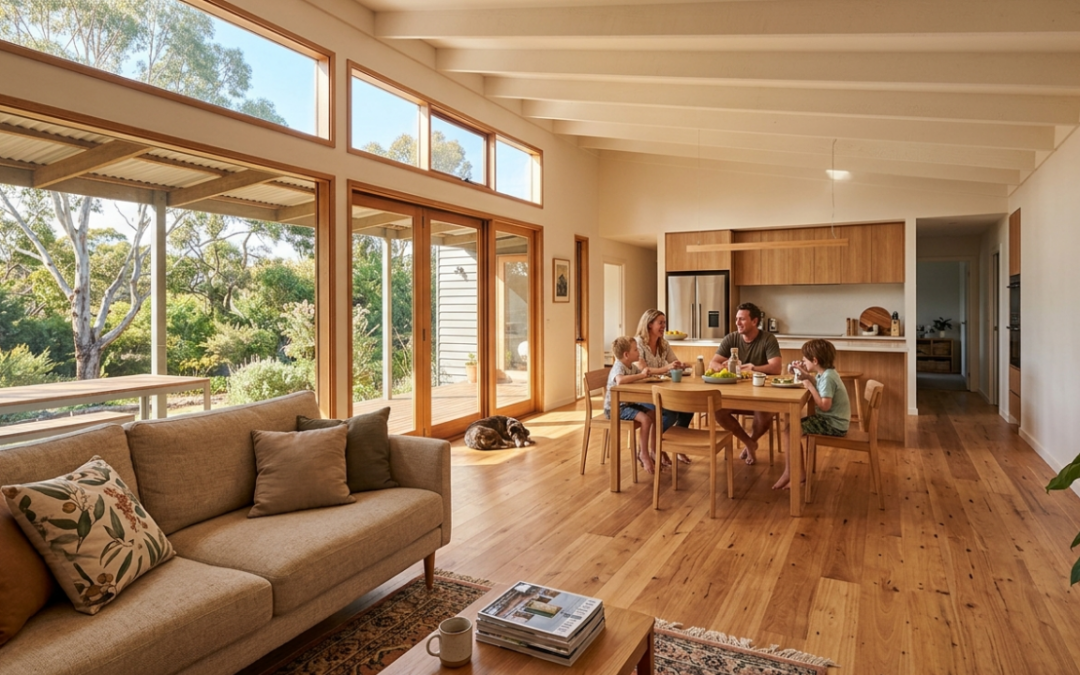
Walk through ten new homes in Australia and at least eight of them will have some version of open-plan living at their centre.
Kitchen, dining, and living areas combined into one connected space. No wall between the person cooking and the conversation happening in the lounge. Natural light travelling freely across the whole zone rather than being divided between separate rooms. The indoor area flowing directly out to the outdoor entertaining space through wide stacking doors.
It has become so standard that most people assume it is simply what modern homes look like — the default rather than a choice. Which means a significant number of people end up with open-plan layouts without having genuinely considered whether open-plan actually suits the way their specific household lives.
And that matters. Because open-plan done well is genuinely excellent. It creates homes that feel generous, connected, and comfortable in a way that separate rooms rarely match. But open-plan done without proper thought, or chosen by a household whose actual lifestyle does not suit it, produces daily friction that no amount of beautiful finishes can compensate for.
This is the honest version of the open-plan conversation — the benefits that are real, the challenges that are real, how to design it well if it is right for you, and how to know if it is not.
Why Open-Plan Became Dominant in Australia
The rise of open-plan living in Australian homes is not a marketing invention or an arbitrary design trend. It happened because it genuinely suits something specific about Australian life.
Australia has a climate that allows outdoor living for a significant part of the year, and a culture that has developed around that possibility. The casual, social, indoor-outdoor way that most Australian households spend their leisure time — the weekend morning that moves between the kitchen and the outdoor area, the summer evening that drifts from cooking to eating to sitting outside — is served well by a layout that does not divide these activities with walls.
The isolated kitchen that was standard in earlier Australian home design — a separate room behind a door, where the cook disappeared while the rest of the household continued in the living room — does not suit this way of living. The person cooking is cut off from the conversation. The indoor and outdoor areas are separated by walls and doors that interrupt the flow. Open-plan solves both of these problems simultaneously.
Natural light distribution is the other major driver. Australia’s climate means natural light is available and desirable for a large proportion of the year, and open-plan layouts allow that light to travel across a much larger area than it could if the same floor space were divided into separate rooms. A connected kitchen, dining, and living area with windows on multiple sides can be genuinely bright throughout the day. The same space divided into three rooms would have at least one of those rooms relying heavily on artificial light.
Granton Homes designs homes where the indoor-outdoor connection and natural light distribution are treated as priorities from the beginning of the design process — not as features bolted on after the floor plan is otherwise settled, but as organising principles that shape how the whole house is planned. Open-plan living suits this approach because it removes the barriers that would otherwise interrupt both.
The Benefits — Where Open-Plan Actually Delivers
The feeling of space. This is the benefit that is most immediately apparent when you walk into an open-plan home and the one that is most difficult to quantify. The same total floor area feels larger in an open-plan arrangement than it does divided into separate rooms. Part of this is visual — you can see more of the home at once and the eye travels further before meeting a wall. Part of it is experiential — moving through the space feels uninterrupted rather than punctuated by doors and transitions.
This matters particularly in Australian suburbs where blocks are not enormous and the total floor area of the home is constrained by budget and planning rules. A modest-sized home that uses open-plan living well can feel generous. The same floor area divided into separate rooms can feel cramped.
Better natural light. In a separated room layout, natural light enters each room through its own windows and stays in that room. In an open-plan layout, light from windows on one side of the zone crosses the entire space and reaches areas that would otherwise be dark. A north-facing window that would illuminate only a living room in a separated layout illuminates a connected kitchen, dining, and living zone in an open-plan one. The result is a brighter home throughout, which reduces the need for artificial lighting during daylight hours and makes the spaces feel more alive and connected to the outside.
Social connection. The household member who is cooking dinner in an open-plan home is still part of the conversation happening in the living area. They can see the children playing, participate in the discussion, respond when someone speaks to them. In a separated kitchen, the cook disappears for the duration of meal preparation. This is a small thing on any individual evening and a significant thing across the cumulative experience of family life over years.
For households that entertain frequently, open-plan living changes the dynamic of having people over. Guests spread naturally across the kitchen, dining, and living areas rather than clustering in one room while the cooking happens somewhere else. The person hosting is present with their guests rather than isolated. It is a more relaxed and social way to have people in the home.
Connection to outdoor living. Open-plan internal layouts connect most naturally to wide-opening doors that extend the space directly into an outdoor entertaining area. The living zone flows to the outdoor zone through a threshold that, when the doors are open, effectively disappears. This indoor-outdoor continuity is one of the most valued features of Australian home design, and open-plan internal layouts are the best way to achieve it.
The Challenges — What Open-Plan Actually Costs You
The challenges of open-plan living are real and they are consistently underplayed in the design and building industry because open-plan is easier and cheaper to build than thoughtfully separated layouts. Understanding them honestly is essential to making a good decision.
Noise. This is the most significant and most commonly underestimated challenge of open-plan living. Sound travels freely through an open space. Every noise source in the kitchen — the exhaust fan, the dishwasher, the blender, the conversation at the bench — is a noise source for the entire connected zone. Every noise source in the living area — the television, the children playing, the video call — is a noise source for the kitchen and dining area.
For many households, this is not a problem most of the time. When everyone is together and the activity is social, shared noise is not a problem. The problem arises when different household members have different noise tolerance needs simultaneously — when one person is trying to concentrate on work, or the children are noisy, or the television is on at a volume that suits one person but not another.
Households that include someone who regularly works from home know this challenge acutely. An open-plan living area adjacent to a home office is an inherently noisy working environment, regardless of how quiet the household tries to be. The acoustic separation that a door and a closed room provides cannot be replicated in an open-plan configuration.
Visibility of clutter and mess. In a separated kitchen layout, the mess of meal preparation is contained within the kitchen and does not affect the visual order of the rest of the home. In an open-plan layout, the state of the kitchen bench is visible from the living area, from the dining table, from any guest sitting in the lounge. A household that cooks regularly and does not maintain a very tidy bench will find this more noticeable than one that either cooks rarely or keeps the kitchen immaculate.
This is not a reason to avoid open-plan — it is a reason to design the kitchen with adequate storage and a layout that allows the bench to be cleared quickly, and to be honest about whether the household’s tidying habits suit a layout where the kitchen is always on display.
Smell. Cooking smells distribute through an open-plan zone in a way they do not in a separated kitchen. Strong-smelling cooking — fish, certain spices, anything that produces significant odour — fills the whole connected space rather than being contained. This is manageable with a good rangehood and adequate ventilation, but it is worth being aware of.
Temperature. Heating and cooling an open-plan space requires more energy than heating or cooling the specific zone of the home you are in, because the whole connected space is being conditioned rather than individual rooms. This can be managed with zoning in a ducted system, but it is worth understanding as part of the energy efficiency picture.
Designing Open-Plan Well — The Details That Make the Difference
The difference between an open-plan layout that is genuinely excellent to live in and one that creates the problems described above is almost entirely in how the design is executed — not whether to do open-plan, but how to do it well.
Zone definition without walls. A well-designed open-plan space has clear definition between the kitchen, dining, and living zones even without walls separating them. The zones are defined through a combination of furniture placement, flooring material or pattern, ceiling height changes, lighting design, and the visual weight of elements like the island bench or a feature pendant light.
This zone definition does the important work of making the space feel organised and legible rather than just large and undifferentiated. When you enter a well-designed open-plan home, you immediately understand where the kitchen is, where the dining area is, and where the living area is — even though nothing separates them. This clarity makes the space more comfortable to be in and more functional in daily use.
Granton Homes thinks carefully about zone definition in their open-plan designs — using the kitchen island bench as a natural divider between the kitchen and dining or living zones, varying ceiling heights between areas to give each zone a distinct spatial character, and designing the lighting scheme so that different parts of the open space can have different lighting levels and temperatures. These tools are what make open-plan feel designed rather than just open.
The kitchen position within the open plan. The kitchen’s position relative to the rest of the open-plan zone matters significantly. A kitchen positioned at one end or side of the zone, with the island bench creating a semi-permeable boundary between the cooking area and the living or dining zone, keeps the cooking activity connected to the rest of the space while providing a degree of visual separation between the work zone and the relaxation zone.
A kitchen positioned in the centre of the open plan, with exposure on all sides, provides less of this separation and makes the bench state visible from every direction. This suits some households and less so others.
The relationship between the kitchen and the outdoor entertaining area is worth specific attention. Being able to move directly and conveniently from the kitchen to the outdoor cooking or serving area — and from the outdoor area back to the kitchen for refills or preparation — makes outdoor entertaining practical rather than effortful. The kitchen should be positioned so this path is short and logical.
Noise management within the open plan. The acoustic challenge of open-plan living can be significantly mitigated through design choices that absorb sound rather than allowing it to reflect across hard surfaces.
Rugs in the living area are one of the most effective and straightforward acoustic interventions available. A large rug under the seating area absorbs sound that would otherwise reflect off a hard floor and travel across the space. The difference between a fully tiled or timber-floored open-plan space and one with a substantial rug in the living zone is clearly audible.
Soft furnishings more broadly — upholstered sofas and chairs, curtains or drapes, cushions — all absorb sound and reduce the reflective acoustic character of an open space. A sparsely furnished open-plan area with hard surfaces throughout is a more reverberant, louder space than one with plentiful soft furnishings.
The kitchen rangehood is worth specifying carefully in an open-plan layout because it is one of the most persistent noise sources in the kitchen zone. A high-quality, quiet rangehood that provides adequate ventilation without running loudly is worth the cost premium in an open-plan context where the noise it makes is audible throughout the connected space.
Lighting as a zone-defining tool. In a well-designed open-plan home, the lighting is doing work that walls would otherwise do — creating distinct atmospheres in different parts of the space that reinforce the zone definition provided by furniture and layout.
A pendant light or chandelier over the dining table is one of the most powerful single design elements in an open-plan space. It defines the dining zone, creates a focal point, and allows the dining area to have its own lighting character distinct from the ambient lighting of the kitchen and living areas. When the main ambient lighting is dimmed and the pendant over the dining table is on, the dining area becomes its own space even within the connected zone.
Task lighting in the kitchen — under-cabinet lighting that illuminates the work surface — provides functional kitchen lighting that operates independently of the ambient lighting in the rest of the space. The kitchen can be well-lit for cooking without the entire open-plan zone being at cooking-brightness.
In the living area, floor lamps and table lamps that can operate independently of the ceiling ambient light allow the seating area to have a warm, lower-level lighting character appropriate for relaxing in the evening while other parts of the zone remain differently lit.
Storage in an open-plan context. Because everything in an open-plan zone is visible, adequate storage is not just about having somewhere to put things — it is about having somewhere to put things away completely, so that the visual order of the space is maintained without continuous effort.
The kitchen in an open-plan home needs enough storage that the bench can be cleared after cooking without items being left out for lack of anywhere to go. This means proper pantry capacity, adequate drawer and cabinet volume, and a bin position that is accessible but not visible.
The living area needs storage for the things that accumulate in living areas — remote controls, books, magazines, children’s toys if applicable, the various items that get set down and need somewhere to live. Built-in cabinetry or quality storage furniture that allows these items to be stored out of sight makes the space consistently presentable rather than requiring active tidying before it looks acceptable.
Is Open-Plan Right for Your Household?
The question worth genuinely answering before choosing an open-plan layout is not “do I like the way open-plan looks?” Most people like the way it looks. The question is “does open-plan suit the way my household actually lives?”
Households where open-plan works well are ones where most of the household is in the same zone doing compatible activities for most of the time they are at home. Social, extroverted households that enjoy shared space and do not often need to pursue activities that require quiet concentration. Households without young children or with children who are past the noisier phases. Couples without competing acoustic needs. Households that maintain reasonable tidiness without significant effort.
Households where open-plan creates friction are ones where different members have meaningfully different noise tolerance needs, or where someone regularly needs quiet concentration at home. Households with young children where the noise of play is constant and penetrating. Households where cooking smells are frequently strong. Households where tidiness of the kitchen is not a natural priority but the kitchen bench is always on display.
This does not mean that any of these households cannot use open-plan layouts. It means they need to design the open-plan more thoughtfully — with a dedicated closed room for work that provides real acoustic separation from the open zone, with extra ventilation capacity for cooking smells, with robust storage solutions that make clearing the kitchen bench easy rather than aspirational.
It may also mean that a partially open-plan approach — maintaining the connection between kitchen and dining while providing a more separated living zone, or opening kitchen and living while keeping the dining area defined by a partial wall or screen — provides the benefits of openness without the acoustic and privacy costs of a fully connected space.
Granton Homes works with clients to find the open-plan configuration that actually suits their household rather than defaulting to the fully open plan that is most common in display homes. Sometimes the conversation reveals that a modified or partial open plan serves the household better. Sometimes it confirms that the full open plan is exactly right. The conversation is worth having specifically rather than assuming one answer is always correct.
What Open-Plan Done Well Actually Feels Like
When an open-plan layout is designed well — with clear zone definition, thoughtful lighting, adequate storage, proper ventilation, and an acoustic approach that manages sound — the experience of living in it is genuinely excellent.
You feel the generosity of the space without feeling exposed or lacking privacy. Different activities can happen in different zones of the connected space simultaneously without interfering with each other in the way they would in a smaller or more poorly designed open plan. The connection to the outdoor area feels natural and easy rather than something you have to make an effort to use. Natural light fills the whole zone and makes the space feel alive throughout the day.
And then there is the specific quality of being in the kitchen while life is happening around you — the particular warmth of that experience, of being connected to the household rather than separated from it while doing something domestic. It is a small thing in isolation and a significant thing as an accumulated daily experience over years.
This is what open-plan living, done well, actually delivers. Not just a design that looks modern or photographs impressively. A way of living in a home that suits Australian life genuinely well when the design supports it.
Granton Homes builds open-plan homes with this understanding — designing the connected space as a coherent whole rather than three areas that happen to lack walls between them. The zone definition, the lighting, the kitchen position, the storage, the acoustic management — all of it is thought through as part of a design that serves the household rather than simply meeting a market expectation.