
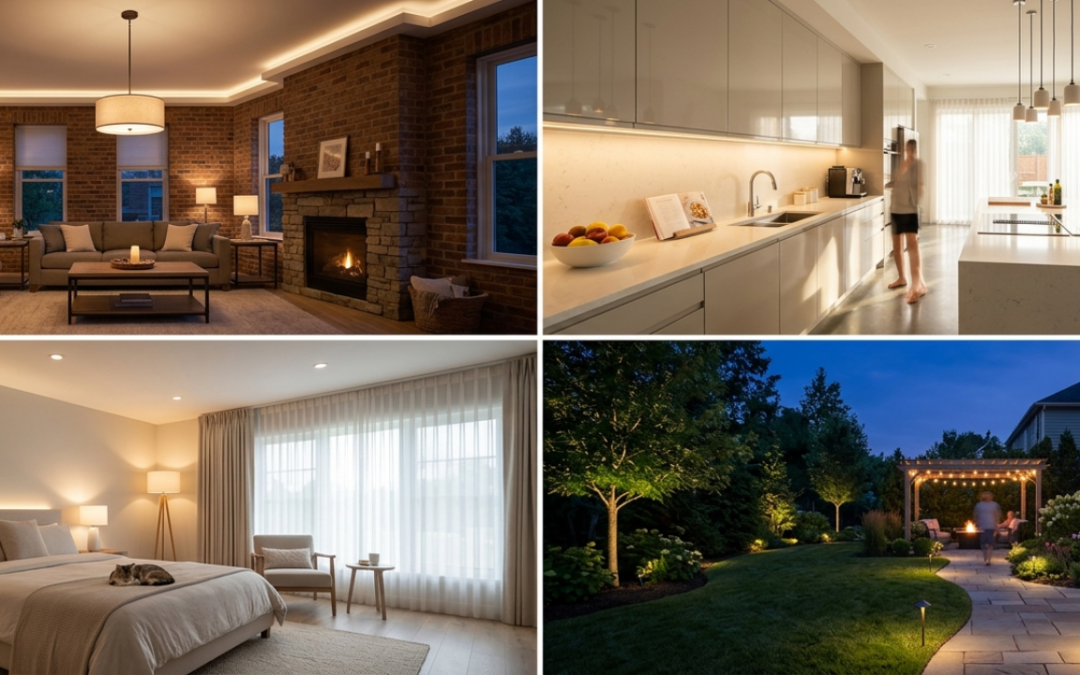
The space feels generous. The rooms feel warm. Everything looks considered and intentional. You are comfortable in a way that goes beyond the furniture or the finishes — the light itself is doing something that affects how you experience the whole space.
Walk into a home where lighting was treated as an afterthought — where someone just put a downlight in the middle of every ceiling and called it done — and you feel that too. Rooms that feel flat despite good furniture. A kitchen that is bright but somehow not pleasant to work in. A living area that looks fine in the afternoon and feels harsh in the evening. A bedroom that never quite feels relaxing no matter what you do with the bedding.
Lighting is the design element that most people treat as a decision to make at the end, once everything else is sorted. It is actually one of the decisions that most rewards being made early — when there is still genuine flexibility in where things go and how they are wired.
If you are building with Granton Homes or planning a renovation, this guide is about getting that decision right from the beginning rather than retrofitting solutions to a lighting plan that was never really thought through.
Why Lighting Affects Everything Else
Before getting into specifics, it is worth understanding why lighting matters as much as it does — because most people significantly underestimate the effect it has on how a space feels.
Light changes the apparent size of a room. A room lit from multiple lower points feels larger and more expansive than the same room lit from a single central ceiling fixture. Lighting that washes walls creates the perception of more space. Dark corners and pools of shadow make a room feel smaller than it is.
Light determines how materials and colours read. The stone benchtop that looked beautiful in the showroom under warm display lighting can look completely different under the cool fluorescent light of a standard kitchen fitting. The paint colour you chose based on how it looked in natural light can shift significantly under artificial evening light. Getting lighting right means your other design choices look the way you intended them to.
Light affects mood in ways that are genuine rather than just aesthetic preference. Bright, cool light is stimulating — which is useful when you are cooking, working, or doing anything that requires focus, and actively counterproductive when you are trying to wind down in the evening. Warm, lower-level light is relaxing — which is exactly what bedrooms and living rooms call for at night, and unnecessarily dim for a kitchen at six in the morning.
A home where lighting responds to these different needs — where the kitchen can be bright and functional while the living area next to it transitions to warm and relaxed — is more comfortable to live in than one where every room is lit the same way regardless of what is happening in it.
Granton Homes plans lighting as part of the overall design rather than as a separate consideration added at the end. That integration is one of the things that makes the finished homes feel as good as they look.
The Layered Lighting Approach — What It Actually Means in Practice
The principle of layered lighting gets mentioned in almost every guide on the subject, and it is genuinely useful — but it often gets explained in ways that are more abstract than practical. Here is what it actually means in a real home.
The ambient layer is the general light that fills a room. In most homes, this means downlights or ceiling fixtures that provide enough illumination to move around comfortably and use the space without being in the dark. In modern Australian homes, recessed LED downlights have become the standard for ambient lighting because they are clean, efficient, and versatile. The positioning of downlights matters more than most people realise — a row of downlights placed too close to a wall creates a scalloping effect on the wall that rarely looks intentional, while downlights positioned thoughtfully distribute light more evenly across the room.
The task layer is the light that makes specific activities possible. This is the under-cabinet lighting that illuminates the kitchen bench where you are actually preparing food — not the ambient light from the ceiling, which casts shadows from your own body when you are standing at the bench. It is the reading light positioned where you actually read, not a general room light that is too dim or too distant for focused reading. It is the pendant light over the bathroom mirror that lights your face rather than lighting the top of your head. Task lighting is functional first, but it does not have to be ugly. The best task lighting solutions work aesthetically as well as practically.
The accent layer is where personality enters the lighting scheme. Strip lighting that illuminates the interior of shelving or cabinetry. An uplighter behind a large indoor plant that creates shadow and texture on the wall. Lighting inside a wine rack or display cabinet. A pendant light over the dining table that functions as a focal point as much as a light source. These elements are not strictly necessary in the way that ambient and task lighting are — the home would function without them — but they are what elevate a lighting scheme from functional to genuinely well designed.
The reason layering matters is flexibility. A room with only ambient lighting can only feel one way. A room with all three layers and the ability to control them independently can feel completely different depending on what is happening in it. Bright and functional for a working Saturday morning. Warm and relaxed for a dinner party Saturday evening. The same room, responding to different needs.
Natural Light — The Layer That Costs Nothing to Run
Every conversation about artificial lighting should happen alongside a conversation about natural light, because the best artificial lighting scheme in the world cannot fully replicate what good natural light does for a space.
A room with generous natural light during the day needs minimal artificial lighting assistance until the evening. It feels alive and connected to the outside. It makes colours and materials look their best. It has a quality that artificial light can complement but not replace.
Getting natural light right in a new home is a design decision made at the floor plan stage — which direction does the house face, where are the windows positioned, what are the window sizes, and what does the light path look like at different times of day. In a renovation, it might involve adding windows, enlarging existing ones, or introducing skylights into areas that are naturally dark.
The orientation of the home is the most fundamental factor. North-facing living areas in Australia receive good light throughout the day with controllable solar gain. East-facing rooms get pleasant morning light. West-facing rooms get afternoon sun that can be problematic in summer without appropriate shading. South-facing rooms tend to be cooler and less naturally bright.
Internal choices affect how far natural light travels into the home. Light-coloured walls and ceilings reflect light deeper into spaces than dark surfaces. Glossy or satin finish paints reflect more light than flat finishes. Internal glazed screens or borrowed light between rooms — a glass panel between a corridor and a room, for example — can bring natural light into spaces that do not have direct window access.
Granton Homes thinks about natural light at the design stage, positioning rooms and windows to maximise the quality of natural light in the spaces where it matters most. If you are reviewing plans, look at where the light will actually come from in each room and at each time of day — not just whether there are windows, but whether those windows are positioned to deliver the light you actually want.
Light Temperature — The Misunderstood Variable
Of all the decisions involved in home lighting, the colour temperature of the light sources is the one most commonly got wrong — and the one whose effect is most immediately noticed once it is wrong.
Colour temperature is measured in Kelvin and describes whether light appears warm or cool. Lower Kelvin numbers — around 2700K to 3000K — produce warm, amber-toned light that feels cosy and relaxed. Higher numbers — around 4000K to 5000K and above — produce cooler, bluer light that feels crisper and more energising.
The standard advice is warm light for living and sleeping areas, cooler light for kitchens and bathrooms. This is broadly right and serves most households well. The living room and bedrooms that you inhabit in the evening, when you are trying to relax and eventually sleep, benefit from warm light that does not work against your body’s natural wind-down process. The kitchen and bathroom, where you need to see clearly what you are doing, benefit from cooler light that renders colours accurately and provides genuine task illumination.
Where people go wrong is in treating this as an all-or-nothing decision — all warm light everywhere or all cool light everywhere. A home where the kitchen is too warm makes food preparation harder. A home where the bedroom is too cool feels energising when it should feel relaxing. Getting different temperature zones in different rooms, and sometimes different temperatures within the same room from different circuits, gives you a home that can respond to different needs.
Smart lighting systems make this more flexible by allowing colour temperature to be adjusted throughout the day — warmer in the morning and evening, cooler during the day. This technology has become more accessible and genuinely useful rather than just a novelty for people who enjoy technology.
Room by Room — What Actually Works
Living room. The living room needs to support multiple different activities — watching television, reading, having conversations, entertaining guests. A single overhead light source cannot serve all of these equally well. The combination that works is dimmable downlights for general ambient light, floor or table lamps positioned near seating for reading and intimate conversations, and accent lighting that highlights the room’s features and can remain on when the ambient lighting is turned down. The ability to control these independently is what makes the room genuinely flexible.
Kitchen. Bright task lighting at the bench where food preparation happens is essential. This means under-cabinet lighting aimed at the work surface — not just the ambient ceiling light, which casts shadows from the cook’s body onto the bench. Pendant lights over an island bench serve both task and decorative functions. The main ambient lighting should be bright enough for cooking and cleaning while being on a dimmer so it can be reduced when the kitchen is not in active use.
Bedroom. Bedrooms need to support rest, and that means lighting that can transition from functional — adequate for getting dressed, reading labels, finding things — to genuinely relaxing. Warm-toned downlights on a dimmer do most of the work. Bedside reading lights, positioned so they illuminate the page without disturbing a sleeping partner, add the task layer. Avoiding blue-toned bright light in the hour before sleep is worth taking seriously — it genuinely affects sleep quality.
Bathroom. Bathrooms are where people consistently make the same mistake — a single overhead downlight that casts shadows on the face when you are standing at the mirror. Lighting for a bathroom mirror needs to come from the front or sides to illuminate the face properly, not from above. Wall-mounted lights on either side of the mirror, or a lit mirror, solve this problem elegantly. The ambient light in the bathroom should be bright enough for practical tasks like applying makeup or shaving.
Children’s rooms. Night lights or the ability to reduce ambient light to a very low level are practical considerations that get forgotten during the design phase and become relevant immediately once children are actually sleeping in the room. Dimmable circuits in children’s bedrooms are worth building in from the start.
Hallways and transitions. These spaces are often lit with a single light source positioned to illuminate the centre of the corridor, which means the ends remain darker than the middle. Multiple smaller light sources distributed along the length of a hallway, or wall-mounted lights that wash light along the wall, work better aesthetically and practically.
Outdoor Lighting — The Part That Gets Forgotten Until After Handover
Outdoor lighting is consistently the category that gets the least attention during the design process and the most attention from homeowners in the months after moving in when they discover the outdoor space is essentially unusable after dark.
A covered outdoor entertaining area without adequate lighting over the dining and seating areas is a space that gets used in daylight and retreated from in the evening — which is precisely when the Australian climate often makes outdoor living most pleasant. Pendant lights or a chandelier over the outdoor dining table, ceiling fans with integrated lighting in the alfresco, and wall lights on the exterior wall of the house that provide ambient illumination across the space make the outdoor living area genuinely usable in the evening.
Garden lighting extends what the outdoor space can do beyond the immediate entertaining area. Spotlights or uplighters in garden beds that illuminate key planting, low pathway lights along walkways, and in-ground lights built into paving all contribute to an outdoor space that has presence and character at night rather than just disappearing into darkness.
Security and safety lighting — motion-activated lights over entry points, adequate illumination on steps and changes of level, lighting along the driveway — is both practically important and often required by insurance conditions. Building this in during construction is far simpler than retrofitting it later.
Granton Homes designs homes where indoor-outdoor connection is a priority. Getting the outdoor lighting right ensures that connection works at night as well as during the day.
Dimmers and Controls — Worth the Investment
The ability to control the level of lighting in a room is one of the most practically useful and consistently underutilised features available in home lighting.
A room with dimmable lighting can be bright when it needs to be and atmospheric when it does not. The living room that is fully lit for a family afternoon can transition to warm and intimate for an evening with guests simply by adjusting the dimmer. The bedroom that is adequately lit for getting dressed can reduce to near-darkness for the final wind-down before sleep.
Standard LED dimmer switches are a modest cost compared to the value they add. Smart lighting systems — where lighting is controlled through an app or voice commands and can be programmed to respond to time of day or specific scenes — add more functionality and cost more, but have become accessible enough that they are worth considering for living areas and bedrooms particularly.
One practical note: not all LED lights are dimmable, and using a non-dimmable LED globe with a dimmer switch causes flickering and shortens globe life. If you are planning to install dimmers, specify dimmable LED globes throughout and confirm with your electrician that the dimmer switch is compatible with the specific globes being used.
The Mistakes That Are Worth Knowing About Before You Start
Planning lighting at the end rather than during design. The position of light switches, the routing of wiring, the structural provisions for pendant lights over specific positions — all of these are much easier and cheaper to get right during construction than to change afterwards. Lighting decisions belong in the design conversation, not the final walk-through before the electrician finishes.
Relying on a single overhead light source in each room. This is the most common lighting mistake in Australian homes and produces spaces that are functionally adequate but aesthetically flat. Every room benefits from multiple light sources at different heights.
Getting the colour temperature wrong. Cool white lights in a bedroom feel institutional. Warm amber lights in a kitchen make it harder to see what you are doing. These are easy mistakes to make and important ones to avoid.
Forgetting about switch placement. A light switch that requires you to cross a dark room to reach it is an inconvenience you will notice every single day. Three-way switching — the ability to control a light from multiple points, like both ends of a corridor or both sides of the bed — is worth building in wherever the layout suggests it will be useful.
Underestimating how much outdoor lighting matters. The outdoor space is part of the home. It deserves a lighting plan, not just a sensor light on the back door.
The Difference Good Lighting Makes
A home where lighting was genuinely planned — where different spaces respond to different needs, where the quality of light in the evening is as good as the quality of light during the day, where the outdoor areas are as usable at night as they are in the afternoon — feels different from one where it was not.
Not just aesthetically different. Functionally different. More comfortable to live in. More flexible in how the spaces work. More enjoyable as a place to spend time.
Granton Homes designs with this understanding — treating lighting as a genuine design element rather than a specification decision made at the end of the process. If you are going through the design phase, engage with the lighting conversation early. Ask where the natural light will land at different times of day. Think through what each room needs to do and what lighting will support those functions. Make the decisions about layers, temperature, and controls before the walls are closed and the ceilings are finished.
It is one of the decisions in home design where the effort put in during planning pays back every single day for as long as you live in the home.