
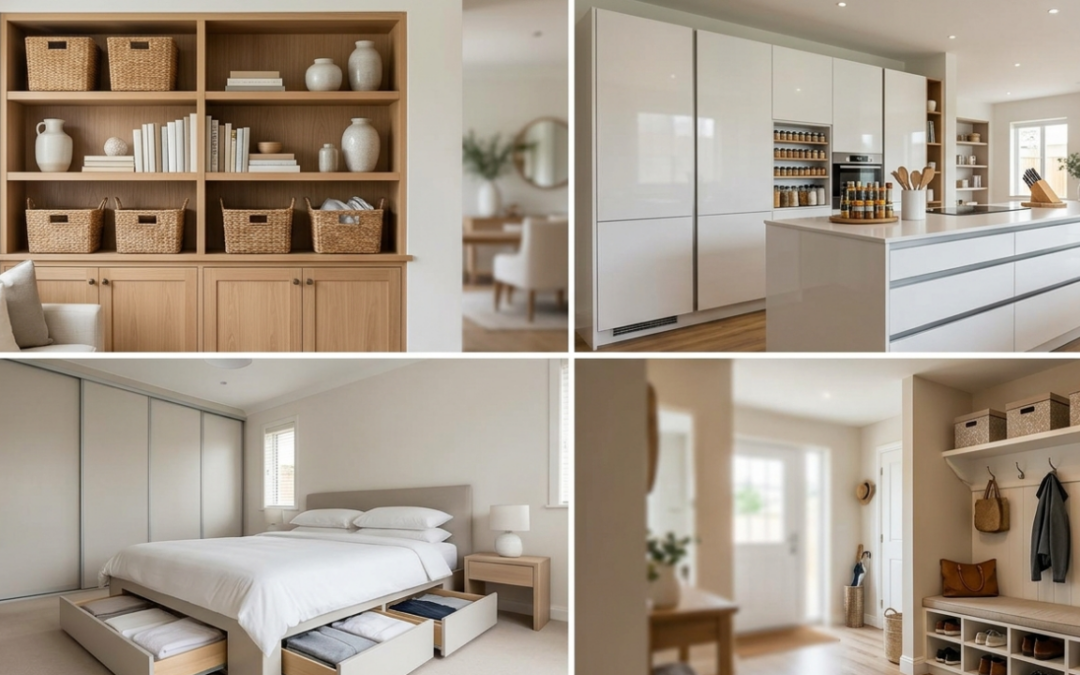
No matter how carefully you planned the design, no matter how many times you walked through the display home imagining your life there, no matter how many conversations you had about room sizes and kitchen layouts and bathroom finishes — the thing that will affect your daily experience of the home more than almost anything else is whether there is enough storage, and whether it is in the right places.
People consistently underestimate how much this matters until they are living with a storage problem. And then they notice it every single day. The bathroom bench that is permanently cluttered because there is nowhere else to put things. The bedroom wardrobe that is crammed to capacity with no room for anything that should logically live there. The kitchen where finding the thing you need requires moving five other things out of the way first. The garage that cannot fit a car because of everything that has accumulated with nowhere else to go.
None of this happens dramatically or all at once. It creeps up gradually, as the things that make up a life fill the spaces available to them and then overflow into spaces that were not designed for them.
The solution is not to own less — though that helps. The solution is to design storage properly from the beginning, thinking specifically about what needs to go where rather than accepting whatever a standard plan includes and hoping it works out.
If you are building with Granton Homes or planning a renovation, this is how to think about storage in a way that actually solves the problem rather than just checking a box.
The First Thing to Do — Be Honest About What You Own
Storage planning that starts with general principles rather than specific inventory almost always produces inadequate results. The right starting point is an honest account of everything your household owns that needs to live somewhere in the home.
Not the idealised version of your possessions. The real one.
Walk through your current home and make a mental list — or an actual list — of all the categories of things that need storage. Clothing and shoes, obviously. But also: bedding and towels. Cleaning products. Medications and first aid supplies. Tools and hardware. Sporting equipment — bikes, balls, racquets, helmets, whatever your household’s particular combination is. Seasonal items — Christmas decorations, winter bedding stored in summer, summer furniture cushions stored in winter. Children’s toys and craft supplies if applicable. Luggage. Books and media. Food — both pantry staples and the bulk buying that makes economic sense but needs somewhere to live.
Now think about whether your current storage arrangement is working for each of these categories. Which ones are well handled? Which ones are creating problems? Which ones are living somewhere inconvenient because they have nowhere better to go?
The answers to these questions are the brief for your storage design. Not “I need a wardrobe and a pantry,” but “I need a wardrobe configured specifically for two people’s clothing including a significant number of long garment items, a separate shoe storage area, and somewhere to keep things that only come out occasionally without them being buried behind everyday items.”
That level of specificity is what produces storage that actually works.
Built-In Is Almost Always Better Than Freestanding
The distinction between built-in storage and freestanding furniture doing the same job matters more than most people realise, and it consistently resolves in favour of built-in.
A built-in wardrobe uses the full height of the room — from floor to ceiling — without wasting the space above it. A freestanding wardrobe leaves a gap between its top and the ceiling that becomes a dust-accumulating zone that is too high to clean easily and too low to store anything in usefully. A built-in wardrobe has no visual footprint beyond its doors — it reads as part of the architecture of the room rather than as furniture placed in it. A freestanding wardrobe is a piece of furniture that takes up floor space and makes the room feel smaller.
The same logic applies in almost every room. Built-in shelving in a study or living area uses vertical space efficiently and creates a permanent, clean-lined storage solution that improves the room aesthetically as well as functionally. Freestanding bookshelves wobble, tip forward over time, and rarely extend to the ceiling without looking like an afterthought.
Built-in storage in the kitchen — the cabinetry that defines the kitchen’s character as much as any surface finish — provides far more functional storage than any combination of freestanding kitchen furniture could achieve in the same footprint.
The limitation of built-in storage is that it requires being thought through during the design and construction phase. You cannot decide you want floor-to-ceiling built-in shelving in your study after the room is finished without it being a renovation project rather than a design decision. Granton Homes plans storage as part of the overall design rather than as an afterthought — but this requires the client to be thinking about storage from the beginning of the design conversation rather than raising it after the major layout decisions are made.
The Kitchen — Where Storage Design Directly Affects Daily Life
The kitchen is the room where inadequate storage is most immediately and repeatedly felt. Every time you cannot find what you need, every time you have to unload three things to get to the one you want, every time the bench fills up because there is nowhere to put things away properly — it is a direct consequence of storage that was not thought through carefully enough.
The decisions that make the most difference in kitchen storage are less glamorous than the ones that get attention — the benchtop material, the splashback tiles, the pendant lights. But they have a far greater impact on how the kitchen actually functions.
Drawer configuration matters enormously. Deep lower cabinets with shelves are one of the least functional kitchen storage solutions in common use — things at the back are inaccessible without removing everything in front of them, and the space is never fully utilised because items stack awkwardly. Replacing these with drawers — full-extension drawers that pull out completely, with the contents visible and accessible from the front — transforms usability. The additional cost over standard cabinet construction is modest relative to the daily improvement in how the kitchen works.
A properly sized walk-in pantry, positioned close to the main preparation area, provides more usable food storage than any combination of overhead cabinets can achieve in the same total volume. The difference is access — in a pantry, everything is visible and reachable. In overhead cabinets, the back third is effectively inaccessible in daily use.
Pull-out shelves in base cabinets, corner cabinet solutions that make use of awkward corner space, dedicated drawer inserts for utensils and cutlery — these are the specifics that separate a kitchen that works from one that is merely functional.
Granton Homes designs kitchens with storage functionality as a priority rather than an afterthought. When you are going through the kitchen design process, push specifically on the storage configuration — not just how many cabinets there are, but how they are configured and where things will actually live.
Wardrobes — Designed for What You Actually Own
The standard wardrobe configuration — a hanging rail and a shelf above it — is adequate for some households and genuinely inadequate for others. Whether it works depends on what the household actually owns and how those items need to be stored.
If you have a significant number of long garment items — dresses, full-length coats — you need a section of the wardrobe with enough hanging height for them. If you have a lot of folded items — jumpers, jeans, t-shirts — drawers or shelves are more efficient than hanging space. If shoes are a significant category, dedicated shoe storage at a sensible height is more functional than stacking boxes on a shelf.
Walk-in wardrobes have become standard in master bedrooms in Australian new builds, and they deserve the same specific thinking as any other storage space. The floor plan and internal configuration of a walk-in wardrobe should be designed around what will actually go in it. A walk-in wardrobe that is the right size on paper but has the wrong internal configuration — wrong hanging heights, insufficient shelf depth, poor access to certain zones — does not function better than a smaller well-configured wardrobe.
For bedrooms without walk-in wardrobes, built-in robes that extend to the ceiling make better use of vertical space than standard-height wardrobes, and sliding doors rather than swing doors allow the wardrobe to be positioned without needing clearance space in front of it for the door to open.
One specific thing worth building into any wardrobe design: somewhere to store the things that are used rarely but cannot be thrown away. The seasonal items, the occasion-specific items, the things that are important but only needed infrequently. Without a designated zone for these, they end up taking space that should be available for everyday items and making everything less accessible.
Under-Utilised Spaces — The Storage That Is Already There
Every home has spaces that are structurally present but not being used for anything. Making these spaces work for storage is one of the most efficient improvements available in any home.
Under stairs is the most significant of these. The void under a staircase is often walled off and left empty, or used as a superficial alcove that does not achieve much. A properly designed under-stair storage solution — custom-built drawers or cabinets that use the angled space efficiently — provides a substantial amount of well-organised storage in an area that was otherwise doing nothing. The cost of doing this properly during construction is much lower than retrofitting it later.
Under beds is another consistently underused space. A bed frame with integrated storage drawers — actual drawers that slide out fully on runners, not the occasional-use version that requires lifting the mattress — provides useful storage in a space that is otherwise completely unused. The practical limitation is access, so this works best for items that are needed infrequently rather than daily.
The space above cabinets in kitchens and laundries — the gap between the cabinet tops and the ceiling — can be used for storage of items that are needed rarely but cannot be discarded. Custom shelving or cabinet extensions that take the storage to ceiling height make this space useful rather than just a gap that collects dust.
Granton Homes thinks about these spaces during the design phase rather than leaving them as wasted voids. Raising these possibilities during the design conversation costs nothing and can add meaningful storage to the finished home.
Vertical Space — The Most Commonly Wasted Resource
Most storage thinking is horizontal. We think about the floor area of rooms and how much of it is dedicated to storage. The vertical dimension — the full height from floor to ceiling — gets far less attention.
Every room in a house has several metres of vertical height that is almost entirely unused above standard furniture height. Shelving, cabinetry, and storage that extends to the ceiling rather than stopping at the conventional furniture height of around 2.1 metres captures this space and makes it available for storage.
In a study or home library, floor-to-ceiling shelving is both practical and visually impressive — it makes the room feel serious and considered in a way that standard-height shelving does not, and it provides significantly more book and object storage. In a kitchen, upper cabinets that extend to the ceiling rather than stopping short make better use of the room’s volume, though the storage near the ceiling is best used for things that are needed rarely rather than daily.
In hallways and corridors, wall-mounted storage that uses the vertical space without encroaching on the floor area keeps the passage functional while adding storage. Built-in hallway cabinetry at full height can accommodate a surprising range of items without making the space feel cluttered.
The principle is simply this: the space between the top of a standard cabinet and the ceiling is not decorative space that needs to be left empty. It is storage space waiting to be used.
Bathrooms — Small Space, High Storage Demand
Bathrooms are almost always smaller than people want them to be, and they have to accommodate a significant amount of daily-use items — products, medicines, cleaning supplies, towels, spare consumables. Getting bathroom storage right requires specific thinking rather than just a vanity and a mirror.
The vanity is the primary storage location in most bathrooms, and the configuration of the vanity matters practically. A vanity with deep drawers is more accessible than one with shelves — you can see and reach the contents at the back of a drawer in a way that is difficult with a cabinet interior. If the bathroom is shared between two people with different morning routines, separate drawer allocation within the vanity makes daily use significantly smoother.
Mirror cabinets — either a standard medicine cabinet recessed into the wall, or a mirror that opens to reveal storage behind it — provide a substantial amount of storage for frequently used items without any visual footprint beyond the mirror surface. The space between wall studs is typically enough depth for a recessed medicine cabinet, and the installation during construction is straightforward.
Wall-mounted open shelving in bathrooms has become popular and can work well for towels and attractive items that do not look cluttered. The limitation is that it works for tidy households and creates a visual chaos problem for households that accumulate more items than look good on open display.
Under-sink storage in bathrooms requires working around the plumbing, but a well-designed vanity that accommodates the plumbing efficiently rather than losing most of the cabinet interior to it is worth specifying. Granton Homes works with suppliers who produce bathroom cabinetry designed for actual functionality as well as appearance.
Garage and Outdoor Storage — The Area That Gets No Thought Until It Is a Problem
The garage is where storage problems that are not solved inside the home eventually accumulate. Sporting equipment, gardening tools, seasonal items, household cleaning supplies, paint tins, the things that are too big for inside storage and too valuable to throw away — they all end up in the garage.
A garage without planned storage becomes an obstacle course. One with planned storage — overhead racks for seasonal and bulky items, wall-mounted tool storage, shelving for organised smaller items, a designated zone for each category of things that needs to live there — remains usable as a garage rather than becoming a storage room that happens to have a car-sized door.
The time to plan garage storage is during the construction of the home, when electrical provisions can be made for garage lighting and power, when wall framing can be designed to accommodate wall-mounted storage systems, and when the garage floor space can be allocated with the storage layout in mind. Retrofitting garage storage after the fact is possible but always more limited than what is achievable when it is considered from the beginning.
Outdoor storage — a garden shed or built-in storage for outdoor equipment, cushions, and garden supplies — follows the same logic. Knowing where outdoor items will live before they arrive is considerably better than figuring it out after the move when the garage is already full.
Multi-Functional Furniture — Useful in the Right Context
Storage furniture that does more than one job — ottomans with storage inside, coffee tables with drawers, beds with integrated storage drawers, dining benches with storage beneath — has a genuine place in homes where built-in storage alone does not solve every problem.
The key is choosing these pieces for quality and longevity rather than as cheap solutions to storage problems. A storage ottoman that looks appealing in a furniture showroom but is too low for comfortable seating, has a lid that does not open easily, and is made from materials that will not hold up to daily use is not actually solving the storage problem — it is adding a piece of furniture that will need to be replaced.
The best multi-functional storage furniture is chosen specifically for what it will store and where it will sit in the room — not as a general storage idea but as a specific solution to a specific storage need. A bench at the end of the bed that stores blankets and out-of-season clothing, chosen for the right size and the right height, is genuinely useful. A collection of decorative baskets that look good but are awkward to access in practice is not.
The Simple Test for Whether Storage Is Working
Walk through your home and look at every surface — benches, tables, the top of the wardrobe, the floor of the laundry. Everything that is sitting on those surfaces that is not decorative is there because it does not have a proper place to live.
A cluttered benchtop is not a tidiness problem. It is a storage problem. The items on that bench are there because they have nowhere designated to go, so they accumulate in the nearest convenient spot.
Good storage eliminates this problem — not by requiring more discipline about tidying, but by giving everything a logical, accessible home so that putting things away is as easy as leaving them out. When every item has a specific place and that place is convenient to access, the home stays organised with reasonable effort rather than requiring constant intervention.
This is what Granton Homes is working towards when storage is built into the design from the beginning — not just providing enough cabinets and wardrobes, but thinking through specifically what will live where so that the storage that is built actually solves the problem rather than just ticking a box.
A home with genuinely good storage does not feel like a home where everything is always put away. It feels like a home where putting things away is effortless because everything has somewhere sensible to go.
That is the goal. And it is entirely achievable if storage is taken seriously at the design stage rather than addressed as an afterthought once everything else is decided.