
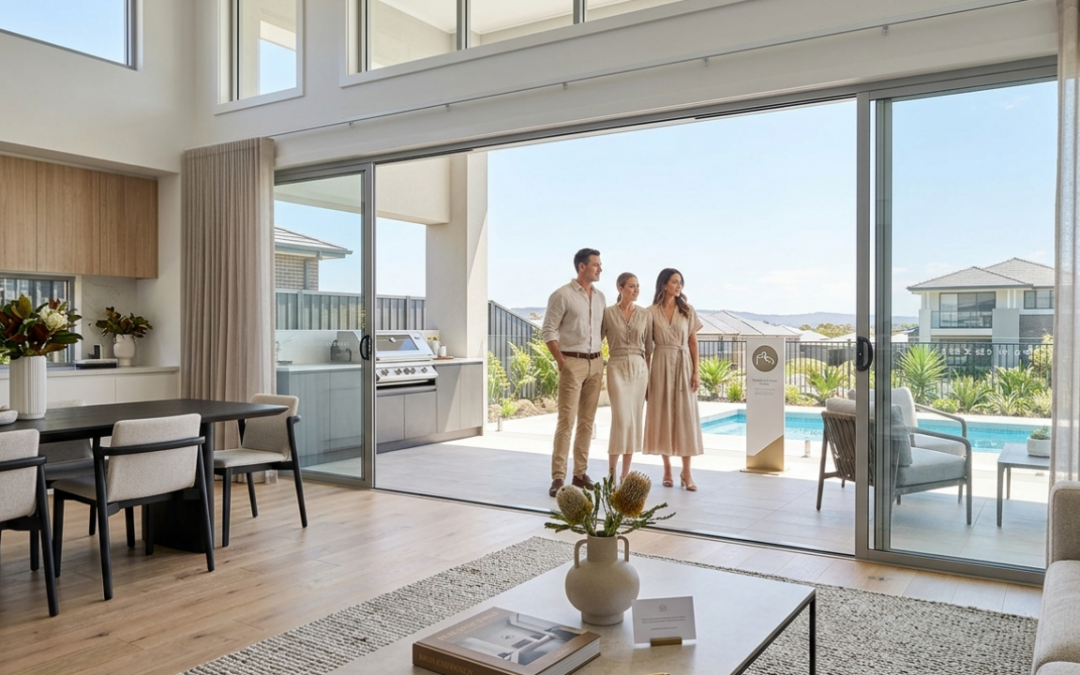
Walk through the entrance of a well-staged display home and within thirty seconds you are picturing yourself living there. The proportions feel right. The light is perfect. The kitchen looks like something from a design magazine. The master suite has a quality that makes your current bedroom feel inadequate by comparison. By the time you reach the outdoor entertaining area, you are already mentally placing your furniture and imagining your first dinner party.
This is not an accident. It is the entire point. Display homes are not built to give you an accurate representation of what a base specification home looks like — they are built to show you the best possible version of what the builder can produce, specifically to create the emotional response that leads to a signed contract.
None of this makes display homes dishonest or the experience of visiting them illegitimate. They are genuinely useful — the layout, the proportions, the flow between spaces, the quality of the workmanship, the way the indoor and outdoor areas connect — all of this is real information about the builder and their product that you cannot get from a website or a brochure.
But if you walk into a display home without understanding what it actually represents and what it does not, you will make decisions based on a misleading picture. You will budget around a price that does not reflect the standard of what you saw. You will be surprised during the selections process when the finishes available at the base price look nothing like the display. And you will feel the specific frustration of a home that does not quite match your expectations — not because anything went wrong, but because the expectations were formed from the wrong reference point.
What a Display Home Actually Is
A display home is a marketing investment, and understanding it as such is the starting point for using it well.
The builder has spent significantly more per square metre on this home than they will spend on any home they build for a client. The finishes are at or near the top of the upgrade range. The materials are the premium options from the selections catalogue. The kitchen is the version you would reach after adding every upgrade in that category. The bathrooms have the best tapware, the most impressive tiles, the highest-end fixtures. The flooring is the option you would see displayed as the aspirational example during the selections process.
The styling on top of all of this — the furniture, the soft furnishings, the artworks, the perfectly arranged accessories — is not part of the build at all. It is a styling investment that the builder or a specialist styling company has made specifically to present the home in the most appealing possible light. The pendant lights you love might stay — they might be an upgrade inclusion. The artwork, the cushions, the furniture, the plants — none of it is coming with the house.
When you strip away the styling and ask what the base specification looks like relative to what you are seeing, you are asking the question that actually matters for your budget and your decision. The display home is showing you the ceiling of what is available. The base price corresponds to something considerably closer to the floor.
The Specific Things Typically Upgraded in Display Homes
Understanding the categories where display homes most consistently show upgraded specifications gives you a map for the conversation you need to have before leaving.
Kitchen benchtop. Stone benchtops — engineered stone or natural stone — are almost universally installed in display kitchens. The base specification for most builders is laminate. The upgrade to stone is one of the most common and most significant selections upgrades, and the display home shows you the upgraded version without flagging it as such.
Flooring. Display homes typically feature engineered timber, large-format tiles, or other premium flooring options in the main living areas. The base specification is often a standard carpet in carpeted areas and a standard-grade tile in tiled areas. The gap between the display floor and the base floor is often more visually significant than buyers expect.
Kitchen cabinetry and joinery. The profile, the finish, the handle style, and the internal fittings of display home joinery are often above the base specification. Two-pack painted finishes, handle-free profiles, and premium internal fittings systems are upgrade items that look standard in a display home because the display home includes them.
Tapware and fittings. The tapware in display bathrooms and kitchens — the finish, the brand, the style — is typically an upgrade range. Base specification tapware is functional but looks noticeably different from what is installed in the display.
Appliances. The oven, cooktop, dishwasher, and rangehood in a display kitchen are often from a premium brand at a premium specification level. Base specification appliances are from more modest brands and specifications, and the difference in appearance and perceived quality is visible.
Tiling. The tile format, brand, and finish in display bathrooms is typically above the base allowance. Large-format tiles with minimal grout lines, premium surfaces, and careful laying patterns are upgrade items that look like standard features in a well-presented display home.
Lighting. The lighting scheme in a display home — pendant lights, feature lighting, strip lighting under joinery — is usually substantially above the base electrical specification. Display homes are lit specifically to look their best, and the lighting that achieves that effect is often an upgrade or a combination of upgrades.
External materials and facade. Display homes are typically built with facade treatments and external materials that are either premium selections or specific options chosen for visual impact. The base facade specification may be simpler.
How to Have the Right Conversation During the Visit
The most important conversation you can have during a display home visit is not “how much does this home cost?” — it is “which of the things I am seeing in this home are standard inclusions and which are upgrades?”
This conversation can feel slightly uncomfortable to initiate because it requires asking the sales consultant to essentially point out the gap between the display and the base offering. But it is the conversation that produces the information you actually need, and any builder worth dealing with will have it honestly.
A useful way to structure this conversation is to walk through each room with the sales consultant and ask specifically about the key selections in that room. In the kitchen: “Is the benchtop material standard or an upgrade? What does the standard benchtop look like? Is the flooring standard? Is the tapware standard?” In the bathroom: “Is the tile size and brand standard? What is the standard tile allowance? Are the fittings standard?” In the living areas: “Is the flooring standard?”
Write down the answers. Not because you will necessarily remember to ask for a written record later, but because the act of writing creates a reference you can actually use when you are comparing the real base cost against the display home standard you responded to emotionally.
Granton Homes is transparent about what is standard and what is an upgrade in their display home. Their sales team will walk you through this conversation honestly because they understand that clients who have realistic expectations from the beginning have a better experience than those who discover the gap during the selections process. Ask for this conversation explicitly rather than waiting for it to be initiated.
What to Pay Attention to That Is Not About Finishes
While understanding the upgrade gap is the most practically important thing to do during a display home visit, there are other things worth paying attention to that are genuinely informative about the builder and their product — and that are not distorted by the upgrade presentation.
Layout and proportions. The actual layout of the floor plan — how rooms relate to each other, how the spaces flow, where the light comes from, how the indoor and outdoor areas connect — is real information. The builder did not upgrade the layout. The proportions of the rooms, the width of corridors, the size of the kitchen relative to the dining area, the relationship between the living area and the outdoor space — these things reflect what you would actually get if you chose this floor plan.
Walk through the display home as a lived experience rather than a visual experience. Stand in the kitchen and think about how you would actually cook in this space. Walk from the master bedroom to the bathroom and think about how that journey feels on a groggy morning. Sit down in the living area and think about whether it would work for how your household actually uses the space. Notice whether the home feels comfortable and functional or whether it creates friction in ways that the styling obscures.
Build quality in the details. Underneath the upgraded finishes, the quality of the construction and workmanship is visible in specific details that do not change with the specification level. The grout lines in the tiling — are they consistent in width, properly filled, cleanly executed? The paint finish where it meets joinery and ceiling lines — is it precise and clean? The operation of cabinetry — do the doors close smoothly and sit flush? The junction between different materials — is it sharp and intentional or rough and approximate?
These details reveal the standard of trade supervision and quality control that the builder applies across their projects. A display home with high-quality finishes but rough execution in the construction details tells you something important. One with elevated finishes and precise construction execution tells you something positive about the builder’s overall quality commitment.
How the team engages with you. The sales consultant’s approach during the visit reveals something about the builder’s client orientation that goes beyond the presentation of the physical space. Are they listening to understand what you actually need, or presenting a script? Do they answer questions specifically or deflect with generalities? Do they make you feel like someone whose specific requirements matter, or like a prospect being moved through a sales process?
The way the team engages during the display home visit is an imperfect but genuine signal of how the client relationship is likely to feel during the design and build process.
The Comparison Problem — Why Multiple Display Homes Can Confuse You
Visiting multiple display homes — which is genuinely useful for comparison — creates a comparison problem if you are not careful about what you are comparing.
If you visit Builder A’s display home and Builder B’s display home and compare your impressions of both, you are comparing the upgraded version of Builder A’s product with the upgraded version of Builder B’s product. Both show you their best. The impression you form of each is based on that best rather than on the base offering that corresponds to the base price.
The meaningful comparison — the one that tells you which builder offers better value at a given price point — requires normalising for the upgrade gap. What does Builder A’s base specification look like, and what does Builder B’s base specification look like? Which builder’s base covers more of what you saw in the display? Which one requires more upgrading to reach the display standard? What does the total cost look like for each builder at an equivalent level of specification?
This comparison requires more work than a display home visit — it requires getting the inclusions lists for each builder and going through them specifically, getting upgrade pricing for the categories that matter most to you, and building a realistic total cost picture for each. But it is the only comparison that produces genuinely useful information for a financial decision.
Using Display Homes for What They Are Actually Good For
Despite everything above about what display homes do not tell you, they are genuinely useful for several specific purposes.
They are the best available way to experience a builder’s construction quality in person. Photographs do not accurately represent the quality of joinery, the precision of tiling, the finish of paintwork, or the feel of a space. Walking through a physical space — looking closely, touching surfaces, noticing details — provides quality information that no digital medium replicates.
They are useful for understanding layout options and spatial preferences. The difference between a floor plan that works for you and one that does not often only becomes clear when you can actually walk through it rather than reading it on paper. Display homes let you experience multiple layouts and develop a clearer sense of what you actually want from a floor plan.
They provide a reference point for conversations about design direction. Having visited a display home and identified specific elements — a kitchen configuration you responded to, a bathroom treatment you found appealing, a spatial relationship between indoor and outdoor areas that felt right — gives you specific language for the design conversations that follow.
And they are an opportunity to interact with the builder’s team and form an impression of how the client relationship is likely to feel. Not a definitive assessment, but a starting point.
Used for these purposes — as a quality assessment tool, a layout exploration experience, a design language reference, and a first impression of the team — display homes are genuinely valuable. Used as a basis for understanding what the base price delivers or for setting expectations about the finished product of a standard specification build, they are misleading.
After the Visit — What to Do With What You Learned
A display home visit produces two categories of useful output: the impressions and preferences you have formed, and the questions the visit has generated.
The impressions and preferences — the layout elements you responded to, the finishes you found most appealing, the spatial qualities you want to achieve — are genuine inputs to the design conversation that follows. Bring them clearly into that conversation rather than trying to describe them from memory.
The questions — specifically, which elements are standard and which are upgrades, what the base specification looks like for each category, what the realistic total cost looks like at the level of specification you actually want — need answers before you make any financial commitment. Do not leave those questions unresolved, because the answers are what allow your budget planning to be realistic rather than aspirational.
For buyers who are seriously evaluating Granton Homes after a display home visit, the follow-up conversation that matters most is the one about the full cost picture — what the realistic total looks like for a project like yours, including site costs, realistic upgrade costs based on your stated preferences, and all the items outside the construction contract. That conversation, and the transparency with which it is handled, tells you far more about whether this builder is right for your project than the impressiveness of any display home.