
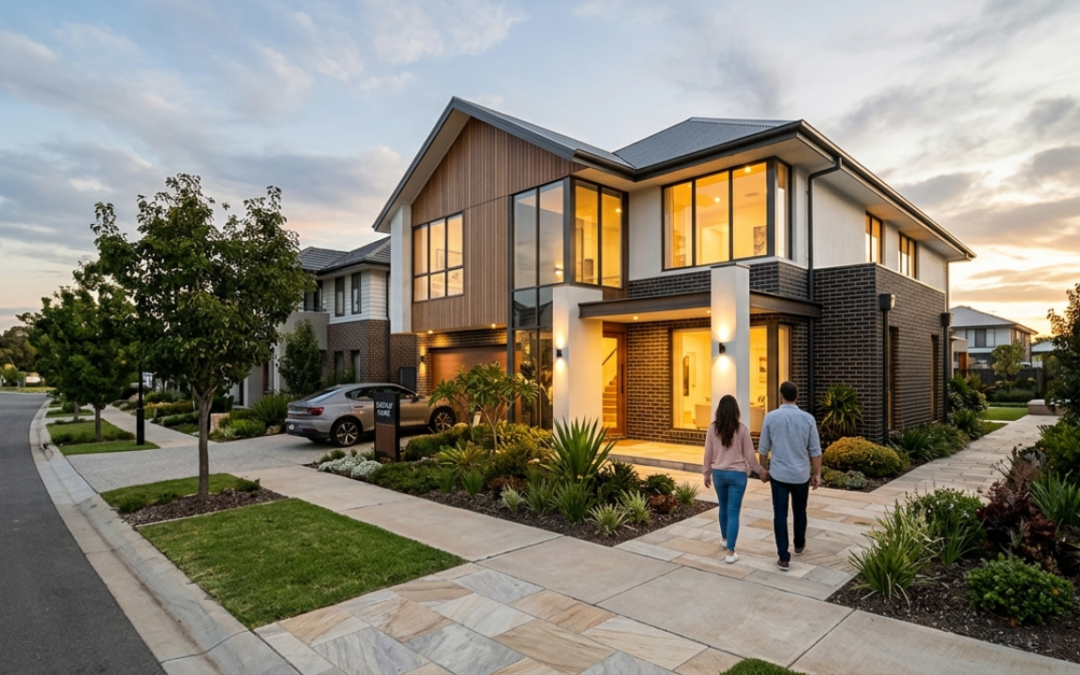
There is a specific moment that happens to almost everyone who is seriously planning a new home. They have been researching online for weeks or months. They have saved hundreds of images. They have watched display home tours, browsed floor plans, compared pricing pages, and read enough builder reviews to have a general sense of who is worth considering. They feel reasonably informed.
And then they actually walk through a display home in person. Within about fifteen minutes, the mental model they had built from their online research starts to shift. Some things that looked impressive on screen feel different in reality — smaller, or more awkward, or less practical than the photographs suggested. Other things that did not stand out online become immediately significant — the way light moves through the space, the feel of the room proportions, the specific quality of the joinery up close.
By the time they leave, they are thinking about their new home differently than they were an hour before. The priorities have moved. The things they thought they wanted have been partly replaced by things they did not know to want until they stood in a room and felt them.
This shift is almost universal among people who visit display homes seriously. And understanding why it happens — and how to use it productively — makes the display home experience considerably more valuable than just a pleasant way to spend a Saturday.
Why Online Research Creates a Misleading Picture
Photography is very good at making spaces look their best. Professional real estate and display home photography involves specific techniques — wide-angle lenses that expand the apparent size of rooms, lighting rigs that eliminate shadows and make spaces feel brighter and more open than they actually are at most times of day, careful staging that removes anything unflattering and adds elements that make the space feel polished.
The result is that photos of rooms consistently make them appear larger, brighter, and more spacious than they feel in person. A bedroom that photographs generously might feel noticeably smaller when you are standing in it. A kitchen that looks expansive in a wide-angle shot might feel cramped when you are trying to cook in it and someone else is trying to move around the island bench simultaneously.
This is not unique to home design. It applies to hotel rooms, restaurant interiors, retail spaces — any designed environment that is professionally photographed. But the stakes are higher in home purchasing and building than in most of these other contexts, because you are making a multi-year, multi-hundred-thousand-dollar commitment based partly on what you see in photographs.
Video tours help somewhat — the movement through a space gives a more realistic sense of its proportions than a still photograph. But even video, shot with the same lighting and staging as professional photography, presents a carefully curated version of the space rather than the experience of actually being in it.
The only way to get the actual experience is to be in the actual space. Everything that precedes this is useful but partial.
What Happens to Your Sense of Layout When You Are Actually Inside
The aspect of display home visits that most consistently surprises people — and most reliably shifts their priorities — is the difference between how a floor plan looks on paper and how it feels to actually move through it.
A floor plan is a two-dimensional representation of a three-dimensional experience. Reading it gives you information about the spatial relationships between rooms — this connects to that, this is adjacent to that, traffic flows through here. But it does not tell you how it feels to make those connections, how the rooms feel when you are inside them, or whether the spatial logic that seemed sensible on paper actually works comfortably in practice.
The corridor that looks generous on the plan might feel narrow when you are walking through it carrying something. The open-plan kitchen and living area that seemed like a unified space on the plan might feel slightly disconnected in reality because of where the island bench sits relative to the seating. The master bedroom that appeared well sized might feel either smaller or larger than expected depending on its actual proportions and where the windows are.
Equally importantly, floor plans do not convey the character of spaces — whether a room feels intimate or spacious, warm or cool, inviting or impersonal. These qualities are determined by a combination of proportions, light, materials, and how the space connects to what is around it, and none of them are readable from a two-dimensional plan.
Walking through a display home gives you access to all of this information. You develop a sense of what proportions work for you, what kinds of connections between spaces feel natural, what room sizes actually feel comfortable for the purposes they serve. This is information that accumulates with each display home visit and becomes increasingly useful for evaluating floor plan options.
Natural Light — The Factor That Photographs Cannot Show
Of all the differences between experiencing a home online and experiencing it in person, natural light is the most significant and the most consistently underestimated.
Professional home photography either takes place in controlled lighting conditions that eliminate the variations of natural light, or it is timed to capture the space in its best natural light conditions. What it rarely shows is how the space feels at other times — in the afternoon when the sun is no longer hitting the living area, in the morning before the day has fully brightened, on overcast days when the sky is flat.
Visiting a display home at different times of day — or at least thinking specifically about what the light conditions would be at the times when you would actually be using each space — gives you much more realistic information than photographs can provide.
Some design decisions that seem neutral on paper have very significant light implications. A living area on the south side of the home is in shadow for much of the day in Australian latitudes, regardless of window size. A master bedroom facing west is bright and warm in the afternoon but direct afternoon sun in summer can make it uncomfortably hot. A kitchen on the north side receives good light throughout the day — pleasant to cook in, practical to see what you are doing.
Walking through a display home, you notice these things experientially rather than analytically. The hallway that feels dim. The bedroom that feels bright and pleasant. The kitchen that is well lit from the side rather than from above, which makes the work surface properly illuminated. These observations inform the floor plan evaluation in ways that studying the orientation diagram on a plan cannot.
When you visit the Granton Homes display home at Kellyville, pay specific attention to where the light is coming from in each room and how it affects the feel of the space. This is one of the most reliable quality indicators available and one of the most informative things you can observe during a display home visit.
The Shift in Priorities That Display Homes Reliably Produce
The change in priorities that almost everyone experiences after visiting display homes seriously follows a consistent pattern.
Before visiting, priorities are typically heavily weighted toward aesthetics — the visual impressiveness of the design, the quality of the finishes, the style of the kitchen and bathrooms. This is natural. Aesthetics are what photographs convey and they are what most of the available content about home design focuses on. The design language most people develop through online research is primarily a visual one.
After visiting several display homes seriously — walking through each one with attention to how it feels rather than just how it looks — most people find that their priorities have rebalanced. The finishes still matter, but they matter somewhat less. The layout, the light, the flow between spaces, the functionality of the kitchen, the acoustic arrangement of the bedroom zone — these things matter more, because experiencing them directly has made their significance concrete rather than theoretical.
Storage is one of the specific things that gets dramatically revalued through display home visits. It is difficult to feel enthusiastic about storage when you are looking at plans and inspiration photos. After walking through a home and noticing the specific frustration of inadequate storage — the bench that has nowhere to put things, the wardrobe that is too shallow for proper coat hangers, the kitchen that has no obvious place for all the appliances that need to live somewhere — the importance of getting storage right becomes viscerally clear in a way that no amount of written advice produces.
The practical details of daily life become more vivid. How wide the corridors are relative to what it feels like to walk through them carrying something. Whether there is a sensible place to put things down when you come in through the door. How the kitchen is oriented relative to the living areas and whether the connection feels natural. Where noise would come from and whether the bedroom zone would be genuinely quiet.
These are the things that determine how much you enjoy your daily life in the home, and they are the things that display home visits make real.
Display Homes as a Budget Calibration Tool
One of the most practically useful things a display home visit does is help calibrate the relationship between budget and outcomes.
Online, the gap between what a standard specification home looks like and what an upgraded display home looks like is often not apparent, because the photographs show the display home without clearly flagging which elements are standard and which are upgrades. The impression formed is that the photographed home — beautifully finished, thoughtfully detailed — is roughly representative of the product.
In person, the quality differences between different specification levels are often clearly apparent once you know to look for them. The large format tiles in the bathroom are an upgrade. The engineered timber flooring is an upgrade. The stone benchtop is an upgrade. The particular tapware brand is an upgrade. Standing in the display home, you can start to develop a sense of which of these upgrades produces a visible and meaningful difference to the experience of the space and which ones are less impactful than they might appear in a photograph.
This calibration is genuinely useful for budget decisions. It gives you a basis for distinguishing between the upgrades that are worth the additional cost for your household — those that would affect how you experience the space every day — and those that are more impressive in photographs than in daily lived reality.
The conversations that are most productive during a display home visit are the ones where you ask the sales consultant to specifically identify which elements in each room are standard inclusions and which are upgrades, and what the upgrade costs are for the categories that are most important to you. This information allows the display home visit to produce useful budget understanding rather than just aesthetic impressions.
What to Actually Do During a Display Home Visit
Most people walk through display homes the way they walk through a gallery — looking at what is there, forming impressions, and moving on. This produces the general shift in perspective described above, but it leaves a lot of useful information on the table.
A more productive approach treats the display home visit as an information-gathering exercise with a specific agenda.
Walk through the layout as a lived experience. Stand in the kitchen and think about how you would actually cook in this space. Is the workspace adequate? Is the sight line to the living area or outdoor space natural? Is the pantry position sensible relative to where food preparation happens? Walk from the master bedroom to the bathroom and think about how that feels at six in the morning. Walk from the front door to where you would put groceries down and think about whether the route is direct and comfortable.
Assess the build quality in specific detail. Look at the grout lines in the tiling — are they consistent and properly filled? Look at the paint finish where it meets joinery and ceiling lines — is it clean and precise? Open and close cabinet doors and drawers — do they operate smoothly and sit flush? Look at the transitions between different materials — are they sharp and intentional? These details reveal the quality of workmanship that the builder’s trades deliver and their site supervision accepts.
Ask specifically about inclusions and upgrades. Which elements in each room are standard inclusions? Which are upgrades? What does the standard specification look like for the key categories — benchtop, flooring, tapware, tiles, appliances? Get as specific as possible, because this is the information that allows a meaningful comparison between what you are seeing and what the base price actually delivers.
Notice the light and think about it at different times of day. Where is the natural light coming from in each room? How would this space feel at eight in the morning? At five in the afternoon? On an overcast winter day? Would the bedroom get morning light? Would the living area be pleasant in the evening?
Take notes. Not just photos — notes about specific observations, specific questions that were answered, specific things that need more investigation. The display home visit produces a lot of information and it is difficult to retain it reliably without writing down the specific things that mattered.
Comparing Display Homes Meaningfully
If you are visiting multiple display homes — which is genuinely worthwhile — the comparison becomes more useful the more specific and consistent your evaluation approach is.
Comparing based on overall impression produces a result that is heavily influenced by staging, styling, and the quality of the presentation rather than the underlying merit of the design and construction. Comparing based on specific quality indicators — the workmanship details, the light quality, the practicality of the layout, the gap between display and base specification — produces a comparison that reflects what actually matters.
Granton Homes‘ display home reflects their commitment to quality and design in ways that are visible when you look at the right things. The joinery detail, the precision of the tile work, the spatial quality of the rooms, the way the indoor and outdoor areas connect — these are not staging, they are the genuine expression of the builder’s standards. Looking at them specifically, and comparing them specifically to what you observe in other builders’ display homes, gives you real information about the quality difference rather than just an aesthetic preference.
After the Visit — What to Do With What You Have Learned
The display home visit is valuable for what it changes about your perspective and for the specific information it produces. Both of these are most useful when they are actively used rather than just retained as vague impressions.
The shift in your priorities — toward practicality, light, layout functionality, and genuine livability — should be reflected in how you evaluate floor plans going forward. Not “does this look impressive?” but “does this work for how my household actually lives?” The display home visit has made you better equipped to answer that question.
The specific information about inclusions, upgrades, and quality indicators should inform your budget planning and your builder comparison. You now know more specifically what the base specification looks like, what the upgrade costs are for the things that matter to you, and what quality looks like in practice rather than in photographs.
And the specific questions the visit raised — about things you noticed that you want to understand better, about aspects of the design you want to explore further with the builder, about how a particular feature or specification choice would work in your specific situation — are the starting point for the next conversation rather than things to file away.
The display home visit, used properly, is one of the most useful things you can do during the home planning process. Not a comfortable Saturday excursion, but a productive information-gathering exercise that changes how you think about the decision you are making and gives you specific, useful knowledge that online research simply cannot provide.