
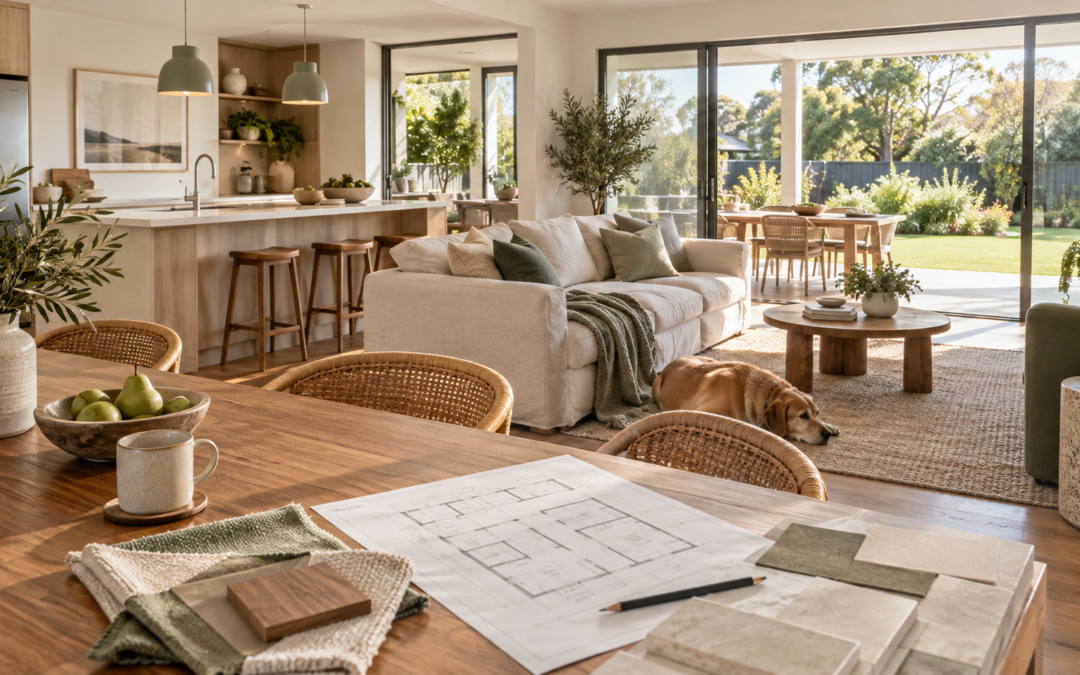
A floor plan can look perfect. Every room has its place, the furniture seems to fit, the kitchen opens nicely into the living area, and the bedrooms are laid out sensibly. On paper, it all makes sense.
But does a home really need to be perfect on paper? Real life is rarely that tidy. People leave things in the wrong place, furniture gets moved around, routines change, guests turn up without warning, and kids grow up. A home has to cope with all of that. So maybe the goal isn’t a perfect floor plan. Maybe it’s a home with enough flexibility to handle everyday life, mess included.
Real Homes Are Never Completely Tidy
Display homes look great. Every cushion is in place, the dining table is set, and the kitchen benches are clear.
Then you move into your own home. There are shoes by the door, mail piling up on the bench, a cup left in the living room, and a bag sitting on a chair. That’s completely normal. A home shouldn’t only look good when everything is arranged just right. It should feel comfortable while people are actually living in it.
Leave Some Breathing Room
One idea that gets overlooked in home design is not filling up every bit of space. A little empty space is useful. It gives you room to move furniture, lets people walk around easily, and makes it simpler to rearrange a room later. It can even make a small room feel less crowded.
Many homeowners try to squeeze out as much usable space as they can and forget that some space is there just to let the room breathe.
What Happens When Your Routine Changes?
Think about your home five years after moving in. Maybe you work from home more now. Maybe your kids are older, or you’ve picked up a new hobby, or you have people over more often.
The house is the same, but your life isn’t. This is where flexible design really helps. A room that can change its purpose stays useful even when your original plans no longer fit.
The Furniture Will Tell You the Truth
An empty room can look huge. Then the furniture arrives and everything changes. The sofa creates a walkway, the dining table needs space around it, beds take up floor area, cabinets use up wall space, and chairs need room to be pulled out.
That’s why it helps to picture your home with real furniture in it. The question isn’t just “Will everything fit?” It’s “Will it still feel comfortable once everything is in there?”
Where Granton Homes Comes Into the Conversation
Granton Homes offers established home designs as well as custom design options, so homeowners have more than one way to plan their new home. That takes some of the pressure off searching for a “perfect” house. You can focus on finding a design that suits the people who’ll actually live in it.
For one family, that might mean a big shared living area. For another, private spaces might matter more. Someone working from home will want flexibility, and a family that loves hosting may care most about how the indoor and outdoor areas connect. There’s no single definition of a perfect home.
Don’t Forget the Awkward Moments
Good planning looks beyond the normal days. Think about the awkward moments too.
What happens when five people walk in at once? Where do wet umbrellas go? What if someone is cooking and another person needs to get past? Where can a guest sit if the main living area is busy? Where do you go when you just need some quiet?
You won’t see these situations in a glossy house photo, but they’re part of daily life.
A Little Imperfection Can Be Useful
Not every space needs one fixed purpose. An empty corner can become a reading spot. A spare room can turn into an office. A slightly wider hallway can hold extra storage. An outdoor area can be used differently depending on the season or the occasion.
Being able to use a space in different ways is a real advantage. A home doesn’t always have to tell you exactly how to use it. Sometimes it’s better when it just gives you options.
Ask Yourself a More Honest Question
Instead of asking “Is this the perfect home?”, try asking “Can I picture myself living here on an ordinary Tuesday?”
That’s a much tougher test. Picture the laundry piling up, the school run, working from home, and cooking dinner. Picture someone watching TV while another person needs quiet, and friends dropping by with almost no notice.
If the home still feels workable in all of those moments, the design is doing its job.
The Most Valuable Feature May Be Flexibility
When people plan a new home, they often go looking for impressive features. But flexibility is one of the most useful things a home can have. That might be a room that can serve different purposes, furniture that can be arranged in more than one way, practical storage, or spaces that connect without feeling crowded.
These things don’t make the biggest visual impact, but they help a home stay useful as life changes.
What Would You Change About Your Current Home?
Here’s something worth thinking about. Don’t think about what you love in your current home. Think about what you’re always working around.
Maybe the entrance is too narrow, or the kitchen feels cut off from everything else. Maybe there’s nowhere to sit quietly, or one room has turned into a dumping ground because it never had a clear purpose. Maybe you simply have more space than you use.
These little frustrations are very helpful when planning your next home. Your current house is already giving you a real-life list of what works and what doesn’t.
Final Thought
A home doesn’t have to be perfect to be a good one. In fact, trying to get every detail perfect can sometimes make a home harder to adapt. Life is unpredictable. People change, routines change, and so do furniture and priorities. A good home should be able to change along with them.
Granton Homes‘ range of established and custom designs gives homeowners different ways to think about what they actually need, instead of assuming one layout suits everyone.
So maybe the better question isn’t “Does this house look perfect on paper?” It’s “Will this house still work when real life gets messy?