
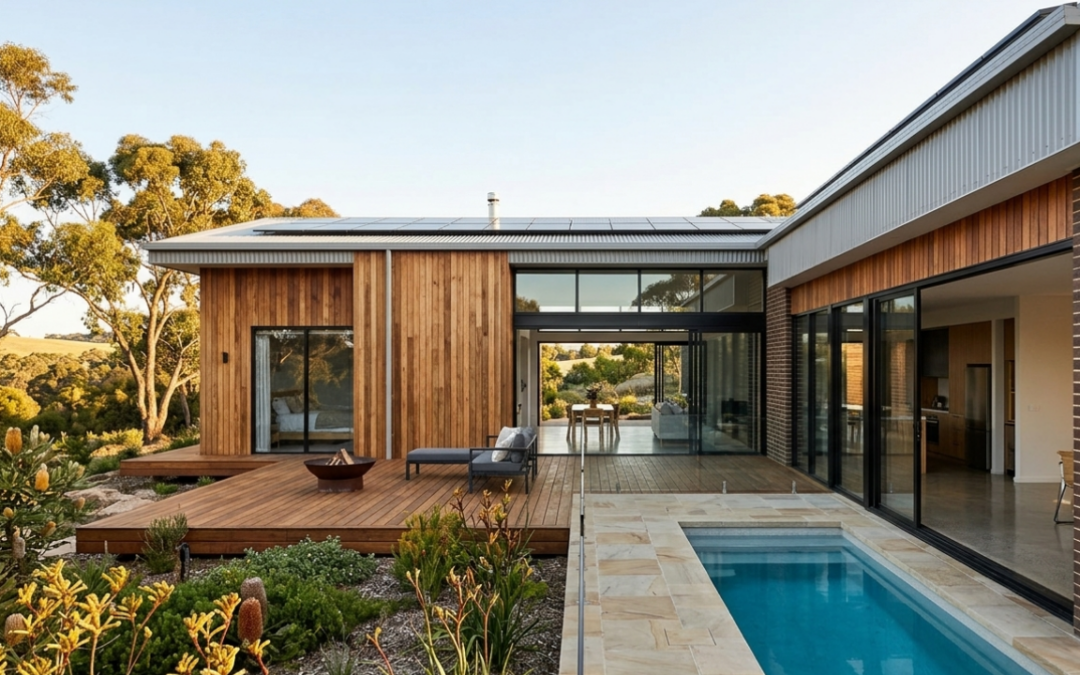
Nobody tells you how much the materials question matters until you are already in the middle of building.
You spend weeks thinking about floor plans and facade styles and kitchen layouts, and then someone sits you down and starts asking about framing systems and glazing specifications and insulation R-values — and suddenly you realise there is an entire layer of decisions underneath the design decisions that you had not really prepared for.
The thing is, the materials that go into your home matter enormously. Not just for how the home looks, but for how it performs — how comfortable it is to live in, how much it costs to maintain, how well it holds up over the decades, and how much your energy bills are every quarter.
Australia’s climate makes this particularly important. Depending on where you are building, you might be dealing with intense summer heat, cold winters, coastal salt air, high humidity, bushfire risk, or some combination of all of the above. The materials that work well in one context are not always the right choice in another.
What follows is an honest guide to the materials that go into modern Australian homes — what each one actually does, why it matters, and what to think about when making decisions. Whether you are building with Granton Homes or working with another builder, this is the kind of knowledge that helps you have better conversations and make choices you will not regret.
Concrete — The Foundation Everything Else Depends On
Concrete does not get talked about much in the exciting parts of the design conversation, but it is the material that everything else ultimately rests on — sometimes literally.
In Australian residential construction, concrete is used primarily for foundations and slabs. The slab your home sits on is one of the most important structural elements of the build, and the specification of that slab — its thickness, the steel reinforcement within it, the design of its edge beams — is determined by the soil conditions of your specific site.
Reactive or unstable soils require more engineered slab designs that cost more but are essential for preventing movement and cracking over time. Clay soils that swell and shrink with moisture changes are a particular consideration in many parts of Australia. Getting the slab specification right for your site is not optional — it is fundamental.
Beyond the foundation, concrete has genuine thermal mass properties that are worth understanding. A concrete slab absorbs heat during the day and releases it slowly at night, which can help moderate indoor temperatures in well-designed homes. Combined with good insulation and orientation, this thermal mass effect contributes meaningfully to comfort — particularly in climates with significant day-night temperature variation.
Granton Homes conducts thorough site assessments to determine the appropriate foundation design for each specific block. This is not a one-size-fits-all decision, and a builder who treats it as one is cutting corners in a place where cutting corners matters.
Brick — Why It Has Survived Every Design Trend
Brick has been the dominant external cladding material in Australian residential construction for generations, and the reason is not nostalgia. It is performance.
A full brick or brick veneer wall provides excellent thermal mass, helping to moderate indoor temperature fluctuations throughout the day. It is genuinely fire-resistant, which matters in a country where bushfire is a real consideration for a significant portion of the population. It requires almost no maintenance — no painting, no sealing, no periodic replacement. And it simply lasts. A well-built brick home from fifty years ago is still performing today and will continue to perform for another fifty years with minimal intervention.
The aesthetic arguments for brick have also evolved. Early Australian brick was fairly limited in colour and texture, but modern brick ranges are extensive — different sizes, colours, textures, and laying patterns that can produce everything from a traditional Federation look to something distinctly contemporary. The material is far more versatile than its reputation suggests.
For buyers building in bushfire-prone areas, brick construction also has practical implications for the Bushfire Attack Level rating of the home and the corresponding construction requirements. Your builder will navigate this, but understanding that material choices affect BAL compliance is worth knowing.
Timber — Where It Works and Where It Does Not
Timber is a material that inspires strong feelings. People love the warmth and naturalness of it, and it has genuine advantages in the right applications. But it also has limitations that are worth being clear-eyed about.
As a structural framing material, timber is still widely used in Australian residential construction. It is lighter than steel, easier to work with on site, and well understood by the trades. In most standard residential builds, timber framing performs perfectly well. The key considerations are appropriate treatment for termite resistance and moisture — both of which are well managed by any competent builder working with quality materials.
Where timber really shines in a modern home is in interior applications. Timber flooring — whether solid hardwood, engineered timber, or quality timber-look alternatives — adds genuine warmth to a space in a way that no other flooring material quite replicates. Feature timber elements on walls, ceilings, or staircases contribute character that manufactured materials struggle to achieve.
Sustainably sourced timber is worth specifying if environmental considerations are important to you. Look for certification from recognised bodies like the Forest Stewardship Council. Granton Homes works with suppliers who can provide responsibly sourced timber options for buyers who want to make that consideration part of their build.
The limitation of timber in external applications is that it requires ongoing maintenance. Painted or oiled external timber cladding needs periodic attention — repainting or re-oiling on a cycle that depends on exposure and climate. In high-exposure coastal locations, that maintenance cycle can be demanding. Understanding the ongoing commitment before choosing a material is always better than discovering it after handover.
Steel — The Material That Has Changed What Is Possible
Steel framing has become increasingly common in Australian residential construction, and for good reasons that go beyond the obvious structural ones.
Termite resistance is a significant practical advantage in many parts of Australia where subterranean termites are a genuine threat to timber structures. A steel frame simply cannot be eaten. Combined with appropriate chemical barriers and good construction practices, steel framing largely eliminates the termite risk that timber framing manages rather than eliminates.
Steel frames are also dimensionally stable — they do not shrink, swell, or warp with changes in moisture content the way timber does. This means doors and windows that are correctly hung during construction remain correctly hung over time, rather than binding or developing gaps as the frame moves.
In larger or more architecturally ambitious homes, steel allows structural spans that are simply not achievable with timber — longer clear spans in living areas without the need for intermediate columns or walls. This opens up design possibilities that the material is increasingly used to realise.
The thermal properties of steel are worth understanding. Steel conducts heat more readily than timber, which means steel frames require thermal breaks — materials that interrupt the conductive path between inside and outside — to prevent cold bridging in cooler climates. This is standard practice in well-designed builds, but worth confirming with your builder.
Glass — Making It Work Rather Than Just Making It Big
The relationship between glass and energy efficiency in Australian homes is more nuanced than most people realise.
More glass is not automatically better. A large poorly-specified window on the wrong side of the house can create serious thermal problems — excessive heat gain in summer on a west-facing wall, significant heat loss in winter on a south-facing elevation. The enthusiasm for glass in modern home design needs to be tempered by an understanding of how glass actually performs thermally.
Double glazing — two panes with a gas-filled gap between them — significantly reduces heat transfer compared to single glazing. In climates with cold winters, the difference in thermal performance is dramatic. In warmer climates, double glazing still makes sense on east and west-facing elevations where unwanted heat gain is the concern. The additional cost of double glazing during construction is recovered in reduced heating and cooling costs over time.
Low-emissivity coatings on glass — Low-E glass — further reduce heat transfer without meaningfully affecting visible light transmission. Combined with double glazing, Low-E glass is genuinely worth specifying, particularly for windows with significant solar exposure.
The position and size of windows is as important as their specification. A large north-facing window with an appropriate roof overhang captures useful winter sun while being shaded from high summer sun. The same window facing west without any shading is a heat gain problem for every afternoon of every summer. Granton Homes thinks about window placement as part of the overall design rather than as a purely aesthetic decision.
Engineered Stone — The Kitchen and Bathroom Material That Earns Its Price
Walk through ten display homes and you will see engineered stone benchtops in almost all of them — and there are good reasons why it has become the dominant material for kitchen and bathroom surfaces in Australian new builds.
Engineered stone is made from quartz and resin, which gives it a surface that is harder and more consistent than natural stone. It does not require sealing. It resists staining better than most natural stone options. It can be produced in a wide range of colours and patterns. And it holds up to the kind of daily use that kitchen benchtops receive without showing the wear that softer materials would.
One development worth knowing about is the ongoing regulatory change around crystalline silica in engineered stone — a serious health issue for the tradespeople who cut and fabricate it, which has led to significant industry attention and some products being restricted. The fabrication industry is adapting, and the products available are evolving. Your builder will be working with compliant suppliers, but it is worth being aware of as context.
For the surfaces themselves, engineered stone remains an excellent choice for durability, hygiene, and appearance. The price premium over laminate alternatives is real but generally justified by the performance and longevity.
Insulation — The Most Important Material Nobody Thinks About
Ask most people to list the materials that matter in a new home and insulation probably does not come up for a while, if at all. It is invisible once the walls and ceilings are finished. It does not appear in the aesthetic of the home. Nobody compliments your insulation when they visit.
But insulation has a more direct impact on your daily experience of the home — and your ongoing energy costs — than almost any other material choice.
Good insulation slows the transfer of heat between inside and outside. In winter, it keeps the warmth you generate inside the home rather than letting it escape through the walls and ceiling. In summer, it slows the rate at which outdoor heat works its way into the living spaces. The better the insulation, the less work your heating and cooling systems have to do, and the lower your bills.
The R-value is the measure of insulation performance. Higher is better. Australian building code sets minimum R-values that vary by climate zone and building element, but the minimums are exactly that — minimums. Going above the code minimum in the ceiling particularly, and in the walls where possible, makes a meaningful ongoing difference.
The decision about insulation is much easier and cheaper to make during construction than afterwards. Retrofitting insulation into a finished home is disruptive and expensive. Specifying a higher R-value during the build is a modest cost increase with clear long-term benefit.
Granton Homes builds to standards that take insulation performance seriously — not just meeting code minimums but considering what actually performs well for the specific climate zone of the build. Ask specifically about the insulation specification during the design and selection conversations.
Tiles — Practical and Underrated
Tiles are one of those materials that people tend to think of as primarily aesthetic — you choose them based on how they look — but their practical advantages in the Australian context are significant.
In wet areas — bathrooms, laundries, outdoor entertaining spaces — tiles are simply the most practical surface. Properly installed with appropriate waterproofing behind them, they are waterproof, easy to clean, and essentially permanent. Unlike carpet or timber flooring, they are not damaged by moisture. Unlike painted surfaces, they do not need periodic refinishing.
In living areas, large format tiles — the 600mm by 600mm and 900mm by 900mm formats that have become popular in modern Australian homes — provide a clean, open feel and are genuinely easy to maintain. They also have thermal mass properties similar to concrete, which can contribute to temperature regulation in well-designed homes.
Grout selection and quality matters more than most people realise. Poorly installed or low-quality grout is the most common source of tile maintenance issues. Specifying epoxy grout in wet areas and ensuring the installation is done by experienced tilers is worth the attention.
Sustainable Materials — Worth the Conversation
Sustainability in building materials covers a wide range of considerations — embodied carbon, responsible sourcing, recyclability, impact on indoor air quality, and durability over the life of the building.
The most sustainable material choice is often not the one marketed as eco-friendly, but the one that lasts longest and requires least maintenance over the life of the building. A material that needs replacing every fifteen years has a much higher lifetime environmental impact than one that lasts fifty years, regardless of what it is made from.
That said, there are genuine sustainability considerations worth raising with your builder. Responsibly sourced timber. Insulation products with low embodied energy. Recycled content in concrete. Low-VOC paints and adhesives that improve indoor air quality. These choices do not necessarily cost significantly more and collectively make a meaningful difference.
Granton Homes is open to these conversations with buyers who have sustainability priorities. If this matters to you, make it part of the brief from the beginning rather than raising it as an afterthought once selections are already being made.
The Way to Think About All of This
Materials decisions are not made in isolation. Every material choice involves trade-offs between upfront cost, long-term performance, maintenance requirements, aesthetic preferences, and specific site conditions.
The goal is not to use the most expensive materials across the board, or to follow whatever is trending in design media this year. The goal is to make choices that will serve you well for the entire time you live in the home — choices that perform in the Australian climate, that suit the specific conditions of your site, and that reflect your priorities and budget.
Granton Homes brings experience to these conversations — understanding how different materials perform in different contexts, what represents genuine value versus what sounds good on paper, and how to balance the competing considerations that every material decision involves.
When you are going through the design and selection process, push beyond the aesthetics and ask about performance. How does this material behave in summer heat? What maintenance will it require in ten years? How does it contribute to the thermal performance of the home overall?
Those are the questions that lead to material choices you will still be satisfied with long after you have moved in.