
I still remember the first time someone asked me what it actually feels like to build a custom home in Australia. My honest answer was confusing at first, then one of the best decisions I ever made.
See, most people think building a home is just about picking a design, handing over some money, and waiting for the keys. That is not how it works. Especially not with a custom build. There are more moving pieces than you would expect, more decisions than you thought you would have to make, and more waiting than anyone really prepares you for.
But here is the thing once you understand the process, it stops feeling overwhelming. It actually starts feeling exciting. So let me walk you through it. Not the polished version you read in brochures. The real version.
Why Custom and Not Just a Project Home?
Project homes are cheaper upfront, faster to build, and perfectly fine for a lot of people. If you want something simple and you are not too fussed about having a say in every detail — a project home does the job.
Custom is a different story. You are not picking from a catalogue. You are starting with a blank page and building something around how you actually live.
Maybe you work from home three days a week and you need a proper office — not a corner in the spare bedroom. Maybe your parents are moving in and you want a separate wing with its own bathroom. Maybe you have a big block with a brilliant north-facing view that every standard floor plan would completely waste.
That is what custom building solves. It fits the home to your life, not the other way around. Companies like Granton Homes have built their entire reputation on exactly this. They are not interested in volume. They want to build homes that genuinely reflect the people living in them — and they take the time to make that happen.
The First Conversation
Nobody tells you how casual this first meeting actually is. You are not signing anything. Nobody is putting pressure on you. You are just talking about what you want, what you have been thinking about, what your day-to-day life looks like.
Do you entertain a lot? Do your kids need their own space, or do they practically live outside? Are you someone who cooks seriously, or is the kitchen mostly just a place where coffee happens in the morning?
These are the kinds of things that shape a home. A good builder asks these questions because the answers end up in the design. A not-so-good builder skips this part and gives you something generic.
Bring whatever you have photos saved on your phone, things you have noticed in other homes, even just vague ideas. Nothing is too rough at this stage. The whole point is to give the designer something real to work with.
Money Might as Well Get Into It
Building a custom home in Australia is not cheap. I am not going to pretend otherwise.
The cost depends on a hundred different things — where you are building, the size of the home, what the land is like, how complex the design is, and what level of finish you are going for. But you need to have a real number in your head before things go too far, because that number shapes every decision that follows.
One thing that catches people out is the gap between construction cost and total cost. Construction is the biggest chunk, but it is not everything. You have got design fees, engineering reports, the cost of getting approvals, connection fees for utilities, landscaping, and the stuff you want to do after handover. Add it all up before you start feeling comfortable about your budget.
And build in a buffer. Things come up. They always do. Not because anyone is doing anything wrong — sites throw surprises, materials prices shift, you change your mind about something halfway through. Ten to fifteen percent on top of your construction cost is not excessive. It is just honest.
If you are borrowing to build, talk to your bank or broker early. Construction loans work differently from standard mortgages — the money comes out in stages as the build progresses, not all at once at the start. Understanding how that works before you are in the middle of it saves a lot of stress.
The Land
If you already own a block, your builder is going to spend some time really looking at it before the design starts.
Slope. Soil type. Which way it faces. Where the neighbours are. What the council rules say about what can be built there. Whether there are any bushfire or flood considerations. How a construction crew is actually going to get equipment in and out.
All of this matters, and some of it can change what is possible or what it costs to build on that particular site.
If you have not bought land yet, seriously consider getting your builder to look at any block you are considering before you sign the contract. Real estate listings do not tell you about soil conditions. They do not mention the steep drop at the back that is going to require a retaining wall. An experienced builder will see things you would not even think to look for.
Difficult sites are not automatically a dealbreaker. Some of the most beautiful homes are built on awkward blocks — they just require builders who know how to work with challenging terrain. But you want to know what you are dealing with before you commit.
Designing the Actual Home
Okay, this part is genuinely fun.
You sit down with the design team and you start building the home on paper. The first floor plan that comes back is usually not perfect — it is a starting point. You look at it, you say what you like and what does not work, and they go away and revise it.
Sometimes you go through this three or four times before you land on something that feels right. That is normal. Do not feel like you are being difficult by asking for changes at this stage. This is exactly the time to be particular.
While the floor plan is being worked out, you are also making decisions about the exterior — the style of the home, what materials will be used on the facade, the roofline. And eventually you get into selections for the inside — cabinetry, tiles, flooring, tapware, light fittings. There are a lot of decisions in here.
My advice? Do not rush this part. Every hour you spend getting the design right saves you money and headaches later. Changes on paper cost nothing. Changes once construction has started cost a lot.
Getting the Approvals
This is the part of the process that nobody loves talking about, but it matters.
In Australia, you need formal approval before you can start building. There are two main ways to get it.
The quicker option is a Complying Development Certificate — a CDC. This goes through a private certifier rather than council. If your design ticks all the right boxes under state planning rules, a CDC can come through in a few weeks.
If your project is more complex, or if it does not quite fit within the standard codes, you will need a Development Application through council — a DA. Council takes longer. They might ask for additional information. They might want changes. The timeline is less predictable and can stretch out considerably.
Your builder handles most of this. They know what documentation is needed, what the certifier or council is looking for, and how to respond if there are questions. But you need to be prepared for this stage to take time, because it often does.
Do not let anyone start work on your site before approvals are in place. It is not worth the risk.
Signing the Contract
When the design is finalised and approvals are sorted, you move to the contract.
Read it. All of it. Yes, it is long. Read it anyway.
The contract is the document that protects you if anything goes wrong. It spells out exactly what is included in the build, what the full cost is, when payments are due, what happens if you want to change something, and what the process is if there is a dispute. If something in there does not make sense, ask your builder to explain it before you sign.
For anything other than a small build, getting a solicitor to look over the contract is money well spent. Not because you expect problems — just because having someone in your corner who knows what they are reading is reassuring.
The other thing to pay close attention to is how variations are handled. A variation is any change you make to the agreed scope after the contract is signed. They cost money, and sometimes more than you would expect. The tighter your design is before you sign, the less likely you are to be hit with variation costs mid-build.
The Build
The actual construction moves through stages, and your payments are usually tied to each one.
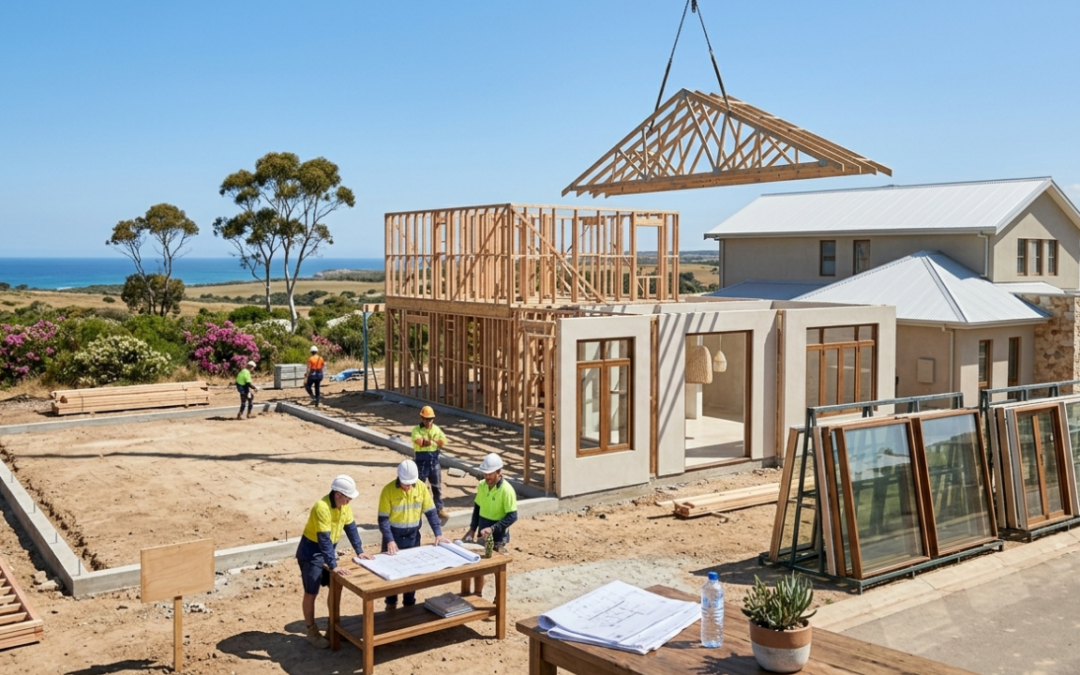
It starts with the base — clearing the site, setting up the foundations, laying the concrete slab or subfloor. Then the frame goes up. Watching the frame appear is one of those moments where it suddenly starts to feel real. You can walk through the outline of your home for the first time.
After the frame is lock-up — the roof, the external doors and windows, the building wrapped up and weathertight. Then internal work begins. Plumbing and electrical happen within the walls before they are closed. Then plastering, tiling, cabinetry, painting, and all the fit-off that gradually turns the shell into something that looks like a home.
Custom builds take longer than project homes. That is just the reality. The finishes are more involved, the tradespeople are doing detailed work rather than repeating a standard sequence, and there is simply more to get right. Most people accept that trade-off without much complaint once they see the end result.
Go to the site when you can. Not to be difficult — just to stay connected to what is happening. If something looks wrong, it is always better to raise it while it is still easy to fix.
Handover Day
When the builder calls to say the home is ready, you do a walkthrough together. This is your chance to go through the whole house carefully before you accept it. Check every room. Open and close every door and window. Look at the paint, the tiles, the joinery. Turn on the taps. Switch on the lights. If something is not right, put it on the list.
Your builder is obligated to fix anything on that list before you take possession, or in some cases shortly after. Do not feel awkward about raising issues this is exactly what the inspection is for.
Once everything is sorted and you are satisfied, you make the final payment and get your keys. Keep all your paperwork. The contract, the plans, the occupancy certificate, anything related to warranties. You will want it if issues come up down the track, and you will definitely want it if you ever sell.
Things Nobody Told Me Before I Started
Be decisive during the design phase. Every decision you leave vague at the start becomes a decision you make under pressure later and usually at extra cost.
Build a good relationship with your site supervisor. They are the person on the ground day to day. If you trust them and communicate well, the whole experience is smoother.
Do not obsess over the timeline. Custom builds take as long as they take. Pushing for a faster finish sometimes creates problems. Better to do it right.
And when you are choosing your builder check their licence, look at their past work, and talk to previous clients if you can arrange it. The relationship you are about to enter lasts the better part of two years. It needs to be built on trust.
At the End of It All
When you are finally living in the home when you have made dinner in the kitchen that was designed around the way you cook, and you are sitting in the living room that faces exactly the direction you wanted, and the storage is where you need it and the light comes in the way you imagined all of it makes sense.
The process is long. There are frustrating moments. There are weeks where nothing seems to be happening and weeks where everything happens at once.
But you end up with something that is genuinely yours. Not a version of someone else’s idea of what a home should look like. Yours.
That is what custom building gives you. And honestly, for most people who go through it — it is worth every bit of the effort.