
Some will say eight months. Some will say eighteen. Some will give you a number and immediately follow it with “but that was longer than we expected” or “we got lucky with the approvals.” Almost nobody will give you a clean, simple answer — and that is because a clean, simple answer does not really exist.
What does exist is a clear picture of what happens at each stage, how long each stage typically takes, and what causes things to move faster or slower. Once you understand that picture, you can set realistic expectations, plan your life around the build more sensibly, and avoid the frustration that comes from expecting things to happen faster than they actually can.
So here is the honest walkthrough. Whether you are building with Granton Homes or still in the early stages of figuring out who to build with, this is what the timeline actually looks like.
The Stage Before You Think the Timeline Has Started
Most people start counting from the day they sign a contract. But the period before that — the research, the comparisons, the early conversations — takes real time and deserves real attention.
You need to get clear on your budget. Not just the base construction price, but the full picture — site costs, design fees, approvals, upgrades, landscaping, everything. You need to research builders properly, which means more than looking at websites. It means visiting display homes, reading independent reviews, checking licences, and if possible speaking to people who have actually built with the builders you are considering.
You need to sort out your finance situation. If you are borrowing to build, a construction loan works differently from a standard home loan — funds are released in stages as the build progresses rather than all at once. Understanding how your lender handles this before you are in the middle of a build is important.
And if you have not already secured land, you need to find it — and have it properly assessed before you commit to buying it. A block that looks perfect in a listing can have site conditions that significantly affect what it costs to build on.
Give this stage three to six weeks if you are being thorough. Rushing through it to get to the exciting part is one of the most common mistakes first-time builders make, and it creates problems that are much harder to fix later.
Design and Getting Finance Confirmed — Three to Eight Weeks
Once you have chosen your builder and committed to a direction, the design work starts properly.
For a pre-designed home with modifications, this stage moves relatively quickly. The fundamental structure of the floor plan exists — you are refining and personalising rather than starting from scratch. Four to six weeks to work through the details, make selections, and get to a design that genuinely feels right is a reasonable expectation.
For a fully custom design developed specifically for your block and your brief, it takes longer. You will go through multiple rounds of plans. The first version will not be perfect — that is completely normal and expected. The rounds of revision are where the design gets good. Six to ten weeks for a genuinely custom design is realistic, sometimes a bit more.
Granton Homes guides buyers through this process carefully, helping them understand what options are available and what different choices mean for the design and the budget. Take advantage of that guidance and ask questions throughout rather than just approving whatever comes back.
The finance side runs alongside the design work. Most lenders want to see final plans and a signed contract before formally approving a construction loan, so you need to be actively working on the finance application while the design is being developed rather than treating them as sequential steps.
One thing I want to be really clear about here: do not rush the design phase. The hours you spend carefully thinking through every room, every storage space, every connection between inside and outside — they are the cheapest hours in the entire process. Changes made on paper cost nothing. Changes made after construction starts cost money, cause delays, and create stress. Get the design right before you sign anything.
Contracts and Approvals — Four to Ten Weeks, Often Longer
This is the stage that most people underestimate, and it is the one that causes the most frustration when expectations are not set correctly.
Once the design is finalised, your builder prepares the formal building contract. Before you sign it, read it properly — the whole thing, not a skim. If anything is unclear, ask your builder to explain it. For a build of significant value, having a solicitor review it is a small cost relative to what you are committing to and is worth doing without question.
After signing, the approvals process begins. In Australia, there are two main pathways and they have very different timelines.
A Complying Development Certificate through a private certifier is the faster option. If your design meets the relevant planning codes, a CDC can come through in four to eight weeks. The certifier works independently of council, which generally keeps the process moving more predictably.
A Development Application through local council is slower and less predictable. Six weeks if the council is efficient and the application is straightforward. Three to four months if the council has a backlog, if they request additional information or reports, or if there are aspects of the design that require more detailed assessment. Some DAs take even longer.
Your builder manages the documentation and the correspondence with the certifier or council. But the timeline itself is largely outside anyone’s control. Plan around the longer end of the range rather than the shorter end, and you will be less frustrated when the optimistic scenario does not materialise.
Site Preparation — Two to Four Weeks, More if the Site is Challenging
Before construction can begin, the land needs to be ready for it.
On a straightforward block — flat, clear, with easy access and decent soil — this stage moves quickly. Two to three weeks to set up the site, do initial soil testing, arrange utility connections, and prepare for the first pour.
On a more complex site, it takes longer and costs more. A steep block needs cut and fill work, possibly retaining walls, and a more engineered foundation design. Clay or reactive soil requires a different slab specification. Poor drainage needs to be addressed before anything else can happen properly. Difficult access for machinery adds time and logistics.
This is why a proper site assessment early in the process — before you finalise your budget, not after — is so important. If you know what site preparation involves upfront, you can plan for it. Discovering it mid-process is an unpleasant and expensive surprise.
Granton Homes conducts thorough site assessments before construction planning begins. Use that information to get a realistic picture of what your particular block will require.
The Construction Itself — Four to Eight Months
This is the main event, and it moves through a sequence of stages that are worth understanding individually rather than just as one undifferentiated block of time.
Base stage. The foundation system is established and the concrete slab is poured, or the subfloor is constructed depending on the design. It is the first physical manifestation of your home — a rectangle on the ground that is much more exciting than it sounds when you are standing next to it. The concrete needs to cure properly before the next stage can begin, which takes time. Six to eight weeks is typical for this stage.
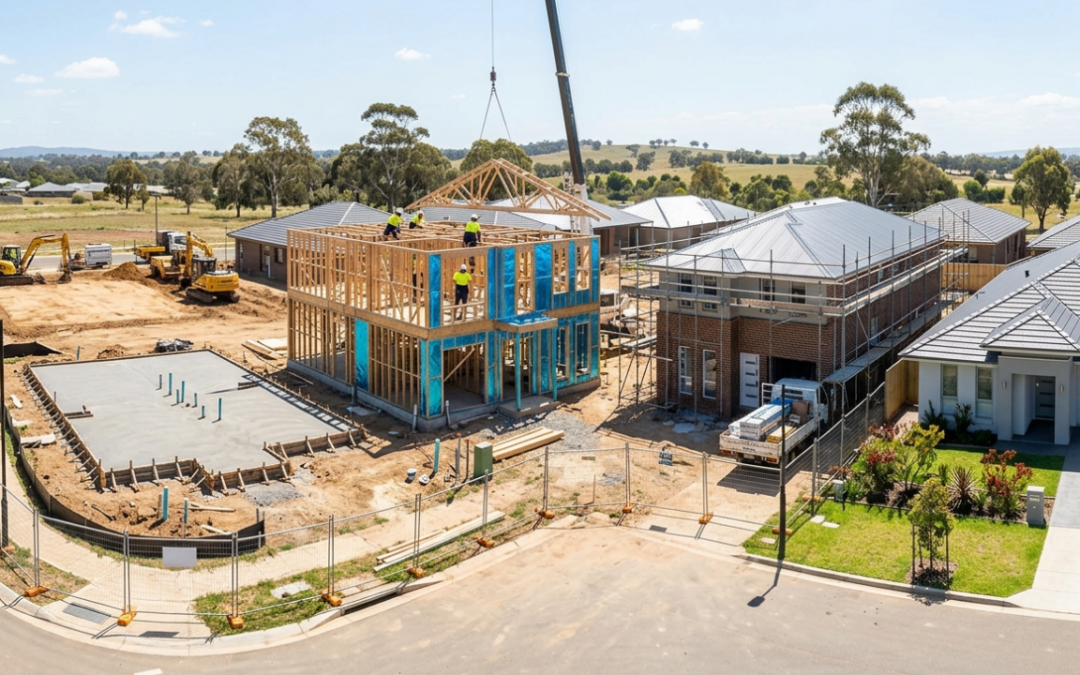
Frame stage. The structural frame goes up, and it goes up faster than most people expect. In a week or two, you go from a bare slab to something that unmistakably looks like a house. You can walk through it for the first time, stand in what will become each room, see how the spaces relate to each other. For most people this is the moment when the build becomes real rather than just theoretical. It is a genuinely good day.
Lock-up stage. The roof goes on, the external walls are completed, and the windows and external doors are installed. The building is now weathertight — internal work can proceed regardless of what the weather is doing outside. Getting to lock-up is a significant milestone. It marks the transition from structure to building. Six to ten weeks from frame to lock-up is a rough guide.
Fixing stage. This is where the home starts to look like an actual home inside, and it takes longer than most people expect. Plumbing and electrical rough-ins happen within the walls before they are closed up. Then plastering. Then tiling, cabinetry, joinery, and all the internal fit-off work that fills the space with the things that make a house liveable. Trades have to work in sequence — one finish cannot start before another is complete. Eight to sixteen weeks is realistic for this stage on a custom home.
Completion stage. The final stretch — painting, flooring, light fittings, tapware, appliances, and all the finishing details that pull everything together. This is also where the quality of the workmanship becomes most visible. The care that goes into the finishing touches is what separates a home that feels refined from one that just feels finished. Granton Homes takes the completion stage seriously because it is what you see and touch every day.
Final Inspection and Handover — Two to Four Weeks
When your builder believes the home is complete, you do a formal walkthrough together — the Practical Completion Inspection.
Do not treat this as a formality. Go through every room carefully. Open every door and window and check that they operate properly. Look at the paint quality, the grouting, the joinery. Run the taps and check the water pressure. Turn on every light switch. If something is not right, write it down — every item, no matter how small it seems.
Your builder is responsible for addressing everything on that defects list before you formally accept the home. A reputable builder will take this list seriously rather than being defensive about it. Getting these things fixed before handover is significantly easier than dealing with them afterwards.
Once you are satisfied that everything has been addressed, you make the final payment and receive your keys.
Keep every piece of documentation from the build — the signed contract, the approved plans, any variation orders, your occupancy certificate, and warranty paperwork. You will want these if issues arise later, and you will definitely want them if you ever sell.
Adding It All Up — What the Real Total Looks Like
Research and planning: three to six weeks. Design and finance: four to ten weeks. Contracts and approvals: four to twelve weeks, sometimes longer. Site preparation: two to four weeks. Construction: four to eight months. Final inspection and handover: two to four weeks.
Total from first conversation to keys: twelve months at the faster end for a relatively straightforward build. Eighteen months to two years for something more complex, a challenging site, or a project going through council approval rather than a private certifier.
These are honest ranges. Granton Homes aims to manage the process as efficiently as possible, but they will also give you a realistic timeline rather than an optimistic one — because an optimistic timeline that slips is more stressful than a realistic one that holds.
Why Things Take Longer Than Expected
Almost no build finishes exactly on the original projected date. Understanding the common causes helps you accept them as part of the process rather than signs that something has gone wrong.
Weather delays are the most frequent and the least controllable. Prolonged rain delays concrete pours and slows external stages. Australia’s weather does not cooperate on demand, and no amount of planning changes that.
Trade availability is a genuine constraint. Good tradespeople are busy across multiple projects, and their availability does not always perfectly align with when your build is ready for them. Gaps happen.
Material supply has been less predictable in recent years. Certain products — specific windows, tiles, appliances — can have lead times that affect when particular stages can be completed.
Approval delays are real, particularly for DA projects going through council. The council timeline is the council timeline, and there is limited ability to influence it.
And variations — changes to the design after the contract is signed — slow everything down. Every change needs to be priced, agreed upon, and sometimes re-documented before work can continue. Minimise variations by making decisions properly before the contract is signed.
What You Can Actually Do to Keep Things Moving
You cannot control the weather or the council’s workload. But you can control several things that significantly affect how smoothly your build runs.
Make your decisions during the design phase and commit to them. This is the single most impactful thing you can do for your timeline. Every decision made before the contract is signed is one that does not cause a delay or a variation cost later.
Stay involved throughout the build. Visit the site regularly. Keep communication with your team at Granton Homes consistent. Respond promptly when decisions or approvals are needed from your end. Problems caught early are always easier and cheaper to resolve than ones discovered late.
Avoid changing the design after construction starts unless something is genuinely wrong. The temptation to adjust things mid-build is real and understandable — but every variation costs time as well as money.
And set honest expectations from the start. A builder who gives you a realistic range rather than a promising-sounding date is actually doing you a favour. Plan around the realistic range and you will be prepared for what actually happens rather than constantly readjusting to news that things are taking longer than you thought.
The Part Worth Holding Onto
There will be a week somewhere around the fixing stage where the home goes from being a building site to actually looking like your home. The cabinetry goes in. The tiles appear. The spaces start to feel like the rooms you imagined during the design phase. And suddenly all the waiting and the patience it required starts to feel like it was pointing somewhere real.
That moment is worth something.
And then there is the day you actually move in and realise that the reason everything works the way it does — the reason the light comes in the way you wanted and the kitchen flows the way you planned and the storage is actually where you need it — is because someone sat down with you at the beginning and helped you design it that way.
That is what building with a builder like Granton Homes gives you. Not just a house. A home that was built around your life. Understand the timeline. Stay patient. Stay involved. And enjoy the process of watching it come together.