
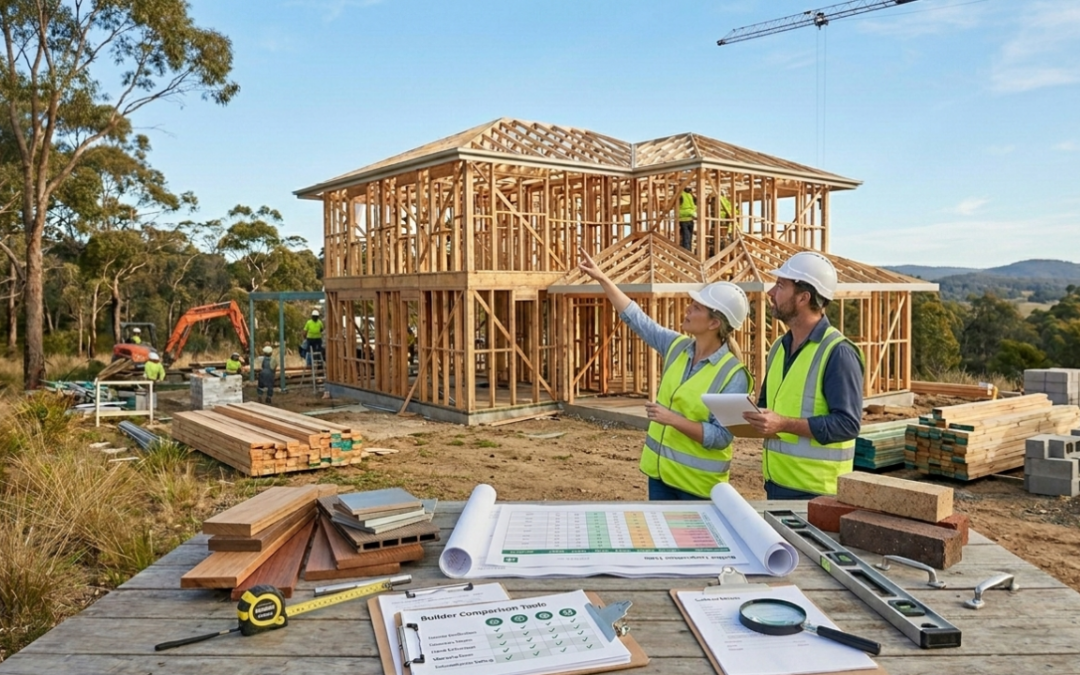
Choosing a builder is the decision that shapes everything else about your home building experience.
Not the land. Not the design. Not the finishes or the floor plan or the kitchen layout. The builder. Because all of those other things — the quality of what gets built, the experience of the process, whether the final cost aligns with what you planned, whether you feel informed and respected throughout — all of it flows from who is doing the work and how they operate.
And yet most people approach the builder decision with less rigour than they apply to buying a car. They look at a few websites, walk through a display home or two, get some quotes, and make a choice based on a combination of price and gut feeling that is not always well-founded.
The result is that builder selection is the most common root cause of building experiences that go wrong. Not bad luck. Not unforeseeable problems. A decision made without the right information at the most consequential point in the whole process.
This guide is about doing it properly. Not a list of obvious things to consider, but the specific process that actually gives you reliable information for one of the most significant decisions you will make.
Understand What You Are Actually Evaluating
Before getting into how to evaluate builders, it is worth being clear about what you are actually trying to find out.
You are not trying to find the cheapest builder. You are not trying to find the builder with the most impressive display home. You are not trying to find the builder whose sales consultant was the most likeable or whose brochure was the most polished.
You are trying to find the builder who will deliver a home that meets your expectations, at a cost that aligns with what was agreed, through a process that treats you as a valued client rather than an inconvenience. And you want to know this before you sign a contract that commits you to a relationship for the next one to two years.
The only way to know it is evidence. Not impressions, not promises, not the confident assertions of a sales consultant whose job is to close deals. Actual evidence of how this builder has performed for actual clients in actual builds. Everything that follows is about how to get that evidence.
The Licence Check — Do This First, Every Time
Before you invest significant time evaluating any builder, confirm that they hold a current, valid licence to build residential homes in your state.
In NSW, all residential builders must be licensed through NSW Fair Trading. The public register is searchable online and shows the current licence status, the licence category, the licence holder’s name and company details, and critically, whether there have been any complaints, disciplinary actions, or licence suspensions.
This takes five minutes. It is not an optional step regardless of how professional a builder appears, how many display homes they have, or how many years they claim to have been in business. An unlicensed or suspended builder cannot legally carry out residential construction work, and the insurance protections that exist for homeowners are contingent on the builder being properly licensed.
While you are confirming the licence, also confirm that the builder carries Home Building Compensation Fund insurance for your specific project. This is the insurance that protects you if the builder becomes insolvent, dies, or disappears before completing the work. Without it, you have no statutory protection if the worst happens. Ask for evidence of this insurance rather than just taking it on faith.
The Price Question — What You Are Actually Comparing
Getting quotes from multiple builders and comparing the numbers is useful. Comparing the numbers without understanding what each one includes is not.
Two quotes for the same project can differ significantly for reasons that have nothing to do with one builder being more expensive than another. One quote might include council approval fees and the other might not. One might have a more comprehensive inclusions specification and the other might have many items that will become upgrade costs during selections. One might include site cost provisions and the other might treat site costs as entirely separate. One might have allowances for landscaping and driveway; the other might not.
When these quotes are compared as headline numbers, the conclusions drawn from the comparison can be misleading or completely wrong.
The right way to compare quotes is to understand what is included in each and to normalise for the differences before drawing any conclusions. Ask each builder to walk you through their inclusions list specifically. Ask what the most common additional costs are that buyers encounter beyond the quoted price. Ask how site costs are handled — whether they are included in the contract price, estimated separately, or left as a completely open variable.
Ask about the contract type. A fixed-price contract gives you certainty about the construction cost — if materials prices rise or something takes longer than expected, that is the builder’s problem rather than yours, within the terms of the contract. A cost-plus arrangement means the final cost reflects actual costs, which provides less certainty. Understanding which type of contract each builder offers and what the provisions are for cost changes is fundamental to meaningful comparison.
Granton Homes is transparent about what is included in their pricing and how their contracts work. Ask the same questions of every builder you are comparing — the quality of the answers, as much as the content, will tell you something useful.
Looking at Their Completed Work — The Evidence That Matters Most
The most reliable evidence of a builder’s quality is the work they have already completed. Not photographs of that work, which are always selected and lit to show the best version. The actual work, in real homes, where you can look at what happens at the junctions and transitions that photographs are framed to avoid.
Ask builders for the addresses of completed homes — not just display homes — that you can drive past or potentially arrange to visit. Walk through any display homes they have with attention to the quality of the finishing work rather than the overall impression. Look at specific things that tell you about care and precision: grout lines in tiling, the paint finish where it meets joinery and cornices, how cabinet doors and drawers operate, how the edges and transitions between materials are handled.
Granton Homes has a display home in Kellyville NSW where the quality of their work is on genuine display. Visiting it with this level of attention — looking at the specific quality of finishing rather than just the overall impressiveness — gives you useful evidence rather than just a general impression.
The quality of finishing work matters because it tells you about the standard of trade supervision and quality control throughout the build. A builder who tolerates inconsistent grout lines or poor paint finish in a display home — which is the best possible representation of their work — is unlikely to be stricter about these things in the homes they build for clients who are less likely to notice.
Past Client References — The Conversations Worth Having
Ask every builder you are seriously considering for references — contact details for past clients you can speak to directly. A builder who is confident in their work will provide these without hesitation. One who deflects or makes excuses about client privacy has given you useful information.
When you speak to past clients, ask specific questions rather than general ones. Not “were you happy with your home?” — which produces universally positive answers regardless of the actual experience. Ask:
How did communication work during the build? Did you receive regular updates without having to chase them? When something changed or a problem arose, were you told promptly and honestly?
Did the final cost align with what was agreed at the start? Were there variations? Were they clearly communicated and fairly priced?
Were there delays? If so, how were they handled and communicated?
Were there defects at handover? How were they resolved?
Looking back, what would you have done differently in the process? And knowing what you know now, would you use the same builder again?
These questions get you past the social pleasantry of “yes, we’re happy with the house” and into the actual substance of the experience. The answers to the last question in particular — knowing what you know now, would you use them again — is one of the most reliable single indicators of client satisfaction available.
The Display Home Visit — What to Actually Look At
Most people visit display homes and come away with a feeling — positive or negative — based on the overall impression of the space. That feeling is a starting point, not a conclusion.
What a display home visit actually gives you is an opportunity to assess the quality of the builder’s work in close detail, to understand how their inclusions translate to a finished home, and to have substantive conversations with their team that give you a sense of how the relationship would feel.
On the quality side, look specifically at things that tell you about precision and care in execution. Are the grout lines in the tiling consistent in width and depth, or do they vary? Is the paint finish clean at the edges where it meets different materials, or are there smears and bleeds? Do cabinet doors close smoothly and sit flush, or do they require adjustment? How are the transitions between different flooring materials handled? Where tile meets timber or carpet meets tile, is the junction clean and precise, or rough and approximate?
On the inclusions side, ask specifically which elements of the display are standard inclusions and which are upgrades. The display home is almost always fitted with upgraded finishes to show what is possible. Understanding which specific elements are above the standard specification — and what they would cost to include in your build — gives you a much more realistic picture of what the base price actually delivers.
On the relationship side, pay attention to how the team treats you. Are they interested in understanding what you need, or focused on presenting their products? Do they answer questions directly and honestly, or deflect and redirect? Do you feel like a prospective client being helped to make a good decision, or a prospect being moved towards a close?
Understanding the Process — What Happens After You Sign
A builder who cannot clearly explain how the process works from contract signing to handover is a builder who has not thought carefully about the client experience. Every reputable builder should be able to walk you through each stage of the build, what happens at each stage, how the payment schedule aligns with construction milestones, and how communication works throughout.
Ask specifically about communication during the build. How often will you receive formal updates? Who is your point of contact — the sales consultant you have been dealing with, or a project manager or site supervisor once construction begins? What is the process for raising questions or concerns during construction? How are variations handled — what is the process and what are the typical costs?
Ask about the payment schedule and what each payment milestone corresponds to in terms of construction progress. Understand when each payment is due and what work should be complete before each payment is triggered.
Ask about their defects and warranty process. What happens at practical completion? How are defects identified and documented? What is the timeframe for rectification? What are the builder’s obligations during the statutory warranty period?
Granton Homes has a structured process that is designed to give clients clarity and confidence at every stage. The willingness and ability to explain this process clearly is itself evidence of how the builder thinks about the client relationship.
Comparing Multiple Builders — How to Do It Properly
Comparing two or three builders gives you perspective that evaluating one in isolation cannot. But comparison is only useful if you are comparing like with like.
Create a consistent framework for comparison. For each builder, document: the total quoted cost, what is explicitly included in that cost, what is excluded and would be an additional cost, the contract type and cost change provisions, the inclusions specification for key items, the timeline estimate, the approval pathway they recommend, and any other terms or conditions that are material to the decision.
Then compare the frameworks rather than just the headline numbers. A builder who quotes higher but includes more, has a better inclusions specification, offers a fixed-price contract with fewer exclusions, and has a stronger track record of client satisfaction may represent better value than a cheaper quote that excludes more, has a less comprehensive specification, and has a less certain cost structure.
The builder who comes out best from this comparison is not necessarily the one with the lowest headline number. It is the one who offers the best combination of quality, transparency, value, and demonstrated performance — which is a more complex judgment but a much more reliable basis for a decision.
Communication — The Factor That Determines the Experience
Of everything that distinguishes good building experiences from bad ones, communication is the most consistently cited. Not build quality — though that matters enormously. Communication.
The people who look back on their builds positively almost always describe a builder who kept them informed, was honest when things changed or problems arose, responded promptly when questions were raised, and treated them as intelligent adults who deserved to understand what was happening with their investment.
The people who look back on their builds negatively almost always describe something different — a builder who was hard to reach, who communicated minimally and only when required, who told them what they wanted to hear rather than what was actually happening, and who made them feel like an inconvenience rather than a client.
The quality of communication during the pre-contract period is the best available predictor of communication during the build. A sales consultant or design team who responds promptly, explains things clearly, answers questions fully, and does not rush you towards signing is showing you something about how the organisation values its client relationships.
One who is slow to respond, vague about costs and timelines, and visibly impatient with your questions is also showing you something.
Pay attention to this signal. It is more reliable than any promise about communication that might be made during the sales process.
The Long-Term Perspective
A home is a long-term investment in two senses. It is a financial asset that you want to hold or grow value in over time. And it is the physical environment where your daily life takes place, potentially for decades.
Both of these long-term dimensions argue for prioritising quality and durability in the builder decision rather than optimising for the lowest upfront cost.
A home built to a higher standard with better materials by a builder who takes quality seriously will require less maintenance, fewer repairs, and less intervention over the years than one where corners were cut and quality was traded for price. The lifetime cost of ownership — including the ongoing costs of maintaining the home to a comfortable standard — is lower for a higher-quality build even if the upfront cost is higher.
The property value dimension is equally clear. A home that is well built, well designed, and in good condition is a better asset than one that was built to minimum standards and shows its age quickly. The premium paid for quality during construction is generally recovered — and often exceeded — in the property’s value over time.
Granton Homes builds homes that are intended to hold their quality over the long term — not just impressive at handover but genuinely well-built structures that perform well for the people living in them for years. That long-term quality is worth considering alongside the upfront cost comparison.
Take the Time the Decision Deserves
The builder decision is one that will affect your daily life for the duration of the build and the quality of your home for as long as you own it. It deserves more time and more rigour than most people give it.
Do not let anyone rush you. A builder who creates urgency — “we have limited spots available,” “this promotion ends soon,” “other buyers are interested in this design” — is prioritising their sales process over your decision-making process. Good builders understand that a client who has made a well-informed decision is a better client to build for than one who was pressured into signing before they were ready.
Take the time to check licences, visit completed homes, speak to past clients, compare quotes properly, and understand the process and the contract before you commit. These steps take time. They are worth taking.
The relationship you enter with your builder is the most significant professional relationship most people will have — longer than most and with more at stake than almost any other. Choosing it carefully is simply the right approach.