
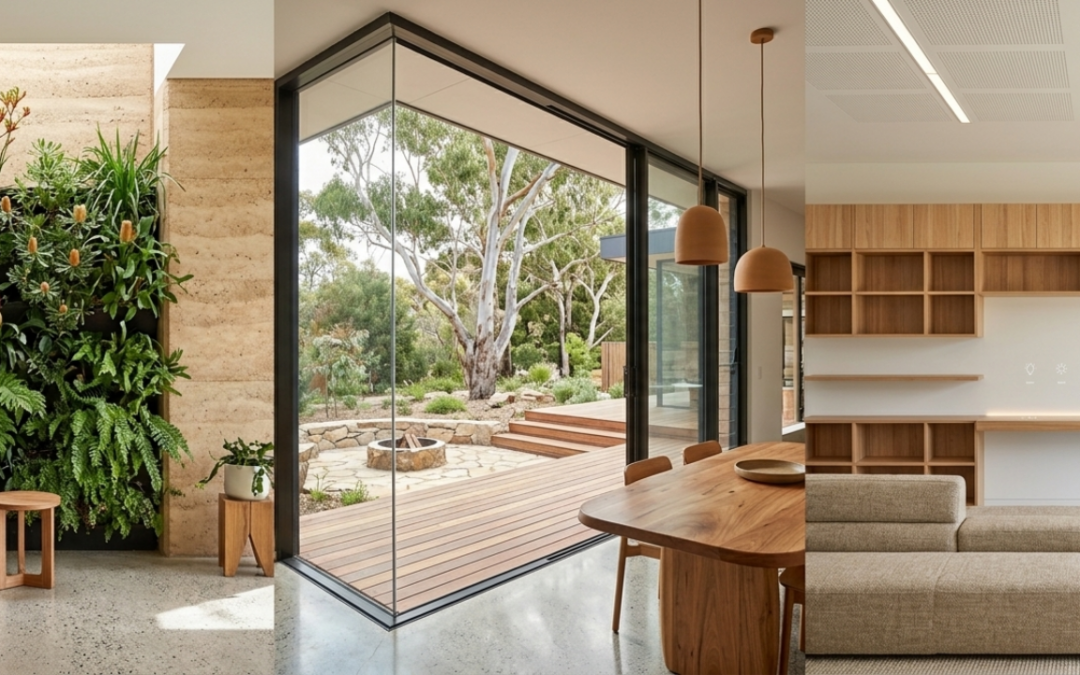
A few years ago, the conversation was dominated by aesthetics. Instagram-worthy kitchens. Dramatic feature walls. Maximalist shelving arrangements with carefully curated objects. The goal seemed to be creating spaces that looked impressive — spaces that photographed well and signalled something about taste and style.
That conversation has quietly changed. The people building and renovating homes in 2026 are asking different questions. Not just “does this look good?” but “does this feel good to live in?” Not just “is this on trend?” but “will I still want this in ten years?” Not just “does this impress guests?” but “does this actually work for the way my household runs?”
The design trends emerging in Australian homes right now are a direct response to that shift in thinking. They are less about making a statement and more about creating spaces that genuinely serve the people living in them. Less dramatic, perhaps. More honest. And in most cases, more satisfying to live with over time.
Here is what is actually happening in Australian interior design in 2026 — and why it matters if you are building or renovating.
The Colour Conversation Has Warmed Up Considerably
For a long time, white was the default answer to almost every interior colour question. White walls. White ceilings. White joinery. The argument was that white was clean, timeless, and made spaces feel larger. And there is some truth in all of that.
But white — particularly the stark, cool whites that dominated Australian interiors for much of the last decade — has a problem that becomes apparent over time. It is not particularly comfortable to live in. It feels clinical rather than warm. It shows every mark and scuff. And despite being theoretically neutral, it gives homes a certain sameness that makes them difficult to distinguish from each other.
The shift happening in 2026 is towards warmer tones — and not in a small, tentative way but in a genuinely committed way that is changing how new homes feel when you walk into them.
Soft beiges and warm off-whites are replacing the cooler whites on walls. The difference between a cool white and a warm white might seem subtle in a paint swatch but is immediately noticeable in a finished room — the warm version feels genuinely inviting in a way the cool version does not.
Earthy tones — warm taupes, clay colours, muted terracottas — are appearing in joinery, cabinetry, and feature walls. These colours work particularly well in Australian homes because they connect visually to the natural landscape and have a quality that genuinely changes across different light conditions, looking different on a bright summer morning than on an overcast winter afternoon in an interesting and appealing way.
Muted greens — not the bright or saturated greens of earlier trend cycles, but soft, dusty, almost grey-green tones — are one of the most consistently popular choices in new builds right now. They bring a connection to nature without the energy of stronger colours, and they work well with timber, stone, and natural materials in a way that cooler colours often do not.
Granton Homes works with clients to develop colour palettes that will feel genuinely right to live with over the long term rather than just reacting to whatever is trending at the moment of selections. The warm palette direction is one that has real longevity behind it — these tones have featured in enduring architectural traditions across many cultures for good reason.
Minimalism Grew Up — And Got More Comfortable
The minimalism that dominated design for much of the last decade had a specific aesthetic: sparse, rigidly controlled, and sometimes more interesting to look at than to actually live in. Everything in its place. Nothing unnecessary. A sense that life itself was a bit too messy for the aesthetic the home was trying to achieve.
That version of minimalism is being replaced by something more mature. Call it warm minimalism, or relaxed minimalism — the underlying principle of not having more than you need is still there, but it has been softened in a way that makes it genuinely liveable rather than aspirationally austere.
The difference in practice is subtle but meaningful. Furniture is chosen for comfort as well as appearance — sofas that you actually want to sit in, dining chairs that are genuinely comfortable to sit in for an extended dinner, not just chairs that look right in a photograph. Surfaces have some texture to them rather than being uniformly smooth. There is warmth in the materials — timber, linen, stone — rather than the coldness of glass and polished metal that earlier minimalism often relied on.
The goal is a home that feels calm and uncluttered without feeling like a show home. One where there is room for actual life to happen without the aesthetic breaking down. Where the design serves the people living in it rather than requiring them to tidy away evidence of their existence before the home looks right.
Granton Homes designs with this sensibility — homes that have genuine character and warmth rather than the kind of cold perfection that looks great in a brochure and feels slightly uncomfortable in daily life.
Rooms That Do More Than One Thing
The idea of dedicated single-purpose rooms — a formal dining room used twice a year, a sitting room that is separate from the main living area, a study that only functions as a study — has been giving way for some time to a more flexible approach. In 2026, that flexibility has moved from being an interesting option to being an expected feature of good design.
The work-from-home shift that happened in the early 2020s has not reversed in any meaningful way. Millions of Australians now work from home at least part of the week, and a home without a genuinely functional workspace is a home with a real gap in its design. But a dedicated home office that sits empty five days a week is not an efficient use of space either.
The answer that is emerging in the better-designed homes is a room that can genuinely do both — serve as a proper workspace when needed and function comfortably as a guest room, reading room, or family study area otherwise. This requires actual thought about the brief, not just labelling a bedroom “multi-purpose” and hoping it works out.
What makes a room genuinely flexible is a combination of size — large enough for a proper desk setup without dominating the room — and infrastructure — proper power points in the right places, adequate lighting that works for both focused work and relaxed use, and acoustic separation from the noisiest parts of the house. These are design decisions that cost nothing to get right during the planning stage and are significantly harder to achieve retrospectively.
Living areas are similarly evolving. Rather than one single open space that is expected to accommodate everything, there is a move towards open-plan living areas with defined zones within them — a space that clearly reads as the dining area, a space that clearly reads as the sitting area, and perhaps a more flexible zone that can shift between lounge overflow, homework area, or quiet reading space depending on what the day requires.
Natural Materials — Why They Work and Why They Are Staying
The trend towards natural materials in interiors has been building for several years, and in 2026 it shows no signs of retreating. The reason is not primarily aesthetic, though the aesthetic case for natural materials is genuine. It is that natural materials have qualities that manufactured alternatives consistently struggle to replicate.
Timber does something to a space that no vinyl plank or laminate timber-look product quite achieves, regardless of how photorealistic the printing technology has become. It has warmth and variation — every plank is slightly different from the one beside it, and the surface responds to light differently at different angles. It gets better with age rather than worse. It can be refinished. And it has a tactile quality that people respond to in a way that is almost instinctive.
Stone — whether engineered or natural — has similar qualities. The variation in a stone benchtop, the weight and solidity of a stone tile, the particular way stone responds to light — these things contribute to how a space feels in a way that pure white laminate surfaces do not.
Textured fabrics and natural fibres — linen cushions, wool throws, cotton or jute rugs — add tactile interest and warmth to a room that smooth, synthetic alternatives do not. They look lived-in in a good way, rather than pristine in a slightly uncomfortable way.
The practical consideration is maintenance. Natural materials generally require more attention than manufactured alternatives — timber floors need periodic refinishing, natural stone needs sealing, linen is less forgiving of spills than synthetic fabrics. Understanding what a material needs before you choose it, and being honest about whether you are willing to do that maintenance, is important. The wrong natural material in the wrong application — timber flooring in a laundry, unsealed stone in a kitchen with young children — creates ongoing frustration.
Granton Homes helps buyers navigate these trade-offs during the selections process, understanding which natural materials will work well in which contexts and what ongoing maintenance each choice involves.
Lighting as Design — Not Just Function
The shift in how Australians think about home lighting has accelerated in recent years, and in 2026 it has reached the point where treating light fittings as purely functional choices — just something that provides illumination — feels genuinely outdated.
The pendant light over the dining table is now understood as one of the most impactful single design choices in an open-plan living area. Not just because it provides useful light over the dining surface, but because it defines the dining zone, creates a visual focal point, and contributes enormously to the atmosphere of the space. A beautiful pendant over a dining table does something for the room that a downlight in the same position simply cannot.
Feature lighting in living rooms — a floor lamp that creates a pool of warm light in a reading corner, an architectural fixture that draws the eye to a feature wall, LED strip lighting that illuminates the underside of a floating shelf — adds layers of interest that make rooms feel designed rather than merely furnished.
The move towards layered lighting — ambient, task, and accent working together rather than a single ceiling source doing everything — is visible in the better-designed new homes being built right now. Rooms where the lighting can shift from bright and functional to warm and atmospheric depending on the circuit you have switched on are fundamentally more enjoyable to spend time in than rooms where you have one option: on or off.
Smart lighting has become accessible enough that it is now a reasonable consideration for most new builds rather than a luxury add-on. The ability to set lighting scenes — specific combinations of brightness and warmth for different activities — and to have the lighting respond automatically to time of day makes a genuine practical difference, not just a convenience.
Open Plan Continues — But With More Thought
Open-plan living is not going anywhere. The reasons it became popular — better flow, more natural light, a more connected and social way of living — are as valid as they always were. In Australian homes, where indoor-outdoor connection is central to the way people live, open-plan design provides the spatial continuity that makes that connection work.
What is evolving is how open-plan is being implemented. The purely open, completely undifferentiated space where kitchen, dining, and living all flow into each other without any visual separation has given way to something more considered — spaces that are connected but have definition.
Zone differentiation is the concept. Different flooring within a continuous space that signals different areas. Changes in ceiling height that give one zone a different spatial quality from another. Partial walls or screens that provide visual separation without closing off the connection. An island bench that defines the boundary between the kitchen zone and the living zone without being a physical barrier.
These approaches preserve everything that makes open-plan desirable while adding the structure that makes it liveable. You get the light and the connection and the social openness, along with enough definition that the kitchen does not visually dominate the living area and the living area has its own sense of enclosure rather than just being one end of a large room.
Granton Homes designs open-plan living areas with this kind of thinking — not just removing walls, but thinking carefully about how the zones within the open space relate to each other and how the space can feel generous without feeling undefined.
Storage — Finally Getting the Attention It Deserves
If there is one aspect of interior design that is getting more serious attention in 2026 than it has historically received, it is storage. And honestly, it is long overdue.
Storage affects daily life more directly than almost any other design element. A home with genuinely good storage — enough of it, in the right places, designed to accommodate what the household actually owns — stays organised with reasonable effort. A home with inadequate storage becomes gradually more cluttered regardless of how tidy the people living in it try to be, because there is simply nowhere for things to go.
The trend in new homes is towards storage that is built into the architecture of the home rather than added to it through freestanding furniture. Built-in wardrobes with interiors designed to actually accommodate clothes and belongings rather than just provide a box to put them in. Kitchen pantries that are properly sized rather than token. Bathroom vanities with genuine storage capacity. A linen press that is actually accessible rather than stuffed to the ceiling.
Multi-use furniture — storage ottomans, beds with under-bed storage, dining benches with storage beneath — is gaining traction in living areas where built-in storage is limited. These pieces work best when they are chosen for quality and longevity rather than as cheap solutions to storage problems, because they are on display in the room rather than concealed within the architecture.
The design principle that most consistently produces good storage outcomes is thinking about where things are used rather than where they fit. Kitchen storage near the preparation area. Bathroom storage near the mirror where you actually get ready. Bedroom storage configured for what you own rather than for what a standard wardrobe configuration offers.
Personalisation Over Catalogue
Perhaps the most significant shift in Australian interior design in 2026 is the move away from identical homes towards genuinely individual ones.
For a period, there was a dominant aesthetic in Australian new homes that was so prevalent it became almost indistinguishable across builders and price points. White joinery, grey or light timber floors, subway tiles, pendant lights with visible filament globes, a feature wall in a slightly darker tone of the same neutral. These choices were not bad choices individually — but their ubiquity made them feel less like design decisions and more like default settings.
People are now pushing past those defaults. Not to be contrarian, but because they have realised that their home is one of the few things in their life they have genuine creative control over, and that surrendering that control to whatever the current consensus is produces a home that could belong to anyone rather than distinctly to them.
The move towards personalised design is showing up in unexpected colour choices that reflect individual taste rather than trend-following. In custom joinery configurations that serve specific household needs. In art and objects that have personal significance rather than generic decorative appeal. In material choices made for how they feel and perform rather than how they align with the prevailing aesthetic.
Granton Homes supports this kind of personalisation specifically. Their design approach starts with the client’s individual brief rather than with a catalogue of pre-determined solutions. The result is homes that feel like they were designed for specific people — because they were — rather than homes that feel like they were assembled from the available options.
Comfort Is the Point
Underneath all of these specific trends is a single organising principle that explains most of them: comfort has become the primary metric by which Australian homeowners are evaluating their homes.
Not visual complexity. Not dramatic statements. Not the kind of impressive-on-first-glance aesthetic that fades into the background once you are actually living with it. Genuine, daily, practical comfort — the experience of being in your own home and feeling completely at ease.
This shift matters because it changes what good design means. A design that looks beautiful in photographs but requires constant tidying to maintain is not a comfortable design. A material that is visually striking but cold underfoot and hard to maintain is not a comfortable choice. A layout that flows impressively on a floor plan but creates daily friction in practice is not a comfortable layout.
The homes being designed and built in Australia in 2026 are increasingly evaluated on this measure. How does it feel to live in, on an ordinary day, by the people who actually live there? That question is driving design decisions in ways that are genuinely changing what gets built.
Granton Homes has always built with this understanding at the centre of the design process. The goal is never to build something that photographs well or impresses on the display home circuit — it is to build something that the people living in it are genuinely happy with, every day, for years.
Wow! This website is absolutely addictive! The
library of trans porn videos is massive – tons of gorgeous trans girls
in high-quality scenes. The streaming is butter-smooth and new content are
added all the time.
If you’re looking to watch shemale porn videos featuring hot performers and raw action, this is definitely
the best spot. Totally recommended!
Feel free to surf to my web site: Thai ladyboy
Thanks a lot for sharing this with all folks
you really know what you’re talking about! Bookmarked.
Please also seek advice from my site =). We will have a hyperlink trade arrangement among us