
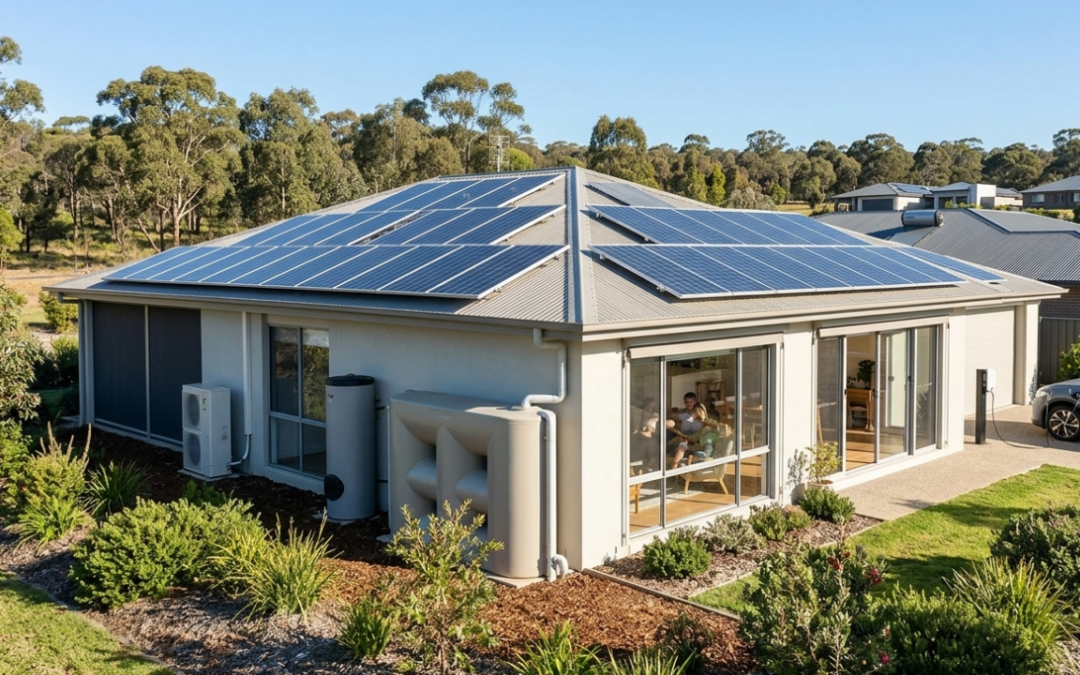
Energy bills in Australia have been climbing for years. Most households have noticed. And most households have also noticed that the standard response — turning things off, washing clothes in cold water, being more careful about the thermostat — makes a difference but not a transformative one.
The reason is that the small behavioural changes people make at the margin cannot fully compensate for a home that was not designed or built with energy performance in mind. A home that leaks heat through inadequate insulation, that overheats in summer because of poor orientation and single-glazed west-facing windows, that requires air conditioning for eight months of the year because there is no cross-ventilation — that home will have high energy costs regardless of how conscientiously the occupants turn lights off.
Real energy efficiency comes from the structure and design of the home itself. The good news is that if you are building with Granton Homes or planning a renovation, many of the most impactful energy efficiency decisions are made during the design and construction phase — and made well, they cost relatively little extra upfront while producing ongoing savings for as long as you live in the home.
Orientation — The Free Decision That Pays Forever
The most impactful energy efficiency decision you can make in a new home costs nothing extra and has its effect felt every single day for the life of the building.
How your home is oriented on the block — specifically, which direction the main living areas face — determines how much free solar heating you get in winter, how much unwanted solar heat gain you get in summer, and consequently how hard your heating and cooling systems have to work throughout the year.
In Australia, the sun tracks across the northern sky. A home with its main living areas facing north receives useful winter sun — the sun is lower in the sky in winter, the light penetrates into north-facing rooms, and it warms the space naturally. In summer, the sun is high in the sky, and the same north-facing windows can be shaded with appropriate eaves or overhangs that block the high summer sun while still admitting the lower winter sun. This passive solar principle — design the home to collect winter sun and exclude summer sun — is the foundation of energy-efficient home design in Australia.
The opposite is a home where the main living areas face south. South-facing living areas receive minimal direct sunlight in Australia. They are cold in winter regardless of the heating system. They require more energy to keep comfortable. And no amount of insulation or technology fully compensates for the absence of free solar energy that a north-facing orientation would have provided.
East-facing rooms receive pleasant morning sun — good for bedrooms and breakfast areas, comfortable in the afternoon when the sun has moved. West-facing rooms receive the afternoon sun in summer — the strongest, most intense sun of the day in terms of heat gain — which creates overheating problems that require significant shading or cooling to manage.
When you are working with Granton Homes on the design of your home, the orientation conversation should happen before the floor plan is settled. Which direction does the block face? How can the floor plan be arranged to put the main living areas on the north side? How can west-facing elevations be managed with shading — eaves, pergolas, screens — that reduce afternoon heat gain without blocking useful light?
These decisions are made on the drawing board, not during construction. Once the slab is poured and the walls are going up, orientation cannot be changed. Getting it right at the design stage is entirely possible and costs nothing extra — getting it wrong costs money in energy bills for the life of the building.
Insulation — Above the Minimum Every Time
Australian building code sets minimum insulation requirements. Meeting those minimums is not the same as having a well-insulated home. The minimums exist as a floor below which construction cannot go — not as a target to aspire to.
Insulation works by slowing the rate at which heat transfers between inside and outside. In winter, it keeps the warmth you have generated inside the house rather than allowing it to escape through the walls, ceiling, and floor. In summer, it slows the rate at which outdoor heat works its way into the living spaces. The better the insulation — measured as R-value, where higher numbers indicate better performance — the less work your heating and cooling systems have to do, and the lower your energy bills.
Ceiling insulation is the most important because heat rises and the ceiling is where the greatest amount of thermal transfer occurs in most homes. Upgrading ceiling insulation from the code minimum to a higher R-value has a clear and measurable impact on thermal performance and energy costs. The additional cost of specifying higher R-value ceiling insulation during construction is modest relative to the total build cost and is recovered in reduced energy bills over a short period.
Wall insulation comes next. In a brick veneer home — the most common construction type in Australian residential building — there is a cavity between the brick and the internal wall lining that can accommodate insulation. Filling this cavity with appropriate insulation significantly improves the wall’s thermal performance. The incremental cost during construction is modest.
Underfloor insulation matters particularly in homes elevated off the ground and in cooler climate zones. Cold air flowing under an uninsulated floor makes the rooms above it cold regardless of how much heat is generated. Insulating the underfloor eliminates this and is straightforward to do during construction.
Granton Homes builds to standards that take insulation performance seriously. When you are going through the design and specification process, ask specifically about the insulation R-values being used in each building element — ceiling, walls, underfloor — and whether upgrading makes sense for your specific climate zone. In cooler parts of Australia particularly, the case for going above minimums is very strong.
Windows — Where Thermal Performance Gets Complicated
Windows are one of the most significant thermal weak points in any building. A large single-glazed window loses heat at a rate many times that of an insulated wall of the same area. Getting windows right matters — both the specification of the glass and the size and placement of windows relative to the sun’s path.
Double glazing — two panes of glass with a gap between them — reduces heat transfer significantly compared to single glazing. The gap between the panes acts as an insulating layer, slowing conductive and convective heat transfer. In cooler climate zones, the energy performance improvement of double glazing over single glazing is dramatic. In warmer climate zones, double glazing still makes sense on east, west, and south elevations where heat gain or heat loss is a problem.
Low-emissivity coatings — commonly called Low-E glass — reduce radiant heat transfer without meaningfully affecting visible light transmission. Low-E glass reduces the amount of heat that passes through the window via radiation, which is particularly relevant in summer when preventing heat gain is the priority. Combined with double glazing, Low-E coatings produce a window system with genuinely good thermal performance.
The sizing and placement of windows affects energy performance as much as the glazing specification. Large north-facing windows with appropriate eaves — sized so that the high summer sun is shaded while the lower winter sun is admitted — are an asset in a well-designed Australian home. Large west-facing windows without external shading are a significant heat gain problem every afternoon of every summer. Large south-facing windows lose heat in winter without providing useful solar gain in return.
This does not mean avoiding east, west, or south-facing windows. It means sizing them appropriately and providing appropriate shading on the east and west where afternoon and morning solar heat gain is a concern. Granton Homes thinks about these relationships during the design process — window placement and size are part of the energy performance design, not separate decisions.
Ventilation — The Energy-Free Cooling System
Before mechanical air conditioning became standard, Australian homes were designed to use natural ventilation for cooling. Wide verandahs provided shading and created air movement. High ceilings allowed hot air to rise away from the occupied zone. Louvred windows on multiple sides of the home allowed breezes to flow through. These strategies worked — not perfectly in extreme heat, but effectively through much of the Australian climate’s warmer periods.
The availability of cheap air conditioning led to a period where ventilation design was largely abandoned. Why think about cross-ventilation when you can just run the aircon? The answer, which is now obvious to anyone paying electricity bills, is that running air conditioning constantly is expensive. And in many parts of Australia, there are months of the year where the outdoor temperature is comfortable enough that a well-ventilated home could be cooled without mechanical assistance.
Cross-ventilation requires windows or openings on opposite or adjacent walls so that when a breeze is present, it flows through the home rather than just into it. The living area on one side of the home, bedrooms on another, windows in each — this is the basic principle. It requires thinking about it during the floor plan stage, because the positions of windows and doors relative to prevailing breezes in your specific location determine whether cross-ventilation is achievable.
A home designed for good cross-ventilation can be comfortable through spring and autumn with windows open and fans running rather than air conditioning operating. In many Australian climates, that is several months of the year. The energy saving over time is real and ongoing.
Ceiling fans are one of the most energy-efficient cooling tools available. A ceiling fan uses a fraction of the energy of an air conditioning unit and in many conditions is sufficient to maintain comfort — the air movement creates a cooling effect that allows the thermostat setting to be raised several degrees without a reduction in perceived comfort. Including ceiling fan provisions in every room during construction is a modest cost with long-term payback.
Solar — In the Right Order
Solar panels have become one of the most popular home improvements in Australia, and the economics are genuinely good. High electricity prices, abundant sunshine across most of the country, and government incentives that reduce the upfront cost combine to produce a reasonable payback period in most situations.
But the most common mistake with solar is treating it as a solution to a problem that should have been addressed differently. A solar array on a poorly insulated home with single-glazed windows that faces the wrong direction is generating electricity to offset an energy load that good design would have significantly reduced in the first place. The right approach is to reduce the energy demand of the home through good design — orientation, insulation, glazing, ventilation — and then install solar on top of a home that does not need as much energy.
In that order, solar is genuinely excellent. A well-designed, well-insulated, well-oriented home with good glazing and cross-ventilation that also has solar panels is a home with very low energy costs. The solar system is serving a modest load rather than compensating for design deficiencies.
If you are building with Granton Homes and solar is in your plans, make sure the roof design and orientation support efficient solar panel placement. A north-facing roof section with minimal shading and appropriate pitch produces significantly more energy than panels on an east or west-facing roof. Solar-ready provisions — the structural and electrical elements that allow panels to be added without significant retrofitting work — are worth building in during construction even if panels are not installed immediately.
Battery storage adds a dimension that changes the solar economics. Rather than exporting surplus generation to the grid at low feed-in tariff rates and buying back from the grid at peak rates in the evening, a battery stores surplus daytime generation for use when the solar panels are not producing. The economics of battery storage have improved significantly and continue to do so. Providing the space and electrical provisions for a battery system during construction keeps the option open without committing to the cost upfront.
Efficient Appliances and Lighting — The Layer That Sits on Top of Good Design
LED lighting is effectively standard in new Australian homes now and there is no meaningful argument for alternatives. The energy consumption of LED compared to older technologies is dramatically lower, the quality of light has improved to the point where most people cannot tell the difference, and the lifespan is far longer.
Energy-efficient appliances — refrigerators, dishwashers, washing machines, dryers, water heaters — make a genuine contribution to overall energy use. The energy star rating system provides a straightforward basis for comparison, and the investment in a higher-rated appliance is typically recovered in reduced operating costs over the appliance’s life.
Heat pump hot water systems are worth specific mention. Water heating is typically the second or third largest energy consumer in an Australian home. A heat pump hot water system uses a fraction of the energy of a conventional electric element system to produce the same amount of hot water — it moves heat rather than generating it, which is far more efficient. The upfront cost premium over a standard electric system is recovered in reduced operating costs within a few years in most situations.
Smart home technology — programmable thermostats, automated lighting systems, energy monitoring — contributes to efficiency primarily by removing the human forgetfulness factor. A thermostat that automatically adjusts to an energy-efficient setpoint when the house is unoccupied rather than relying on someone remembering to adjust it makes a real difference. Energy monitoring that shows where consumption is going allows informed decisions about where to focus improvement effort.
These technologies are increasingly accessible and increasingly useful. Granton Homes incorporates smart home integration as part of their modern home designs — building in the provisions during construction so these systems can be used effectively rather than being afterthoughts.
Designing for Your Specific Climate
Australia’s climate zones range from tropical in the far north to cool temperate in the south, with significant variation between humid and dry conditions, and coastal versus inland environments. The energy efficiency strategies that matter most vary accordingly.
In tropical and subtropical climates — Darwin, Cairns, Brisbane and surrounds — the priority is managing heat gain and maintaining natural ventilation. Shading of all elevations, particularly east and west, is critical. Cross-ventilation and elevated construction that allows air movement under the floor are traditional and effective strategies. Insulation matters for keeping the interior cooler than the exterior during the heat of the day.
In the temperate climates of Sydney, Adelaide, and Perth — hot dry summers and mild winters — the design challenge is managing both summer heat and winter cold. North-facing solar access for winter warmth, combined with shading strategies for summer, is the classic response. Double glazing is beneficial on most elevations. Insulation above the minimum is a sensible investment.
In the cool temperate and alpine climates of Melbourne, Canberra, Hobart, and regional Victoria — warm summers and cold winters — the priority shifts towards winter thermal performance. Higher R-value insulation is warranted. Double glazing and potentially triple glazing in the coldest areas is beneficial. Maximising north-facing solar access is particularly valuable because the free heating benefit is greatest where winters are coldest.
Granton Homes builds primarily in NSW and designs for the specific climate conditions of each site. Understanding which climate zone your specific location falls into, and what that means for the design decisions that will most improve energy performance, is part of the design conversation.
The Habits That Sit on Top of Good Design
All of the above is about the structure and design of the home — the decisions that establish the energy performance ceiling of the building. On top of that, the way the home is used affects how close to that ceiling the actual energy performance gets.
Using natural ventilation when outdoor conditions allow it — opening windows to cross-ventilate on mild days rather than defaulting to air conditioning — makes use of the ventilation design that was built into the home and avoids mechanical cooling energy costs.
Managing the thermostat sensibly — not overcooling in summer or overheating in winter, using programmable settings to reduce conditioning of unoccupied spaces — is the single most impactful behavioural choice for most households.
Keeping the sun out on hot days — closing blinds and curtains on west-facing windows on hot summer afternoons rather than letting the sun pump heat into the home and then running the air conditioning to remove it — is a simple habit with a real energy impact.
These habits matter. But they matter most when the home they are applied to was designed with energy performance in mind. Good behaviour in a poorly designed home produces modest results. Good behaviour in a well-designed home produces excellent results.
The combination — a home built with orientation, insulation, glazing, ventilation, and appropriate systems designed for the Australian climate, and a household that uses it thoughtfully — is how genuinely low energy costs are achieved. Not through one intervention alone, but through the accumulated effect of many good decisions made at the right times.