
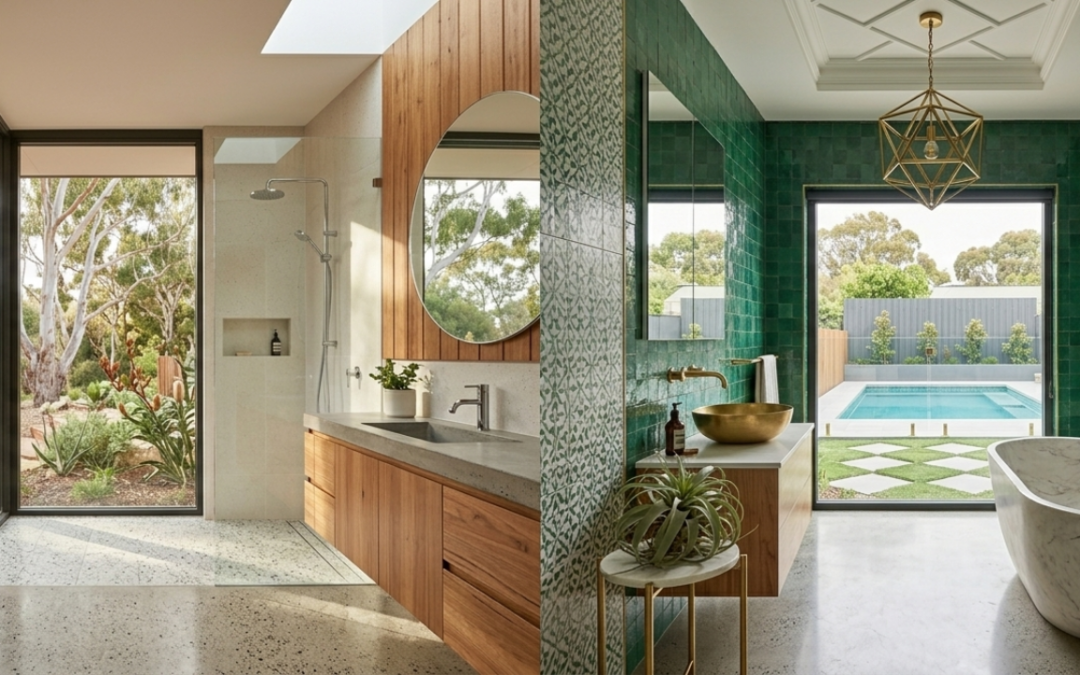
You designed the kitchen carefully, spent real time on the living areas, agonised over the master bedroom — and then the bathroom got whatever was left of the budget and the decision-making energy. A shower, a vanity, some tiles. Done.
That approach has shifted considerably. Partly because renovation culture has elevated the bathroom’s status in the overall home hierarchy. Partly because people spend more time in their bathrooms than they used to — the ritual of a decent shower or a long bath has become genuinely important to a lot of households. And partly because good bathroom design has a disproportionate effect on how the whole home feels, in the same way that a well-designed kitchen does.
The bathrooms being designed and built in Australian homes right now — including the ones coming out of Granton Homes’ projects — look and feel very different from what was standard even a decade ago. Not because design is chasing novelty, but because the thinking about what makes a bathroom genuinely good has matured considerably.
The Case for Simplicity — And What It Actually Means
Every guide on modern bathroom design mentions minimalism. And then most people look at their existing bathroom, or the display bathrooms they have walked through, and are not quite sure what minimalism actually means in a space that by definition has to contain a toilet, a shower, a vanity, a mirror, and various plumbing fixtures.
It does not mean stripping the bathroom back to bare surfaces and nothing else. It means making deliberate choices about what goes in the space and how it is arranged, rather than filling every available surface and wall with things because they are available to be filled.
In practice it means: a vanity that has enough storage built into it that the bench surface stays clear rather than accumulating bottles and products. A shower that is properly waterproofed and tiled without the visual clutter of a frame and curtain track. Fixtures chosen for quality and restraint rather than for decorative impact. A mirror that does its job well — large enough, well-positioned, well-lit — without competing for attention with everything else in the room.
The result of doing this well is a bathroom that feels immediately calm when you walk into it. Not dramatic, not impressive in a look-at-me way, but genuinely pleasant to be in. A bathroom you can use every morning without it contributing to the visual noise of the day.
Granton Homes approaches bathroom design with this sensibility — designing spaces that work beautifully without requiring constant tidying or maintenance to look good. The discipline of not putting things in just because you can is harder to execute than it sounds, and it is one of the things that separates a well-designed bathroom from one that just has nice tiles.
Colour — Neutral Does Not Mean Boring
The dominant palette in modern Australian bathrooms is neutral, and it has been for long enough that there is a risk of it becoming boring through repetition. White tiles, grey floor, white vanity, chrome fixtures. It works. It is clean, it is timeless, it does not date. But executed without thought, it is also indistinguishable from every other bathroom built in the last five years.
The interesting thing happening in 2026 is how that neutral palette is being warmed up and given more character without abandoning the fundamental logic of why neutral works in bathrooms.
Warm whites and off-whites are replacing the cooler, bluer whites that dominated earlier. The difference sounds small and is immediately visible in a finished room — the warm version feels like a space you want to be in rather than a clinical one you pass through.
Earthy tones are appearing in bathroom tiles — terracotta-adjacent tones, warm stone colours, the kind of muted clay tones that look genuinely beautiful against timber vanity elements and aged brass or brushed gold fixtures. These are not conservative choices but they are not trend-chasing ones either. They have a quality that will look as good in fifteen years as they do now.
Darker tones in bathrooms — deep greens, charcoal, even navy in the right application — are being used more confidently. A bathroom with dark tiles and excellent lighting can feel genuinely dramatic and luxurious rather than oppressively dark, and the contrast with white fixtures and fittings is striking in a way that an all-neutral palette is not.
The principle to hold onto is that the colour you choose should suit the specific bathroom — its size, its natural light, the overall palette of the home — rather than being chosen because it is currently popular. A dark tile choice that looks stunning in a large, naturally lit main bathroom looks oppressive in a small, windowless second bathroom. The same decision-making that applies to every other design choice applies here.
Walk-In Showers — Why They Have Become the Standard
The shower over bath combination that was the default in Australian bathrooms for decades has been largely replaced by a walk-in shower as the primary bathing fixture, and the reasons are straightforward enough that the trend is almost certainly permanent rather than cyclical.
A walk-in shower with frameless glass — or no glass at all in a fully wet-room style — takes up the same footprint as a shower recess with a screen but feels dramatically more open and easier to use. There is no frame to accumulate mould and soap scum. No shower curtain or screen to clean. No step to negotiate. You walk in, you shower, you walk out. The simplicity of it is appealing and the maintenance reality of it is genuinely better than the alternative.
Frameless glass panels make a significant difference to how a bathroom feels. The visual weight of a framed shower screen — the aluminium or chrome frame running around the perimeter — creates a boundary within the bathroom that makes the space feel segmented. A frameless panel removes that visual interruption and lets the whole bathroom read as one space rather than a series of zones.
The sizing of the shower is worth getting right during the design phase. A shower that is technically adequate but feels cramped is a daily irritation. The difference in floor area between a shower that feels properly generous and one that feels just functional is usually modest — but that difference requires making the decision during design when the floor plan still has flexibility. Once the tiles are down and the plumbing is set, changing the shower footprint is an expensive renovation.
If you are building with Granton Homes and the main bathroom floor plan allows for a larger shower, push for it. You will use the shower every day for as long as you live in the home. The extra few hundred dollars to make it properly sized during construction will not be something you ever regret.
The Vanity — More Than Just Storage
The vanity is the piece of furniture that defines the character of a bathroom more than any other element. Get it right and everything else feels intentional. Get it wrong and no amount of nice tile work fully compensates.
Floating vanities — mounted to the wall with space underneath — have become a staple of modern bathroom design for practical reasons as well as aesthetic ones. They are genuinely easier to clean around than a floor-mounted vanity. They make the floor area of the bathroom more readable, which helps smaller bathrooms feel larger. And they have a clean, contemporary appearance that suits the direction most Australian bathroom design is moving.
The depth and length of the vanity matters practically. A vanity that is too shallow does not give you enough bench space to actually use. One that is too deep makes the bathroom feel narrow if the space is limited. The standard depth of around 450-500mm is a reasonable starting point, but the specific dimensions should be considered against the bathroom floor plan rather than just accepted as default.
Storage within the vanity is worth thinking through more carefully than most people do. The typical drawer configuration — one or two large drawers — works for some households and is inadequate for others. If the bathroom is shared between adults with different morning routines, having separate dedicated storage zones within the vanity makes daily use significantly smoother. Consider specifically what you own, where it currently lives, and what the vanity configuration would need to look like to accommodate it properly.
Tapware selection for the vanity is one of those decisions that seems minor but has a noticeable effect on the finished result. Brushed nickel and brushed gold have largely overtaken chrome as the preferred finishes in new builds, partly because they show water marks and fingerprints less and partly because they have a warmer, softer quality that suits the direction bathroom design has moved. Consistency of tapware finish across the bathroom — shower, bath if there is one, basin, accessories — matters more than most people expect.
Storage — Design It Specifically, Not Generally
The bathroom storage problem is almost universal. People consistently underestimate how much storage they need in a bathroom until they are living in one that does not have enough, at which point the bottles and products that have nowhere to go accumulate on every available surface and the room that was supposed to be calm and organised looks like a chemist warehouse.
The solution is to design storage specifically for what your household owns and how you use it, rather than accepting whatever the standard vanity configuration offers.
Think through your actual bathroom routine. How many people share this bathroom? What products do each of them use? Where do those products currently live, and is that working? A couple who each have a significant collection of skincare and haircare products needs considerably more storage than a single person with a minimal routine — and the vanity configuration that works for one situation is inadequate for the other.
Built-in niches in shower walls are one of the most practical and aesthetically pleasing storage solutions available in bathroom design. A recessed niche — tiled to match the shower, built into the wall during construction — provides a waterproof shelf for shower products without requiring a freestanding shelf that accumulates grime around its fixings. The cost of including a niche during construction is modest. The cost of adding one after the fact — opening up a tiled wall, waterproofing, retiling — is significant.
Medicine cabinets or recessed storage behind the mirror are worth considering in bathrooms where the wall allows for it. They provide a significant amount of storage with no visual footprint — the mirror surface looks exactly like a regular mirror and the storage is concealed behind it.
Lighting — The Detail That Most Bathrooms Get Wrong
There is a specific lighting mistake that appears in the majority of Australian bathrooms, and it is so common that most people do not even register it as a problem until someone points it out.
A single overhead downlight positioned above the vanity and mirror illuminates the top of the head. It does not illuminate the face. The result is that using the mirror — for applying makeup, for shaving, for any task that requires seeing your face clearly — is harder than it should be, because the light source is creating shadows on your face rather than eliminating them.
Lighting that works for a mirror comes from the front or sides. Wall-mounted lights on either side of the mirror — at approximately face height — provide even, flattering illumination that makes the mirror actually useful. A lit mirror with integrated lighting around its perimeter achieves a similar effect in a single fitting. These solutions are not expensive or complicated, and the difference they make to how the bathroom functions is immediate and significant.
Overhead ambient lighting still matters for general illumination in the bathroom, but it should not be doing the work of mirror lighting on its own. The right approach is layered — ambient light for general use, specific lighting at the mirror for grooming tasks, and where possible a warm and dimmable option for the evenings when the bathroom is being used for a bath or a relaxing shower rather than a functional morning routine.
Natural light in bathrooms is worth pursuing wherever the floor plan and site conditions allow. A bathroom with a well-positioned window — obscured for privacy but allowing light — feels dramatically more pleasant than one that relies entirely on artificial lighting. Skylights are an excellent option in ground floor bathrooms or bathrooms below a roof space where a window on an external wall is not possible.
Granton Homes designs bathrooms with the lighting conversation integrated from the start rather than decided after everything else is finished. If you are going through the design phase, ask specifically about mirror lighting early enough that the right provisions can be made.
Materials — Durability Is Not Negotiable
Bathrooms are wet, steam-filled, constantly used spaces. The materials that go into them need to cope with that reality, not just look good in dry conditions.
Tiles are the dominant surface material in modern Australian bathrooms, and for good reason. Properly installed and waterproofed, tiles are essentially permanent — they do not degrade with moisture, they are easy to clean, and they can look as good after twenty years as they did when they were laid. The investment in quality tiles and professional installation is one of the most reliable investments in any bathroom renovation or new build.
The format and finish of tiles makes a significant difference to both the aesthetic and the practical maintenance of the bathroom. Large format tiles — 600mm by 600mm or larger — have fewer grout lines, which means less surface for mould and grime to accumulate and a cleaner visual result. Matte finish tiles are generally more practical in wet areas than high-gloss finishes, which show every water mark and fingerprint. Rectified tiles — precisely cut for consistency — allow for much finer grout joints that look cleaner and are easier to maintain.
The waterproofing behind tiles is the most important element that is least visible in the finished bathroom. Inadequate waterproofing is the root cause of most serious bathroom failures — water getting behind tiles causes substrate damage, mould growth, and eventually structural issues that are expensive to repair. Ensure the waterproofing membrane specification is adequate and that it is being applied properly during construction. An independent inspection at this stage is worth the cost.
Vanity materials need to be selected for bathroom conditions. Solid timber looks beautiful but requires careful finishing and maintenance in a wet environment. Engineered products designed specifically for wet areas are more practical. Stone surfaces — natural or engineered — are excellent in bathrooms if they are properly sealed and maintained.
Natural Elements — Warmth Without Complication
The bathroom trend that has had the most consistent impact on how Australian bathrooms feel over the last several years is the inclusion of natural elements — timber particularly, but also stone, plants, and natural textures more broadly.
A timber vanity in a bathroom that is otherwise tiled in cool tones does something that changes the whole character of the space. It brings warmth and a human quality that hard surfaces alone cannot achieve. Engineered timber products and timber-look alternatives designed for bathroom conditions provide this quality with better moisture resistance than solid timber, which is practical in most bathroom applications.
Indoor plants in bathrooms feel like a small detail and have a disproportionate effect on how the space feels. A plant that tolerates low light and humidity — and there are many that do — brings life and colour to a space that is otherwise all hard surfaces. It is one of the most low-cost, high-impact additions to a bathroom aesthetic.
Stone surfaces — a stone tile feature wall behind the bath, a stone basin, a stone benchtop — add texture and visual interest in a way that feels grounded and natural rather than trend-dependent. The specific stone does not need to be expensive to work well. The variation and texture in the material is what matters.
The principle behind including natural elements in a bathroom is not about following a trend but about understanding that rooms made entirely of manufactured surfaces — no matter how high quality — tend to feel slightly cold and impersonal. Natural materials address that without adding complexity.
Functionality — The Thing That Determines Whether You Love Your Bathroom
A bathroom that looks beautiful in a photograph but does not work well in daily use is a daily frustration.
The functional questions worth asking during the design phase are specific. Is the shower large enough to actually use comfortably? Is the vanity positioned so you are not bumping into the door when it opens? Is there somewhere to hang a towel that is accessible from the shower without stepping out onto the floor? Is the toilet positioned so that using it does not feel cramped? Is there adequate ventilation to manage moisture and prevent mould?
These are not glamorous design questions. They are the questions that determine whether the bathroom is comfortable to use every day rather than just impressive to look at occasionally.
The placement of fixtures relative to each other matters enormously in smaller bathrooms. A toilet that is positioned too close to the vanity creates an uncomfortable dynamic that is immediately noticeable to every person who uses the bathroom. A shower that is positioned so that the water hits the door when you first turn it on means a wet door and a minor annoyance every day. Getting a bathroom designer or a builder who has thought carefully about these relationships — as Granton Homes does in their bathroom layouts — is worth more than any individual fixture choice.
The Personal Touches That Make It Yours
Modern bathroom design in its more rigid forms can feel a little impersonal — as if the room is striving for a look rather than serving a person. The antidote is not to abandon the design principles that make modern bathrooms work, but to add the specific details that make the space genuinely personal.
A mirror with an unusual shape or a distinctive frame. Tapware in a finish that is specific to your taste rather than defaulting to whatever the standard specification offers. A print or a small piece of art on the wall. A distinctive basin shape. An unexpected tile choice in the shower niche.
None of these things needs to be expensive or dramatic. They just need to be chosen rather than defaulted to. The difference between a bathroom that feels like it could belong to anyone and one that feels specifically like yours is usually in exactly these kinds of small choices — the ones that required a specific preference to make rather than just going with what was available.
What a Well-Designed Bathroom Actually Feels Like
When it all comes together — when the proportions are right, the materials are well chosen, the lighting works properly, the storage is adequate, and the fixtures are well positioned — a bathroom does something that good design always does.
You are not aware of the design because everything is working as it should. The shower is the right size. The vanity has space for your things. The mirror is well lit. The room is warm and calm in the morning and easy to keep tidy. You use it every day without friction, without inconvenience, without noticing it.
That absence of noticing is the mark of genuinely good design. Not the dramatic bathroom that photographs beautifully but requires daily effort to maintain. The bathroom that simply works, every day, for years. That is what Granton Homes is aiming for in every bathroom they design. And it is what you should be aiming for too.