
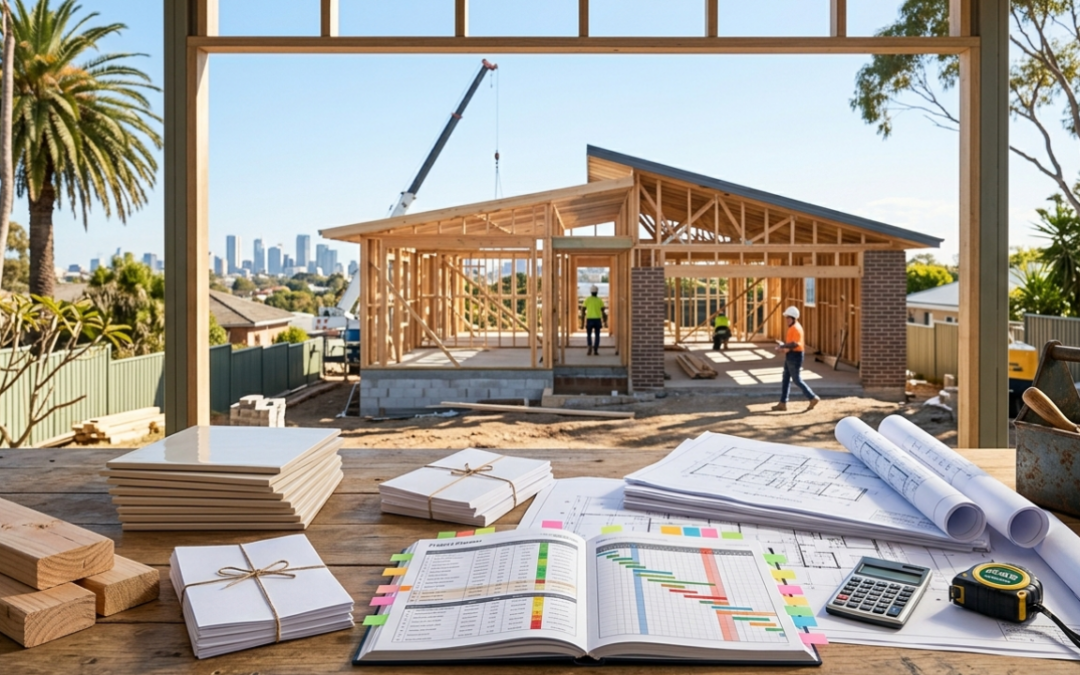
There is a specific kind of frustration that sets in about six months into a home build.
You started with a projected completion date. You planned around it — maybe gave notice on a rental, maybe coordinated the sale of your current property, maybe made arrangements for where you would live in the meantime. The date felt like something you could build your plans around.
And then the date shifted. Not dramatically, not all at once, but incrementally — a few weeks here, a month there, an explanation that made sense individually but that cumulatively pushed the finish line further than you expected.
This experience is common enough in Australian home building that it almost qualifies as a standard feature of the process rather than an exception. And the frustration it produces is not primarily about the delay itself — most people can handle their plans being disrupted. It is about the gap between what they were told to expect and what actually happened, and the feeling that nobody adequately prepared them for the reality.
This guide is an attempt to change that. Not to make delays sound acceptable or inevitable, but to explain honestly why they happen, which ones are genuinely unavoidable, which ones can be significantly reduced through the right preparation and choices, and how to set your expectations in a way that makes the experience of a real build considerably less stressful than the experience of a build measured against an unrealistic timeline.
The Reality of Building Timelines in Australia
Let us start with the baseline that most guides gloss over.
A realistic total timeline for a custom home build in Australia — from first conversations with a builder through to collecting the keys — is twelve to twenty-four months. For a project of meaningful complexity, eighteen months is a reasonable midpoint expectation rather than a worst case. Builds that complete at the faster end of that range tend to have uncomplicated sites, CDC approval pathways, minimal design complexity, complete decision-making before contract signing, and favourable conditions throughout construction. These are not the majority of custom builds.
Most first-time buyers, when they hear a projected timeline at the beginning of the process, anchor to the optimistic end of the realistic range. A builder who says “the build will take approximately twelve months” creates an expectation of twelve months, and the first time that expectation is revised upward, it feels like something has gone wrong — even if fourteen or fifteen months was always a more realistic expectation for that specific project.
Setting expectations around the realistic midpoint or upper end of the range — rather than the optimistic end — is one of the most practically useful things any buyer can do before starting the process. Not because being pessimistic about timing produces better outcomes, but because planning your living arrangements, your financial commitments, and your emotional expectations around a realistic range rather than a specific optimistic date makes the actual experience of the build considerably more manageable.
Approval Delays — The Part Nobody Controls but Everyone Forgets to Plan For
Before a single piece of earth is moved on your building site, the project needs formal approval. This is not optional, it is not a formality, and the timeline for getting it done is not fully within anyone’s control.
In NSW and most Australian states, residential construction goes through one of two main approval pathways. A Complying Development Certificate through a private certifier is the faster option — if your design meets the standard planning codes, a CDC can come through in four to eight weeks, sometimes faster. A Development Application through local council is the longer pathway — council assesses the application in detail, may request additional information or design changes, and the timeline is determined by council’s workload and the complexity of the application. Six weeks is optimistic for most DAs. Three to four months is not unusual, and some DAs take considerably longer.
The approval pathway your project qualifies for depends on the design, the zoning, and the planning environment of your specific site. Your builder will know which pathway applies and will manage the application process. But the timeline is substantially outside the builder’s control — and outside your control — once the application is lodged.
The practical implication for timeline planning is clear. Add the approval period to your overall timeline calculation before you start counting construction time. If your project needs a DA, the approval process alone could add three to four months to the period between contract signing and construction commencement. Planning around a construction start date that assumes approval will be immediate — or that the optimistic end of the approval timeline will apply — means your overall timeline is underestimated before a slab has been poured.
Granton Homes manages the documentation and submission process for their projects, coordinating with certifiers or council and keeping clients updated. But honest communication about the realistic approval timeline from the beginning of the process — rather than optimistic projections that sound better — is the more useful service to buyers who need to plan their lives around it.
Site Conditions — Why They Matter More Than People Expect
The construction of a home begins not with the frame or the slab but with the preparation of the site for construction. And what that preparation involves — and how long it takes — depends entirely on the specific characteristics of the block of land.
A flat, clear block with stable soil, good access, and no unusual characteristics can be prepared for construction relatively quickly. The site is cleared, the soil is assessed and classified, the slab design is confirmed based on the classification, and construction can proceed efficiently.
A more challenging site takes longer and adds complexity at every stage. A steeply sloped block requires significant earthworks — cutting into the uphill side, filling the downhill side, potentially constructing retaining walls — before a level building platform exists. This work takes time, requires engineering oversight, and involves trade coordination that adds to the schedule. Rock encountered during excavation requires mechanical breaking that is time-consuming and not always fully anticipated before it starts. Poor drainage that needs to be engineered before the site is ready for construction adds more time.
Site-related delays are among the most consistently underestimated in their impact on the overall timeline, partly because buyers focus on the construction stages they can visualise — frame, roof, fit-out — and give less attention to the site preparation that happens before those visible stages begin.
A proper site assessment before construction begins — which Granton Homes conducts as part of their pre-construction process — identifies the likely site challenges and allows the timeline to be planned around them rather than discovered as they arise. If your site is going to require significant earthworks, knowing that before you commit to a construction start date allows you to build the time into your overall plan rather than having it appear as an unexpected delay.
Material Supply — Better Than It Was, But Still a Real Factor
The material supply situation in Australian construction in 2026 is considerably better than it was during the 2020 to 2023 disruption period. Supply chains have largely normalised. Most materials are available on predictable lead times. The extreme shortages that affected timber, steel, and many other products during the COVID years are not the current reality.
But supply chain reliability is never perfect, and specific products can still have lead times that affect construction scheduling. Custom or imported items — particular window systems, specific appliances, certain tile ranges — may have lead times that need to be built into the construction programme. A product that needs to be ordered eight weeks in advance of its installation date requires that order to be placed at the right time in the construction sequence, and if the order is delayed or the delivery is late, the installation stage waits.
The builders who manage material supply challenges most effectively are those who do thorough pre-construction planning — identifying the products with longer lead times and ensuring orders are placed at the appropriate point in the programme — rather than those who order reactively as each stage approaches.
When evaluating builders, asking about their procurement and scheduling approach is a legitimate question. How do they manage materials with longer lead times? What is the process for product substitution if a specified item is unavailable? How do material delays get communicated to clients and incorporated into the programme? The answers reveal something about the sophistication of their construction management.
Labour Availability — The Factor That Is Hardest to See From the Outside
Construction is a people-intensive industry, and the availability of the right tradespeople at the right time is one of the most significant drivers of construction schedule outcomes — and one of the least visible from the client’s perspective.
The sequencing of a residential build requires different trades at different stages. Concreters for the slab. Framers for the structure. Roofers. Rough-in plumbers and electricians within the wall cavities before they are closed. Plasterers. Tilers. Joiners and cabinetmakers. Painters. Fit-off plumbers and electricians. Each trade needs to follow the previous one in the right sequence, and gaps in availability create gaps in the schedule.
Good builders have established relationships with reliable trades and manage their project programmes in a way that gives trades enough notice to be available when needed. Less organised builders deal with trade availability on a more reactive basis, with schedule gaps as the frequent consequence.
This is one of the reasons that builder selection matters for timeline outcomes beyond what any contract can guarantee. A builder who is disorganised in their scheduling, who uses trades they have not worked with consistently, or who manages too many simultaneous projects to give each one appropriate attention will have more trade availability problems — and more schedule gaps — than one who manages these relationships carefully.
When speaking to past clients of any builder you are considering, asking about schedule momentum — whether the build seemed to move continuously or had periods of inactivity — gives you useful information about the builder’s trade management. Granton Homes manages a relatively small number of projects simultaneously specifically because this allows the attention that produces consistent schedule momentum rather than the gaps that come from overextension.
Weather — The Delay Nobody Can Plan Away
Concrete cannot be poured in heavy rain. External structural work stops in severe weather. Painting and some external finishing work require conditions that extended wet weather prevents. Australian weather — unpredictable at the best of times — does not cooperate on demand.
Weather delays are the genuinely unavoidable component of Australian construction timelines, and any builder who tells you weather will not affect your build is either not being honest or has never actually managed a real build.
The right approach to weather delays is to include them in timeline expectations from the beginning rather than treating them as unexpected events that represent something going wrong. A buffer of one to two months in the overall timeline for weather-related delays is not excessive — it is realistic for a project of any meaningful duration in most Australian climate zones.
Some construction stages are more vulnerable to weather than others. The slab pour and the frame are the stages most directly affected — concrete needs appropriate conditions to be placed and cure properly, and structural framing in heavy rain creates practical problems. Once the home reaches lock-up — roof on, windows and external doors in — the weather vulnerability reduces significantly, because internal work can continue regardless of external conditions.
Understanding which stages of your specific build are most weather-dependent, and what the typical weather patterns are in your area during the months when those stages are scheduled, allows for more realistic timeline planning than a generic completion date that ignores weather variability.
Design Changes During Construction — The Delay That Is Almost Always Avoidable
Of all the common causes of construction delay, mid-build design changes are the one that is most directly within the buyer’s control — and the one that produces the most frustration because the buyer is simultaneously the cause and the person most affected.
A variation — any change to the agreed scope of work after the contract is signed — disrupts the construction schedule in ways that extend beyond the direct cost of the change. The change needs to be priced and approved before work on the affected part of the build can proceed. Trades that were scheduled for that part of the build may need to be rescheduled. Materials may need to be reordered or returned. The sequence of the programme may need to be adjusted to accommodate the change.
Even changes that seem minor from the client’s perspective can have scheduling consequences that are not proportional to the apparent simplicity of the change. Moving a wall after framing is complete means the framing needs to be adjusted, the rough-in plumbing and electrical that was completed within those walls may need to be moved, and the schedule needs to accommodate all of that before the next stage can proceed.
The most powerful single thing any buyer can do to minimise construction delays is make their design decisions completely and carefully before the contract is signed, and then resist the temptation to change them during the build unless something is genuinely wrong.
Granton Homes manages the design process to support complete decision-making before contract — working through every aspect of the design in enough detail that the decisions on paper are the decisions that get built. Taking this process seriously, bringing specific attention to every design review, and resolving every question before signing rather than deferring things to be worked out later is the preparation that keeps the construction phase free of variation-driven delays.
Communication During Delays — Why It Makes the Difference
The experience of a delay is fundamentally different depending on how it is communicated.
A builder who tells you about a delay before you notice it — who contacts you proactively to explain what has happened, why, what the revised timeline looks like, and what is being done to manage the situation — is giving you information you need and treating you as a partner in the project. The delay is inconvenient, but you have what you need to adjust your plans accordingly.
A builder who says nothing until you notice that nothing has been happening on site — and who then provides vague or evasive explanations that leave you uncertain about what is actually going on — creates a very different experience. The delay is the same length, but the uncertainty and the feeling of being kept in the dark make it feel much worse.
This is why communication quality is so consistently cited by experienced home builders as one of the most important factors in the overall experience — more important, in some cases, than the delay itself. You can manage information. You cannot manage what you do not know.
When evaluating any builder, specifically asking past clients how delays were communicated — whether they were proactively informed, whether the explanations were honest and specific, whether the revised timelines were accurate — gives you useful information that no display home visit or sales conversation can provide. Granton Homes maintains active communication with clients throughout the build, and the test of that commitment is most visible in how it holds up when things are not going to plan.
Building a Realistic Timeline Into Your Plans
Given everything above, here is how to approach timeline planning for a new home build in a way that minimises the frustration of unrealistic expectations.
Start from a total timeline range rather than a specific date. For a custom home build in Australia, twelve to twenty-four months from first conversations to keys is the realistic range, with eighteen months being a reasonable midpoint. Your specific project may be faster or slower depending on design complexity, approval pathway, site conditions, and how completely decisions are made before construction begins.
Add the approval period explicitly to your construction timeline. Do not count construction time from contract signing — count it from anticipated construction commencement, which is after approvals are in place. For a DA project, add three to four months for approvals. For a CDC project, add four to eight weeks.
Build flexibility into your living arrangements for the duration of the realistic range. If you are renting during the build, do not lock yourself into a lease that ends at the optimistic completion date with no capacity to extend. If you are coordinating the timing with the sale of a current property, build buffer into that coordination so that a timing mismatch does not leave you without accommodation.
Maintain the contingency buffer — both financial and temporal. The time buffer and the financial contingency serve the same purpose: they are the reserves that convert unexpected events from crises into inconveniences.
And stay engaged throughout the build. Regular site visits, consistent communication with your project team at Granton Homes, and prompt responses when decisions or approvals are needed from your end all contribute to a build that moves as efficiently as the circumstances allow.
The builders who consistently deliver the best timeline outcomes — and more importantly, the best client experience of the timeline — are the ones who set honest expectations at the start, communicate proactively when things change, and work systematically to keep construction moving rather than reacting to delays as they appear.
That combination of honest expectations and proactive management is what makes the difference between a build that feels like it went well — even with some delays — and one that feels like a constant battle against an unrealistic plan.