
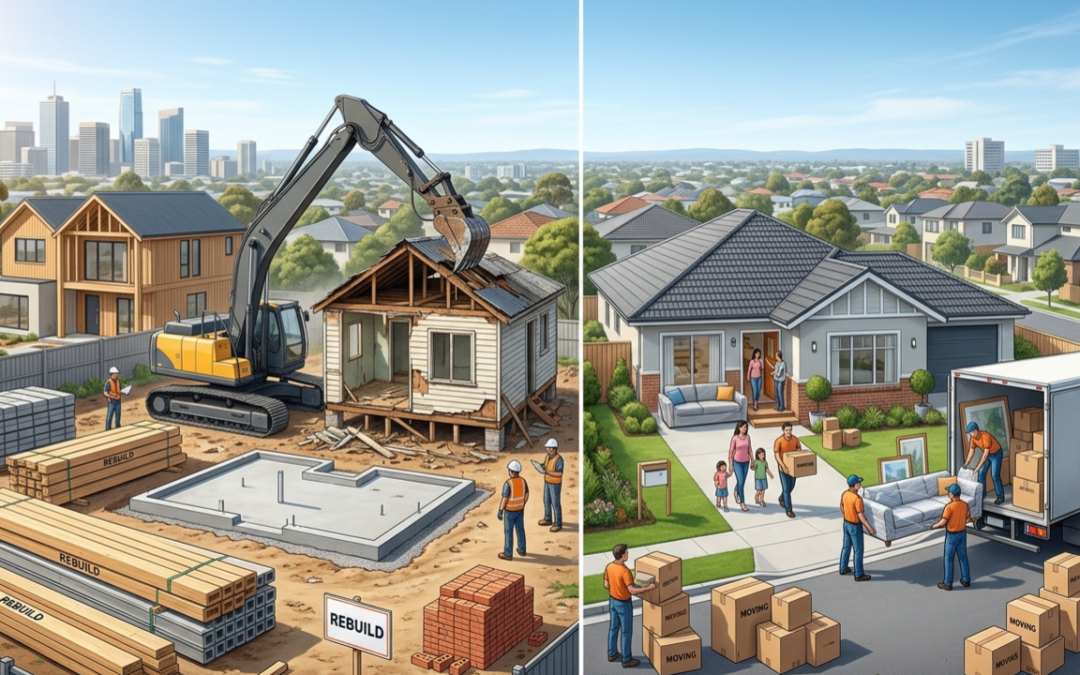
Most homeowners reach the same crossroads eventually. You have been in your home for a decade or more. The neighbourhood is exactly right — the schools, the commute, the street, the community you have built. But the house itself has not kept up with how your life has changed. It is too small or poorly configured for your current household. The layout made sense when you bought it and does not anymore. The bones are ageing and the cost of bringing it up to the standard you want through renovation looks increasingly prohibitive.
The natural instinct is to start looking at what is available in your area and consider moving. But in most established Australian suburbs in 2026, this instinct runs into an immediate problem: property prices in the neighbourhoods you want to stay in have made buying an equivalent or better home extremely expensive. The stamp duty on a new purchase, the agent fees on selling your current property, the costs of moving, and the inevitable need to compromise on something because nothing exactly fits — it all adds up to a solution that feels expensive and imperfect.
This is why knockdown rebuild has become a genuinely popular consideration across Australia. Not as a niche option for unusual circumstances, but as a mainstream approach that an increasing number of homeowners are choosing over the traditional sell-and-buy cycle.
Whether it makes more sense for your specific situation than moving depends on factors that are worth thinking through carefully rather than assuming either path is obviously better. This is an honest look at both options.
What Knockdown Rebuild Actually Involves
A knockdown rebuild is exactly what the name suggests — demolishing the existing structure on your land and constructing a new home in its place. You keep the land you already own, in the location you already know, but replace everything above ground with something new.
The process involves more steps than building on a vacant block, because the existing dwelling needs to be properly decommissioned and removed before construction can begin. But the fundamental outcome is the same — a new home on an existing block — and the advantages of working with land you already own and a location you already know are real.
The broad sequence of a knockdown rebuild project looks like this. You engage with a builder — like Granton Homes, who has experience with knockdown rebuild projects — to develop the design for the new home and assess the site. You manage the demolition of the existing structure, including disconnection of services, asbestos assessment and remediation if applicable, actual demolition, and site clearing. You go through the approval process for the new construction. And then construction proceeds on your cleared block in the same way as it would on a vacant lot.
The additional complexity relative to a standard new build is real but manageable with the right builder and the right planning.
The Case for Knockdown Rebuild — Why It Makes Sense in Many Situations
You keep what property prices cannot replace. In most established Australian suburbs, the value in the property is substantially in the land — specifically its location, its proximity to facilities, its school catchment, its access to employment and amenity. That location is what you paid for when you bought. It is what has appreciated in value over the years. And it is what makes moving expensive, because buying equivalent location in the same area costs what your current land is worth plus significant additional expense.
A knockdown rebuild lets you keep the location without paying again to acquire it. The cost of the new build is the cost of construction — not the cost of land acquisition plus construction that a new purchase in the same area would involve.
For homeowners in established suburbs where land values are high, this comparison often significantly favours rebuilding. You are not competing in a market to acquire something you already own.
You get a genuinely new home designed for how you actually live now. Renovation — even substantial renovation — works within the constraints of the existing structure. You can reconfigure internally, extend, update finishes, but the bones of the building shape what is possible. A knockdown rebuild has no such constraints. The new home is designed from scratch around your current household, your current lifestyle, and your future needs — not adapted from something built for previous occupants in a different era.
This means you can address the actual problems with how you live now rather than patching around them. The kitchen that never worked quite right, the bedroom configuration that stopped suiting your household years ago, the lack of a proper home office, the outdoor area that faces the wrong direction — all of these can be solved in a new design in a way that renovation cannot.
Granton Homes approaches knockdown rebuild projects as genuine custom design opportunities — developing the new home around the client’s brief, the site’s specific orientation, and the characteristics of the existing block. The result is a home that suits the people living in it rather than a renovation that improves an existing inadequate design.
The numbers often compare favourably to moving. When you add up the full cost of selling your current home and buying a new one — agent fees on the sale, stamp duty on the purchase, legal and conveyancing costs, moving costs, and the premium you pay to buy in a market where desirable properties are competitively priced — the transaction cost alone can be substantial. In many markets, this transaction cost represents a significant portion of what a knockdown rebuild would cost, before you have even gained a new home rather than just a different one.
The comparison is genuinely case-specific and the numbers need to be worked out for your particular situation. But the assumption that moving is automatically cheaper than rebuilding is not well-founded — in many situations in established Australian suburbs, the economics favour rebuilding quite clearly.
You avoid the stamp duty on the new home’s full value. When you buy an established home, stamp duty is payable on the full purchase price. On a knockdown rebuild, you already own the land — there is no land purchase transaction and therefore no stamp duty on the land. Stamp duty applies only to the construction contract in some states, or may be subject to specific rules around owner-builder arrangements, but the overall stamp duty exposure is almost always significantly lower than on a comparable established property purchase.
In high-value suburban markets, the stamp duty saving alone can be a meaningful financial advantage.
The Honest Challenges — What Knockdown Rebuild Requires
Demolition costs and complexity. Before the new home can be built, the existing one needs to be properly removed. Demolition involves more than just knocking the house down.
Services need to be disconnected before demolition begins — gas, electricity, water, and sewer connections all need to be formally disconnected and capped by the relevant authorities. This involves applications, inspections, and fees that take time and cost money.
Asbestos assessment is mandatory before demolition of any home built before 1990, and many homes built before 2000 also contain some asbestos-containing materials. An asbestos survey identifies what is present, and any asbestos must be removed by a licensed removalist before demolition proceeds. The extent and cost of asbestos remediation depends on how much is present and where — a home with minimal asbestos requires modest remediation, while one with widespread asbestos in multiple locations requires more extensive work.
The demolition itself has a cost that varies by the size and construction type of the existing dwelling and by the access conditions for demolition equipment. A typical single storey timber-frame home costs less to demolish than a double storey brick construction. A site with easy access for machinery costs less than one with access constraints.
Waste disposal and site clearing add to the demolition cost. Not all demolition waste can go to a standard tip — some materials require specialist disposal — and the site needs to be left in a condition that allows construction to begin.
Budgeting for demolition including all of these components — services disconnection, asbestos assessment and remediation, demolition, waste disposal, site clearing — requires getting actual quotes rather than relying on rough estimates. Costs vary significantly by property characteristics, and the only reliable figure is one based on your specific home.
Temporary living — planning for it properly. During the period from demolition through to completion of the new home, you need to live somewhere. This is one of the most consistently underestimated cost and logistics challenges of a knockdown rebuild.
The total period from commencing demolition to moving into the finished new home is typically twelve to eighteen months or more for a custom build. This is a long time to be in temporary accommodation, and the cost of that accommodation — rent, storage for belongings, the various inconveniences of not being in your own home — is real and needs to be in the total project budget.
If you are renting during the build, rental costs in most Australian markets represent a significant monthly outlay that runs for the full construction period. Planning the project so that the temporary accommodation period is as short as possible — through efficient approval processing, starting the design process early, making decisions completely before construction begins — is worth genuine effort because every month of unnecessary delay costs real money.
Some homeowners with flexibility in their living arrangements can stay with family or friends during the build, which reduces the cash cost significantly. Others have the option of living in an on-site structure during construction, subject to council approval. These options are worth exploring if they are available.
Approval processes — more involved than a standard new build. Knockdown rebuild projects generally go through the same approval pathways as new builds on vacant land — a Complying Development Certificate or a Development Application, depending on the design and the planning environment. However, there are some additional considerations.
If the existing dwelling is heritage-listed or is in a heritage conservation area, demolition requires specific heritage assessment and approval that adds complexity and time to the process. Some areas have character overlays or other planning controls that affect what can be demolished and what must be retained. Confirming the planning status of your property specifically — and understanding any heritage or character requirements that apply — before committing to a knockdown rebuild is essential.
The new design needs to meet the planning controls applicable to the site, including setbacks, height limits, site coverage limits, and any other relevant controls. A design that exceeds these controls requires a DA rather than a CDC, with the longer and less predictable timeline that entails.
Working with a builder like Granton Homes who has knockdown rebuild experience means having someone who understands these planning dimensions and can guide the design to work within the applicable controls rather than designing something that then requires extensive revision during the approval process.
When Moving Makes More Sense
Knockdown rebuild is not the right answer for everyone, and it is worth being honest about the situations where selling and moving is the better choice.
When location genuinely needs to change. If the reason your current home no longer works includes the location — not just the dwelling — then rebuilding on the same site solves only part of the problem. A new home in a suburb that no longer suits your work location, your children’s school needs, or your lifestyle preferences is a very expensive way to stay in the wrong place.
When the land has restrictions that limit what can be built. Some blocks have planning constraints — overlays, covenants, easements, or heritage listings — that prevent the kind of new home you want to build. A thorough planning assessment of your specific block before committing to a knockdown rebuild identifies these constraints. If the constraints are significant, the rebuild option may not deliver what you need.
When the budget genuinely cannot accommodate rebuilding. A knockdown rebuild on a quality site in an established suburb, with a new custom home designed and built to a contemporary standard, costs what a quality custom new build costs — plus demolition and temporary living costs. This is not a budget option. If the realistic total cost of the rebuild exceeds what is financially achievable, moving may be the practical path even if it is less ideal.
When speed is genuinely critical. If your household circumstances require a larger or better-suited home within a timeframe that a new build cannot meet, buying an established property that is immediately available is faster. Custom builds take time — twelve to twenty-four months from design to completion is the realistic range — and if that timeframe is not compatible with your circumstances, the rebuild path may not be feasible.
How to Make the Decision Well
The decision between knockdown rebuild and moving is one that benefits from specific financial analysis rather than general impressions.
Start by getting a clear picture of the full cost of moving. Not just the purchase price of the kind of home you would buy and the estimated sale price of your current home, but the full transaction cost — agent commission, stamp duty, legal and conveyancing fees, moving costs, and the cost of any work needed to bring the purchased home to the standard you want.
Then get a realistic estimate of the full cost of rebuilding. This means engaging with a builder like Granton Homes to understand the construction cost range for the home you want to build, getting demolition quotes from licensed demolishers, understanding the temporary accommodation cost for the realistic build period, and accounting for all the approval and connection costs that apply.
Compare these totals honestly — not the headline numbers but the full cost on each side. In many situations in established Australian suburbs, the comparison is closer than people expect, and sometimes favours rebuilding quite significantly.
Talk to a financial advisor if the decision has significant tax implications — which it often does in terms of capital gains treatment, stamp duty, and other considerations that vary by individual circumstances and property ownership structure.
And engage with a builder experienced in knockdown rebuilds early in the process — before you have made any commitments — so that the assessment of what is possible on your specific site informs the decision rather than following it.
The Outcome That Matters
Both paths — rebuilding and moving — are legitimate responses to the same underlying problem: a home that no longer suits the household living in it.
The path that makes more sense depends on how strongly location matters, what the financial comparison reveals, what planning constraints apply to the existing block, and what the household’s timeline and tolerance for disruption are.
What neither path should involve is a decision made without the full information — a comparison of the incomplete headline numbers without the full costs, or a decision driven by assumption rather than analysis.
For homeowners seriously considering a knockdown rebuild, Granton Homes is experienced in this specific type of project — understanding the demolition and clearance requirements, the approval processes, the site assessment needs, and the design opportunities and constraints of established blocks. Engaging their team early in the decision process — to understand what is possible on your specific site and what it would cost — gives you the information to make the right decision rather than finding out after the fact.