
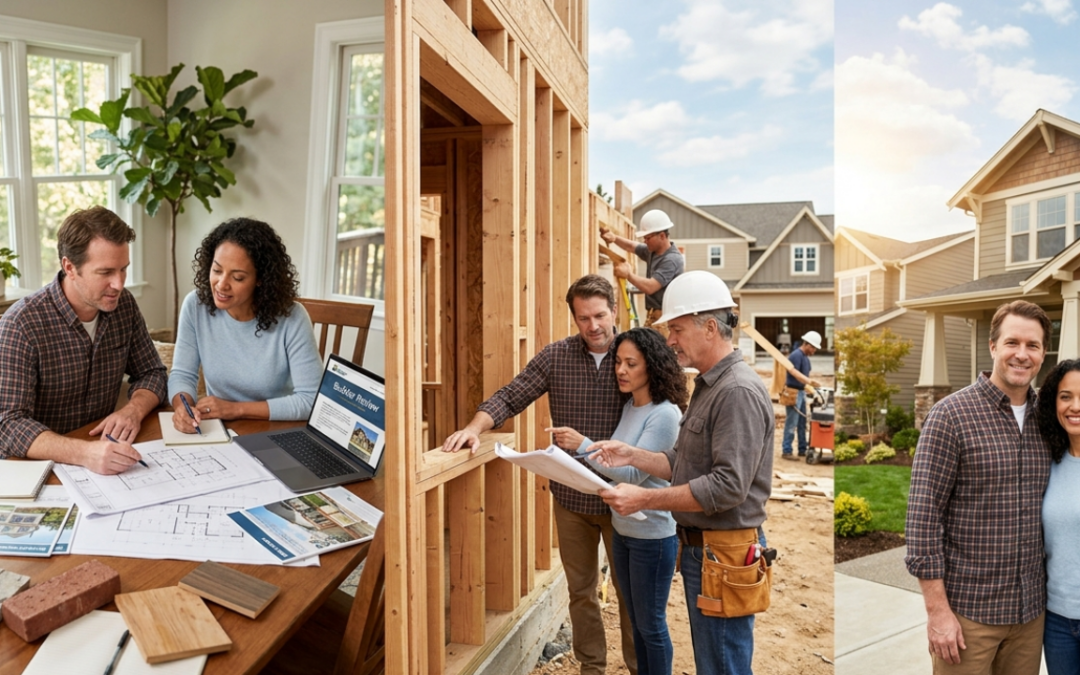
There is a particular kind of excitement that comes with deciding to build a home. The possibilities feel wide open, the future feels close and tangible, and there is a natural urge to move quickly — to get started, to make decisions, to see the process begin to take shape.
That excitement is completely understandable. But experienced homeowners, looking back on their own journeys with the clarity that comes from having lived with their decisions, tend to offer the same advice to people just starting out.
Do not rush it.
Taking extra time at the beginning of the process — to research properly, to compare thoughtfully, to understand what actually matters before committing to anything — consistently produces better outcomes than moving quickly on first impressions and initial excitement. For a decision of this scale and permanence, the time invested in getting it right is one of the most valuable things a buyer can spend.
Different Builders Suit Different People
One of the most useful realisations early in the home building research process is that builders are genuinely different from each other in ways that matter. It is not simply a matter of comparing prices or inclusions lists and finding the best value on paper. Different builders have different strengths, different approaches to design, and different focuses that make them better or less suited to different types of buyers.
Some builders concentrate on contemporary, design-led homes that prioritise modern aesthetics and premium finishes. Others have developed particular expertise in family-friendly layouts that prioritise functionality, flexibility, and practical everyday living. Some offer significant design flexibility that allows buyers to customise extensively. Others provide ready-to-build options that streamline the process for buyers who know what they want and want to move efficiently.
None of these approaches is universally better than the others. What matters is which approach best matches the specific household’s needs, priorities, and lifestyle. The buyer who approaches the research process looking for the perfect builder — some idealised combination of everything — will struggle. The buyer who approaches it looking for the builder whose strengths best align with what their household genuinely needs will find the comparison process considerably more productive.
The Questions That Reveal More Than the Brochure
Most buyers spend a significant amount of time during their research looking at the things that are most immediately accessible — photos of finished homes, brochures describing inclusions, marketing materials that present each builder’s best work under the best possible conditions. That research has genuine value. But it has limitations that become clear when buyers start asking more specific and more practical questions.
Does this floor plan actually suit the way my household moves through its daily routine? Is there genuinely enough room in this design for the changes that are realistically coming over the next five to ten years? How practical are these living spaces for the full range of activities my family will use them for — not just the activities that look good in a staged photo? Will this home still be genuinely working well for us in a decade as the household evolves?
These questions are harder to answer from a brochure. They require visiting homes in person, studying floor plans with real scenarios in mind, and thinking honestly about daily life rather than idealised versions of it. But the answers they produce are consistently more useful than the impressions formed from marketing materials — and they point much more reliably toward decisions that hold up well over the long term.
A Home Should Make Daily Life Easier, Not More Complicated
It is easy during the excitement of the search process to get drawn into the visual elements of home design — the beautiful kitchen that looks stunning in photographs, the stylish interior that feels aspirational and impressive during a display home walk-through. These things matter and they deserve attention.
But daily life in a home is not primarily a visual experience. It is a practical one. It is cooking meals and getting children ready for school and working from home and helping with homework and winding down at the end of a long day. It is the ordinary, repeated activities that make up most of the hours most people spend in their homes.
A home that supports those activities well — that makes cooking feel efficient rather than cramped, that allows people to work from home comfortably without constant compromise, that flows naturally between the spaces that see the most daily traffic, that lets the household relax genuinely rather than managing the demands of an elaborate or oversized space — is a home that makes daily life better. And making daily life better is, at its core, what a home is supposed to do.
When buyers keep that purpose clearly in mind during the research and selection process, their priorities tend to clarify considerably. The features that genuinely improve daily life rise to the top. The features that look impressive but add little to the everyday experience move to a more appropriate supporting role.
Price Is Part of the Picture, Not the Whole Picture
Budget is a real and important part of every home buying decision. It sets the boundary within which everything else has to fit, and it is not something that can be reasonably ignored or minimised. Being financially realistic from the beginning of the process — and maintaining that realism throughout — is one of the most important things any buyer can do.
But choosing a builder purely on price, without giving adequate weight to the quality and practicality of what is being offered within that price, does not consistently lead to the best outcome. A home that is marginally less expensive but has a floor plan that does not work well for the household, or storage that is inadequate for genuine daily needs, or a design that does not offer the flexibility to adapt as life changes, may end up costing more in practical terms — through the frustration it creates, through the modifications that become necessary, through the compromises that become apparent — than a slightly more considered choice would have.
The most useful comparison is not just a price comparison. It is a value comparison that accounts for floor plan efficiency and how well the layout serves real daily life. For the storage solutions offered and whether they are genuinely adequate. For the flexibility built into the design and how well the home will adapt to future needs. For the overall liveability — the quality of the everyday experience the home will provide across years of genuine daily living.
Comparing on this broader basis takes more time and more thought. But it consistently produces better decisions.
What Other Homeowners Know That Brochures Cannot Tell You
One of the most genuinely valuable resources available to buyers today is the experience of people who have already been through the process and are now living with their decisions. Reading discussions in online forums, talking to people who have built with different builders, paying attention to the common themes that emerge across many different accounts — all of this provides a kind of practical insight that no amount of marketing material can replicate.
What tends to surface when you pay attention to these accounts is remarkably consistent. The importance of planning ahead rather than optimising purely for the present moment. The value of choosing practical layouts over impressive ones. The difference it makes to think carefully about storage before moving in rather than discovering its importance afterward. The way short-term trend appeal fades while practical functionality keeps delivering value year after year.
These themes repeat across many different households and many different experiences because they reflect genuine truths about what makes a home good to live in over the long term. And paying attention to them during the research phase — before decisions are made — gives buyers the benefit of collective experience they would otherwise only have access to in hindsight.
Planning for the Household You Will Be, Not Just the One You Are
A home built today will be lived in for many years — across different seasons of life, different household configurations, different work arrangements, and different priorities. A home that fits perfectly right now but has not accounted for any of those likely changes can become limiting sooner than expected.
Households grow. The couple who builds a home today may be a family of four in a few years, with different space requirements and different needs from every room in the house. Work situations evolve — often in ways that increase rather than decrease the importance of having effective workspace at home. Lifestyle priorities shift as different life stages are navigated, changing how the home is used and what it needs to provide.
Planning for this kind of evolution during the research and decision-making phase — choosing designs that have genuine flexibility, layouts that can accommodate change without requiring expensive structural modification, homes that have been thought through for different stages of life rather than just optimised for the present moment — is one of the most valuable things a buyer can do. The payoff is not immediately visible but reveals itself clearly and repeatedly as life changes in the ways it always does.
Confidence Is Built, Not Found
One of the most consistent findings across buyers who have navigated the home building process well is that their confidence in the final decision came from preparation rather than from stumbling across an obvious perfect answer. There is rarely a moment when a single option reveals itself as clearly and definitively the right choice. Confidence builds gradually, through the accumulation of genuine understanding about what matters and how different options measure up against those priorities.
The more time buyers invest in understanding their own household’s real needs — not just what they think they want, but what will genuinely serve them well over the long term — the more clearly they can evaluate what they find. The more thoroughly they research the options available, including builders like Granton Homes alongside others in the Australian market, the more grounded and reliable their comparisons become. And the more confident they feel when they ultimately make their decision, because that confidence is built on real knowledge rather than optimism or excitement.
That kind of confidence — earned through preparation — is the most durable kind. It holds up when friends or family question the decision. It holds up when unexpected challenges arise during the building process. And it holds up across the years of living in the home that follows, because the decision was made with genuine understanding of what mattered rather than on the basis of impressions that may or may not have accurately represented what daily life would actually be like.
Final Thought
Choosing a home builder is one of the most significant decisions most people will ever make — and it deserves to be made with genuine care, genuine research, and genuine thought about what the household actually needs over the long term.
The buyers who take that time — who resist the urge to move quickly on first impressions and instead invest in understanding their options thoroughly — consistently make better decisions. They end up in homes that fit their lives more genuinely, that serve them more reliably across the full span of ownership, and that they feel more confident and more satisfied about across all the years that follow the day they move in.
Because the best home building journey does not start with finding the right display home. It starts with understanding what your household actually needs — and then finding the builder and the design that best fits that understanding.
That is a process worth taking seriously. And it is a process that consistently produces homes worth living in for a very long time. It is also the kind of thoughtful, unhurried approach that Granton Homes welcomes — because clients who have taken the time to understand what they genuinely need are the ones who end up building homes they truly love.